HACCP & staff hygiene stations
Why personnel hygiene is a HACCP prerequisite and how a hygiene barrier serves as an auditable control point.

HACCP mandates personnel hygiene not directly as a device, but as part of the prerequisite program (PRP) on which the system is built. Handwashing and hand sanitizing are core requirements defined in the good hygiene practices (GHP) section of the Codex General Principles of Food Hygiene; this is why no standard says "buy a hygiene barrier," yet they all expect consistent and verifiable personnel hygiene at the entrance. A hygiene barrier is not a critical control point (CCP); it is, however, the tool that satisfies this PRP requirement in the most auditable way. In this article we explain — from a manufacturer’s perspective — the relationship between HACCP and the staff hygiene station, what the standards actually require, and where a hygiene barrier fits within an audit.
What is HACCP and what is it built on?
HACCP (Hazard Analysis and Critical Control Points) is a systematic approach that identifies and controls food safety hazards within the production flow before they occur. Rather than catching the problem after the product has left, it aims to prevent the hazard at the point where it arises. Its structure rests on seven principles: hazard analysis, determining the critical control points (CCPs), establishing critical limits, monitoring, corrective action, verification, and record-keeping.
The key point is this: HACCP does not stand on its own. Good hygiene practices (GHP) and prerequisite programs (PRP) are the foundation on which HACCP is built. Without that foundation, hazard analysis loses its meaning. Codex Alimentarius’ General Principles of Food Hygiene (CXC 1-1969), in its 2020 revision, separates these two layers precisely: first good hygiene practices, then HACCP. Within this framework, personnel hygiene is not a CCP of HACCP but a core requirement of the GHP/PRP layer.
Without a solid prerequisite program, HACCP is like a building with no foundation; personnel hygiene is one of the load-bearing columns of that foundation.
Why is personnel hygiene a prerequisite for HACCP?
Personnel hygiene is a prerequisite for HACCP because people are the most common and most variable source of contamination in a food business. Hands, footwear, and work clothing carry microorganisms, soil, and organic residue from outside into the clean production area. This risk is not distributed evenly across every point — it concentrates not on the production line itself, but at the moment personnel enter the clean area.
The Codex General Principles of Food Hygiene expect food businesses to establish policies and procedures for personnel hygiene and to provide adequate handwashing facilities. This is not a "preference" but a fundamental requirement of the system: handwashing sinks, the means to sanitize, and personnel applying these steps consistently. The same document also clarifies practical rules, such as that handwashing sinks must not be used for washing food or utensils. In short, the standard requires the outcome (reliable personnel hygiene at the entrance); it leaves the choice of which equipment delivers it to the facility.
Personnel hand hygiene is almost always managed as a prerequisite program (PRP) element, not as a CCP. PRPs control hazards spread across the whole site; a CCP is a specific control point monitored at a particular step against measurable critical limits. This distinction also explains how a hygiene barrier works and why passage logging requires concrete data.
Does HACCP make using a hygiene barrier mandatory?
No — and it is important to be honest about this. Neither the Codex General Principles of Food Hygiene nor HACCP requires purchasing a named device called a "hygiene barrier." The standards do not prescribe an equipment brand or model; they require a hygiene outcome. What is required is clear: an arrangement in which personnel can wash and sanitize their hands before entering the clean area, footwear/boot hygiene can be ensured in high-risk facilities, and all of this is applied consistently.
You can satisfy this requirement with a sink, a wall-mounted sanitizer unit, and a written procedure. The difference emerges here: auditability and consistency. At an open sink, hygiene depends on the individual’s choice at that moment; at the start of a busy shift, steps can be skipped, and it is hard to give an auditor proof that it "was done at every passage." A hygiene barrier closes exactly this gap — it makes hygiene the physical precondition of passage. This is why a hygiene barrier is not a mandate but the engineering control that most strongly satisfies the PRP requirement.
How does a hygiene barrier work as an auditable control point?
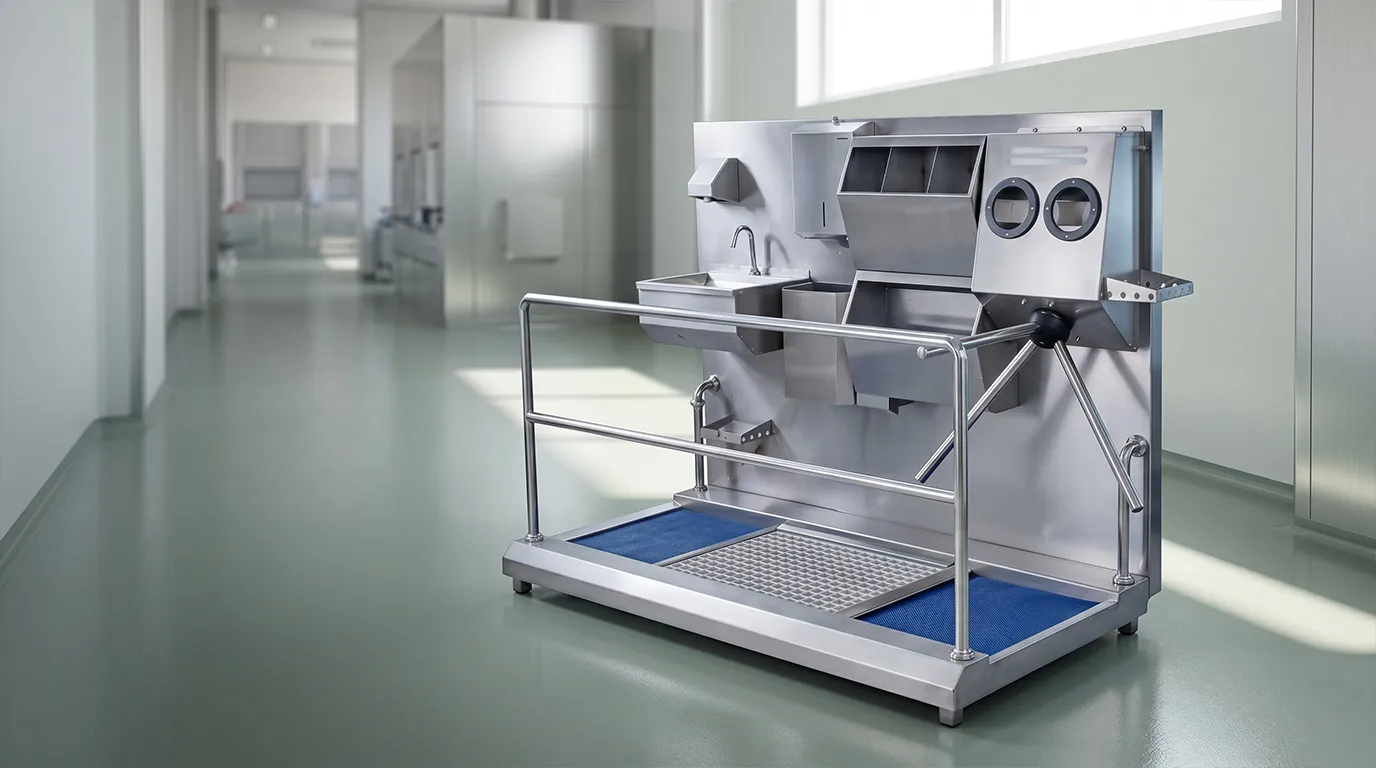
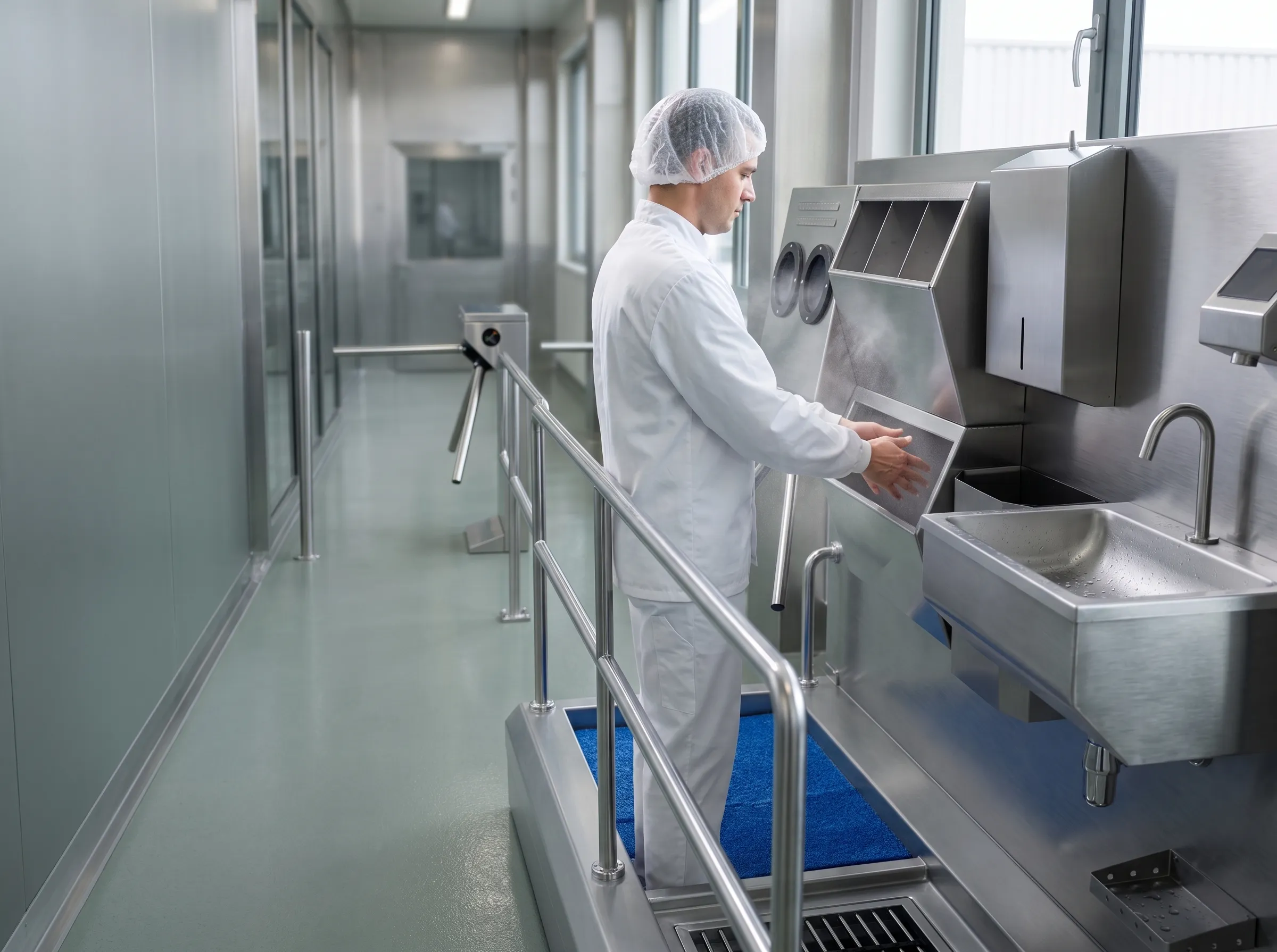
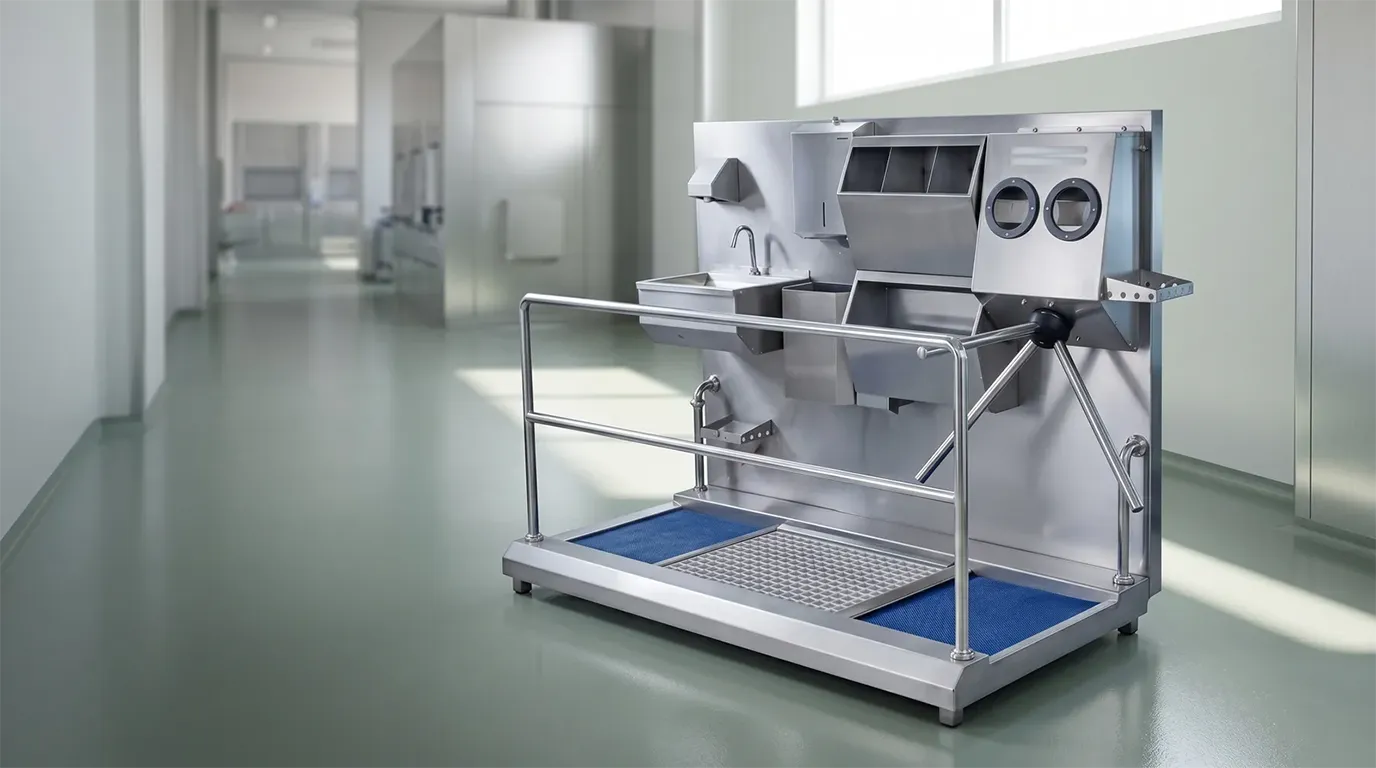
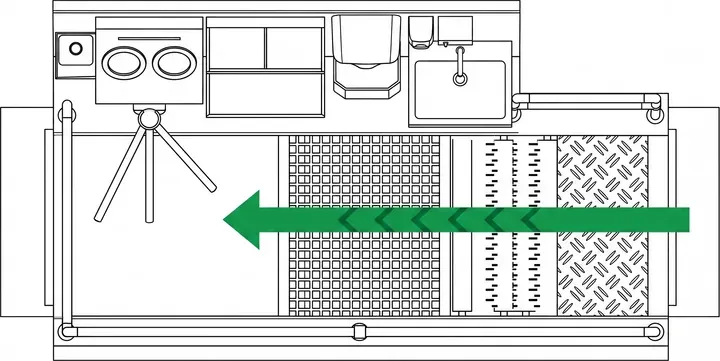
A hygiene barrier creates an auditable control point by turning personnel hygiene from a "was it done?" question into a "you cannot pass without doing it" rule. What sets it apart from an ordinary sink is that it links the hygiene steps to the turnstile lock: the turnstile does not open until the steps are verified by sensors, and passage is usually one-way. This logic (interlock) turns hygiene into auditable data.
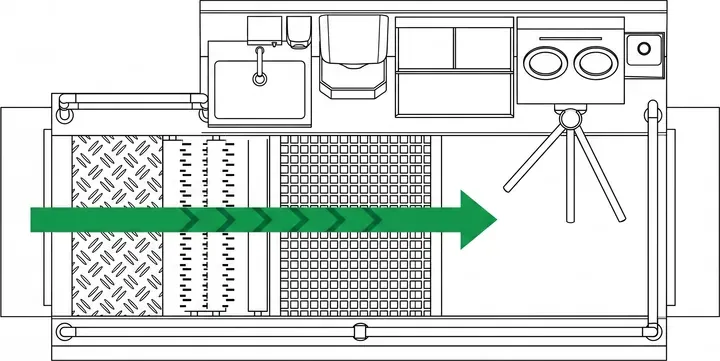
In a typical staff hygiene station the flow proceeds as follows; each step depends on the previous one, and if a step is skipped, passage does not occur:
- 1Personnel approach the unit; if required, identity is recognized via a card/reader.
- 2Handwashing is performed at a sensor-operated (touchless) tap; a liquid soap and paper towel unit is used.
- 3Hands are dried — this step matters because wet hands reduce the effectiveness of the sanitizer.
- 4Hand sanitizing is applied from a touchless, automatically dosed unit.
- 5Where facilities require it, boot/wellington washing and disinfection (brushed grating or a disinfectant basin) is carried out.
- 6Sensors verify that the steps are complete; the turnstile lock releases and personnel pass one-way into the clean area.
With optional counter and logging integration, every passage becomes digital. This maps directly onto the HACCP verification and record-keeping principles: instead of telling an auditor "hygiene was applied at the entrance," you can show how many passages went through which steps. So even though it is not a CCP, the hygiene barrier becomes a control point that supports the application of the PRP with objective evidence. We cover the basis of this approach in what a hygiene barrier is and what it does.
Which standards require personnel entrance hygiene?
Personnel entrance hygiene is expected not only by HACCP but by all food safety standards built upon it. In different wording they all require the same outcome: that the hand hygiene of personnel entering the clean area is assured and that cross-contamination is prevented at the entrance.
- Codex CXC 1-1969 (GHP) — personnel hygiene policies and adequate handwashing facilities; the prerequisite foundation of HACCP.
- ISO 22000 / ISO/TS 22002-1 — personnel hygiene facilities and cross-contamination prevention are treated as prerequisites (PRPs).
- BRCGS and IFS Food — these GFSI-recognized standards expect hand hygiene and personnel flow control at the entrance.
- Turkish food hygiene legislation — requires adequate handwashing facilities and personnel hygiene.
None of these standards says "buy this device"; their common denominator is that the outcome must be proven in an auditable way. The hygiene barrier is the solution that produces this evidence most directly.
Audit preparation: personnel hygiene checklist
When personnel entrance hygiene is assessed in an audit, the following points are typically questioned. You can use this list when setting up or reviewing your hygiene station:
- Does entry to the clean area pass through a single, controlled hygiene point? (Are there unmonitored back doors left open?)
- Are a touchless tap, liquid soap, and hygienic drying (paper towels) provided for handwashing?
- Is hand sanitizing touchless and automatically dosed; is the sanitizer full and effective?
- In high-risk facilities (meat, dairy, seafood, poultry), is there a separate step for boot/wellington hygiene?
- Are the hygiene steps a physical precondition of passage, or do they depend on the individual’s initiative?
- Can passages be monitored and recorded? (Concrete data for verification and record-keeping.)
- Are the surfaces made of a cleanable, non-porous, sanitizer-resistant material? (Typically stainless steel.)
The table summarizes a typical case; the facility’s risk, flow, and existing infrastructure can change the outcome. When determining the right configuration, the sector and number of people must also be taken into account.
For which facilities is a staff hygiene station critical?
A staff hygiene station becomes critical in facilities where the contamination risk is high and the organic load is heavy. Meat processing, dairy, seafood, and poultry facilities require the strictest entrance hygiene, owing to both pathogen risk and an intensive washing regime. We detail which components (sink, boot wash, number of lanes) are needed in such facilities in types and models of hygiene barriers.
In facilities with heavy personnel flow — such as ready-meal, bakery, and beverage production — the critical factor is capacity: the crowd at the start of a shift must be able to pass through a single point without slowing down the hygiene steps. In this case a twin-lane configuration prevents queuing and reduces the pressure to skip hygiene. To determine the right number of lanes, you can use the calculation in hygiene barrier capacity.
Conclusion
HACCP mandates personnel hygiene not as a device, but as a core requirement of the prerequisite program on which the system is built. Within this framework a hygiene barrier is not a critical control point — but it is the engineering control that satisfies the handwashing and sanitizing PRP in the most consistent, most auditable way. An open sink "meets" the requirement; a hygiene barrier "guarantees" it and produces objective evidence in an audit. We can determine together the configuration that suits your facility’s risk and personnel flow.
Frequently asked questions
Is a hygiene barrier mandatory for HACCP?
No. Neither HACCP nor the Codex General Principles of Food Hygiene requires buying a "hygiene barrier" by name. The standards require the outcome of reliable personnel hygiene at the entrance (handwashing and sanitizing); they leave the choice of equipment to the facility. A hygiene barrier is the solution that satisfies this requirement in the most auditable way.
Is a hygiene barrier a critical control point (CCP)?
No. Personnel hand hygiene is almost always managed as a prerequisite program (PRP/GHP) element, not as a CCP. A CCP is a specific control point monitored at a particular step against measurable critical limits. A hygiene barrier, by contrast, is an auditable control point that reinforces the PRP requirement.
Why is personnel hygiene considered a prerequisite for HACCP?
Because good hygiene practices (GHP) and prerequisite programs (PRP) are the foundation on which HACCP is built. Codex CXC 1-1969 defines this foundation as a separate section. Since personnel are the most common and most variable source of contamination, hand and entrance hygiene are among the core requirements of that foundation.
Is an open sink sufficient for HACCP?
It can technically meet the requirement, but it does not guarantee the hygiene sequence and provides weak evidence in an audit. At an open sink, hygiene depends on the individual’s choice at that moment; during busy shifts, steps can be skipped. A hygiene barrier, by linking the steps to the turnstile lock, ensures consistency and a verifiable record.
How does a hygiene barrier provide evidence in an audit?
With optional counter and logging integration, every passage becomes digital. This data aligns with HACCP’s verification and record-keeping principles: instead of telling an auditor "hygiene was applied at the entrance," you can objectively show which steps the passages went through.
Which standards require personnel entrance hygiene?
Alongside Codex CXC 1-1969, which is the foundation of HACCP, GFSI-recognized standards such as ISO 22000 / ISO/TS 22002-1, BRCGS, and IFS Food, together with Turkish food hygiene legislation, expect personnel hygiene and adequate handwashing facilities as a prerequisite. None of them prescribes a specific device; they require auditable evidence of the outcome.