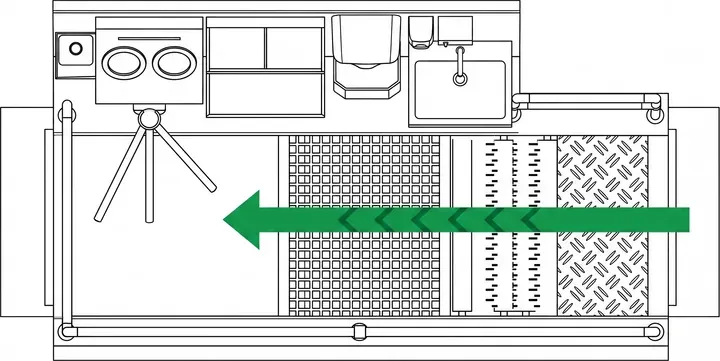
What is a hygiene barrier and what is it for?
What a hygiene barrier is, how it works, its components and why AISI 304 — a manufacturer’s complete guide for food and pharma facilities.
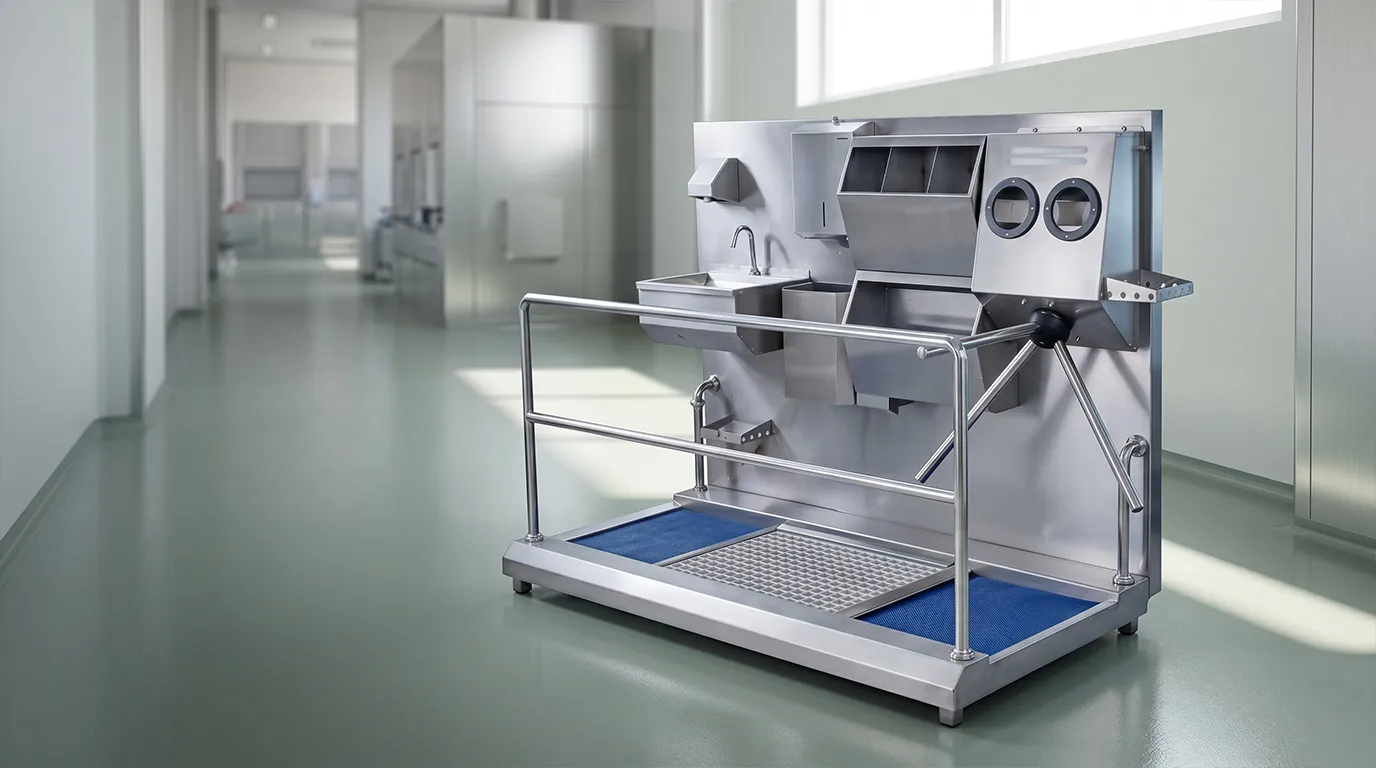
A hygiene barrier is a personnel hygiene unit that combines hand washing, hand and boot disinfection and turnstile-controlled passage in a single stainless steel body. Its core function is to physically block passage into the clean production area until the hygiene steps are completed — in other words, to take hygiene out of the employee’s discretion and turn it into a mandatory precondition for entry. In this guide we explain, step by step and from a manufacturer’s perspective, what a hygiene barrier is, how it works, which components it consists of and the value it adds to food, pharmaceutical and healthcare facilities.
What is a hygiene barrier?
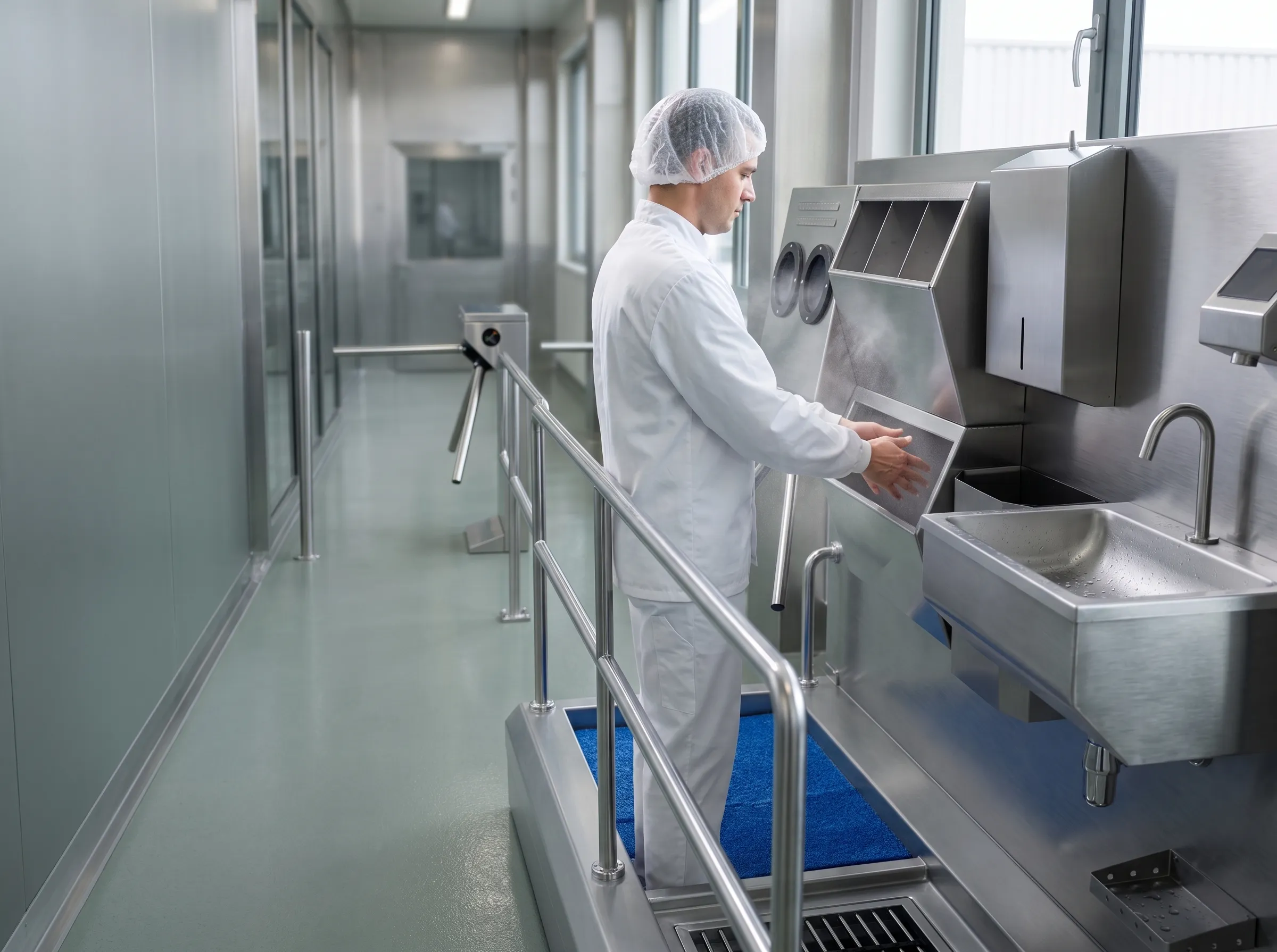
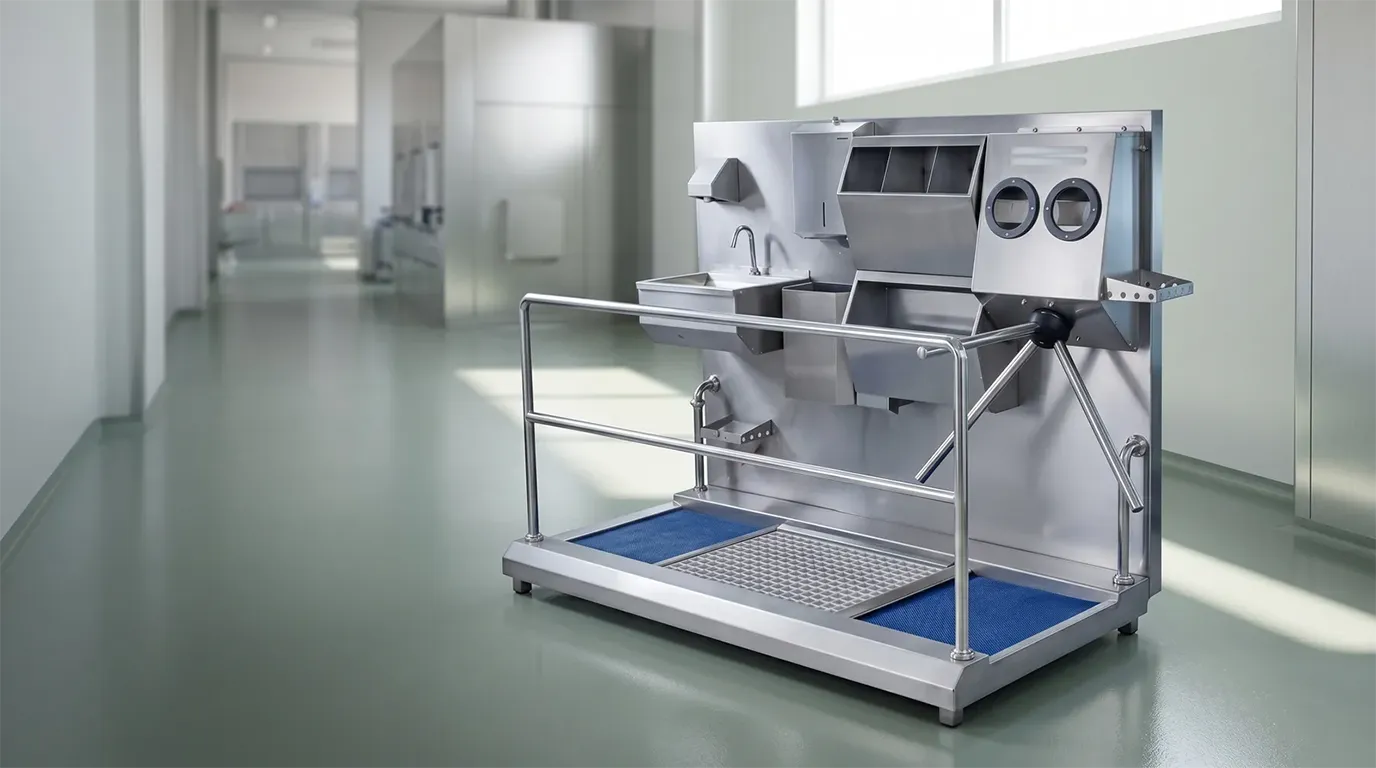
A hygiene barrier is an integrated access system that forces every employee entering a controlled production area to complete a specific hygiene sequence before passing through. It combines a hand washing sink, a hand disinfection unit, a boot cleaning station and a turnstile on a single stainless steel line. The critical element is the turnstile: it stays locked until the hygiene steps are verified by sensors, so it is the steps actually completed — not a claim of "I did the hygiene" — that release the passage.
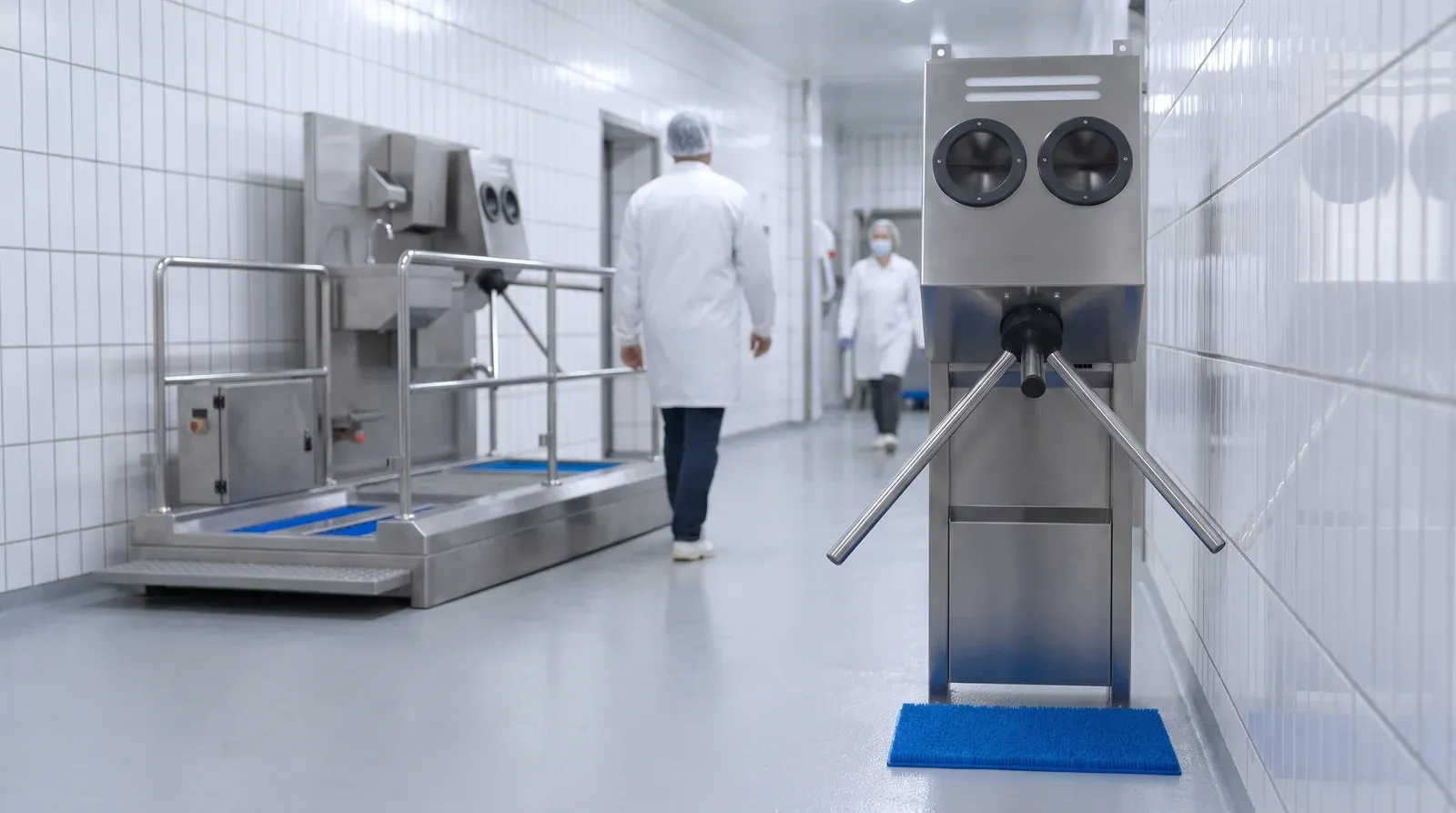
The industry uses many synonyms for the same product: hygiene access unit, hygiene turnstile, disinfectant turnstile, sanitation turnstile or, when several units are lined up one after another, a hygiene corridor. They all share the same purpose; the differences are mostly about which components (with or without a sink, with boot washing, how many lanes) are brought together.
Hygiene becomes auditable once it stops being a rule and becomes a precondition for passage.
What is a hygiene barrier for?
In a food or pharmaceutical facility, the place where cross-contamination most often begins is not the production line itself but the personnel entrance. Hands, footwear and work clothes coming from outside carry microorganisms, soil and organic residue into the clean area. A hygiene barrier is designed to stop this risk right at the entrance — before contamination reaches the production area.
Hygiene left up to people is inconsistent: at the start of a busy shift, at an unsupervised door, steps get skipped. A hygiene barrier removes this inconsistency; it ties every passage to the same standard and makes it measurable. Its main functions are:
- Cross-contamination control — reduces the microbial load from hands and footwear at the clean-area entrance.
- Mandatory sequence — the turnstile does not open until the steps are completed; hygiene stops being "optional".
- Auditability — with counter and sensor integration, passages can be logged, which provides concrete evidence during audits (auditable hygiene passage).
- Standardized culture — everyone, including new staff and visitors, learns and applies the same hygiene behaviour.
How does a hygiene barrier work?
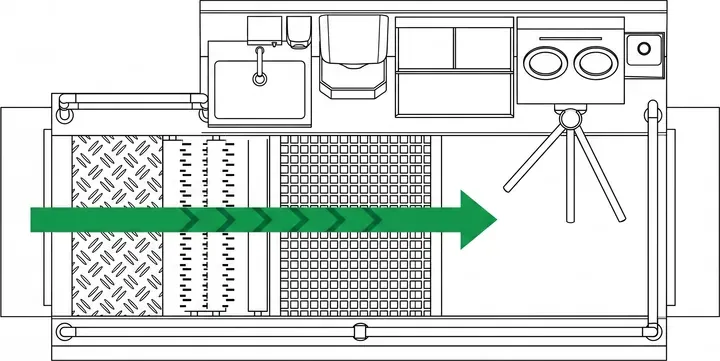
In a typical hygiene access unit, personnel complete the following steps in order. Each step depends on the previous one; if a step is skipped, the turnstile stays locked and no passage takes place:
- 1The employee approaches the unit; if present, identity is read via a card/reader.
- 2Hands are washed at the sensor-operated tap (with liquid soap and paper towel units).
- 3Hands are dried — this step matters because wet hands reduce the effectiveness of the disinfectant.
- 4Hand disinfection is applied from a touchless, automatic-dosing unit.
- 5Where required, boot washing and disinfection is performed (brushed grate or disinfectant basin).
- 6Sensors verify that the steps are complete; the turnstile unlocks and the employee passes into the clean area in one direction.
Why is the sequence locked? (interlock logic)
What separates a hygiene barrier from an ordinary turnstile is the locking logic known as "interlock". The turnstile opens only when the hygiene steps are verified, and passage is usually one-way; this also keeps the back-flow from the clean area to the dirty area under control. The turnstile type (tripod or flap) directly affects capacity and safety — we cover which one suits your facility in our tripod or flap turnstile comparison.
What components does a hygiene barrier consist of?
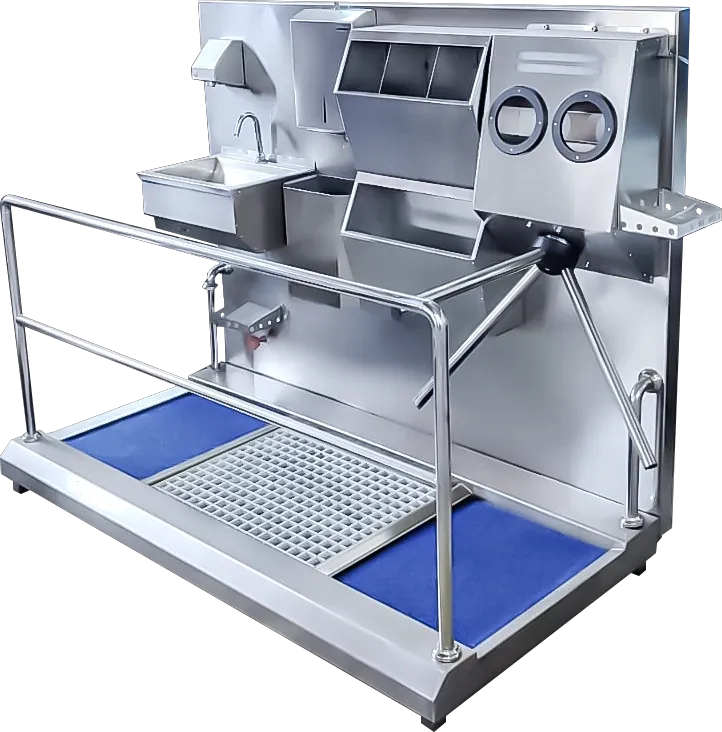
A standard hygiene access unit consists of modular components that can be added or removed as needed. The core components are:
- Hand washing sink — with a photocell (touchless) tap, liquid soap and paper towel units.
- Hand disinfection unit — touchless, automatic-dosing dispenser.
- Boot washing and disinfection — brushed grate, sole washing or disinfectant basin.
- Turnstile — a one-way locked
Ø38 mmtripod (or flap) passage that opens once the hygiene steps are completed. - Sensors and control — photocells that verify the steps, a control board/PLC and an optional counter.
- Stainless steel body — usually AISI 304; a washable, non-porous and corrosion-resistant surface.
The body material is as much a part of hygiene as the components: a non-porous surface that withstands caustic cleaning does not harbour bacteria and is easy to clean. That is why almost all hygiene equipment is made of stainless steel — we examine the technical rationale in detail in our why AISI 304 stainless steel article.
The table above shows only a sample configuration; the actual capacity, number of units, power supply and protection class are determined by the facility’s flow and cleaning regime.
What types of hygiene barriers are there?
Hygiene barriers are not a single mould; they are configured according to the facility’s risk, the number of personnel and the available space. The main axes of distinction are:
- With / without a sink — a full line including hand washing, or just disinfection + turnstile.
- Brush / basin boot cleaning — mechanical brushing of the shoe sole, a disinfectant basin (or both).
- Single / double lane (capacity) — the number of parallel passages according to the heavy personnel flow at the start of a shift.
- Entry / exit control — one-way, or a layout with separate turnstiles for entry and exit.
Which configuration is right depends on the sector, the number of people and the physical layout of the entrance. Placing the unit in the right location in the facility is at least as important as choosing the model.
Why stainless steel — 304 or 316?
The body of hygiene barriers is typically made of AISI 304 stainless steel. 304 contains roughly 18% chromium and 8% nickel. Thanks to the thin, self-healing chromium-oxide (passive) layer that forms on its surface, it is corrosion-resistant; its non-porous structure does not harbour bacteria and it withstands caustic cleaning chemicals. These three properties — corrosion resistance, cleanability and durability — make it the default material for food and pharmaceutical hygiene equipment.
AISI 316, on the other hand, contains roughly 2–3% molybdenum in addition to what 304 has. Molybdenum markedly increases resistance to pitting and crevice corrosion, especially in chloride-bearing environments (heavy salt, brine or chlorine-based disinfectant). In return, 316 is usually about 25% more expensive. For most personnel entrance hygiene applications, 304 is sufficient and the right choice; 316 is considered for special environments with a high chloride load.
Rule of thumb: 304 for a standard food/pharma personnel entrance; 316 for aggressive environments with constant chloride contact. For a detailed comparison, see our why AISI 304 stainless steel article.
Is a hygiene barrier mandatory for HACCP and ISO 22000?
The direct and honest answer: no standard requires purchasing a device named "hygiene barrier" as such. However, every food safety standard makes personnel hygiene and the means for hand washing/disinfection mandatory as a prerequisite (prerequisite programme). A hygiene barrier is the tool that fulfils these requirements in the most auditable and most consistent way.
The Codex Alimentarius General Principles of Food Hygiene, which form the basis of HACCP, define good hygiene practices (GHP) and personnel hygiene as a prerequisite programme. ISO 22000 and ISO/TS 22002-1, the document that details the prerequisites for food manufacturing, explicitly address personnel hygiene facilities, hand washing provisions and the prevention of cross-contamination. GFSI-recognised standards such as BRCGS and IFS Food also expect hand hygiene and personnel flow control at the entrance. Food hygiene legislation in Türkiye likewise requires having adequate hand washing facilities. Within this whole, a hygiene barrier creates a control point that can be demonstrated during an audit — we explore the relationship between HACCP and the hygiene barrier in depth in a separate article.
Which facilities use a hygiene barrier?
A hygiene barrier is used in every sector where personnel entering the clean area carry a contamination risk. The most common areas of application are:
- Meat and dairy processing — high organic load and cold-chain sensitivity.
- Poultry and seafood — high pathogen risk, intensive washing regime.
- Ready meals, bakery and beverage production — heavy personnel flow, shift-based entry.
- Pharmaceutical and cosmetic cleanroom entrance — controlled environment and particle control.
- Hospitals and healthcare facilities — staff and visitor hygiene in critical areas.
Each sector has a different contamination profile; the measures taken at the entrance vary accordingly. We compare sector-based strategies in our stopping contamination at the entrance article.
What does a hygiene barrier bring to your facility?
- Lower cross-contamination — contamination is cut off before it reaches the production area.
- Evidence in audits — counter/sensor records can be presented in HACCP, BRC and IFS audits.
- A consistent hygiene culture — everyone applies the same steps on every shift.
- Water and chemical control — dosing units regulate consumption and waste.
A hygiene barrier takes hygiene out of the employee’s discretion and turns it into a mandatory step for passage — measurable, auditable and consistent.
Where should a hygiene barrier be located in the facility?
The most effective location is the single controlled passage point between the changing/dressing area and the production area. Personnel must use the unit after putting on their work clothes and just before entering production; otherwise the cleaning effect is lost on the way. The layout should be planned so that everyone passes through a single point without blocking the personnel flow — you can find the detailed checklist in our best location for a hygiene barrier in your factory article.
Is a hygiene barrier difficult to maintain?
No; the maintenance of a correctly installed unit is routine and simple. Stainless surfaces are wiped with suitable (chloride-free or well-rinsed) cleaners, the disinfectant and soap reservoirs are refilled regularly, and the sensor and dosing units are checked periodically. We have listed the daily, weekly and periodic maintenance steps in our hygiene barrier maintenance and cleaning article.
Conclusion
A hygiene barrier is less an "item of equipment" than a control point: it turns your clean-area entrance into a visible shield that makes personnel hygiene mandatory and auditable. When installed with the right material (usually AISI 304), the right configuration and the right location, it reduces cross-contamination, produces evidence for audits and standardises the hygiene culture. We can determine together which configuration is right for your facility. To identify the right system for your facility, you can explore our hygiene barrier models or request a quote from our technical team.
Frequently asked questions
Are a hygiene barrier and a hygiene turnstile the same thing?
Largely yes — they are synonyms used for the same product. While "hygiene turnstile" emphasises the turnstile-controlled passage, "hygiene barrier" or "hygiene access unit" describes the whole line including hand washing and disinfection. The difference lies less in the name than in which components are brought together.
Is a hygiene barrier mandatory for HACCP?
No standard requires purchasing a "hygiene barrier" by that name; however, standards such as HACCP, ISO 22000, BRCGS and IFS make personnel hygiene and the means for hand washing/disinfection mandatory as a prerequisite. A hygiene barrier fulfils these requirements in an auditable way.
Which stainless steel is used, 304 or 316?
In most applications AISI 304 (roughly 18% chromium, 8% nickel) is sufficient and is the standard choice. In aggressive environments with constant chloride contact, 316 — which contains molybdenum and is about 25% more expensive — is considered.
How many people can one hygiene barrier handle?
A single-lane tripod turnstile typically lets through about 25–30 people per minute; the actual figure depends on the turnstile type and the duration of the hygiene steps. If there is heavy flow at the start of a shift, a double-lane configuration prevents queuing.
Does a hygiene barrier require electricity and water?
Yes. Units with a sink require a clean water supply and a drain; the sensor-operated tap, disinfectant dosing and turnstile control require an electrical connection. The typical supply is 220 V / 50 Hz, and the requirements vary by configuration.
What determines the price of a hygiene barrier?
The price is determined by the unit type (with/without a sink), the boot cleaning method, the number of lanes, the turnstile type, the stainless steel grade (304/316) and the sensor/automation level. For a precise price tailored to your facility, you can request a quote from us.