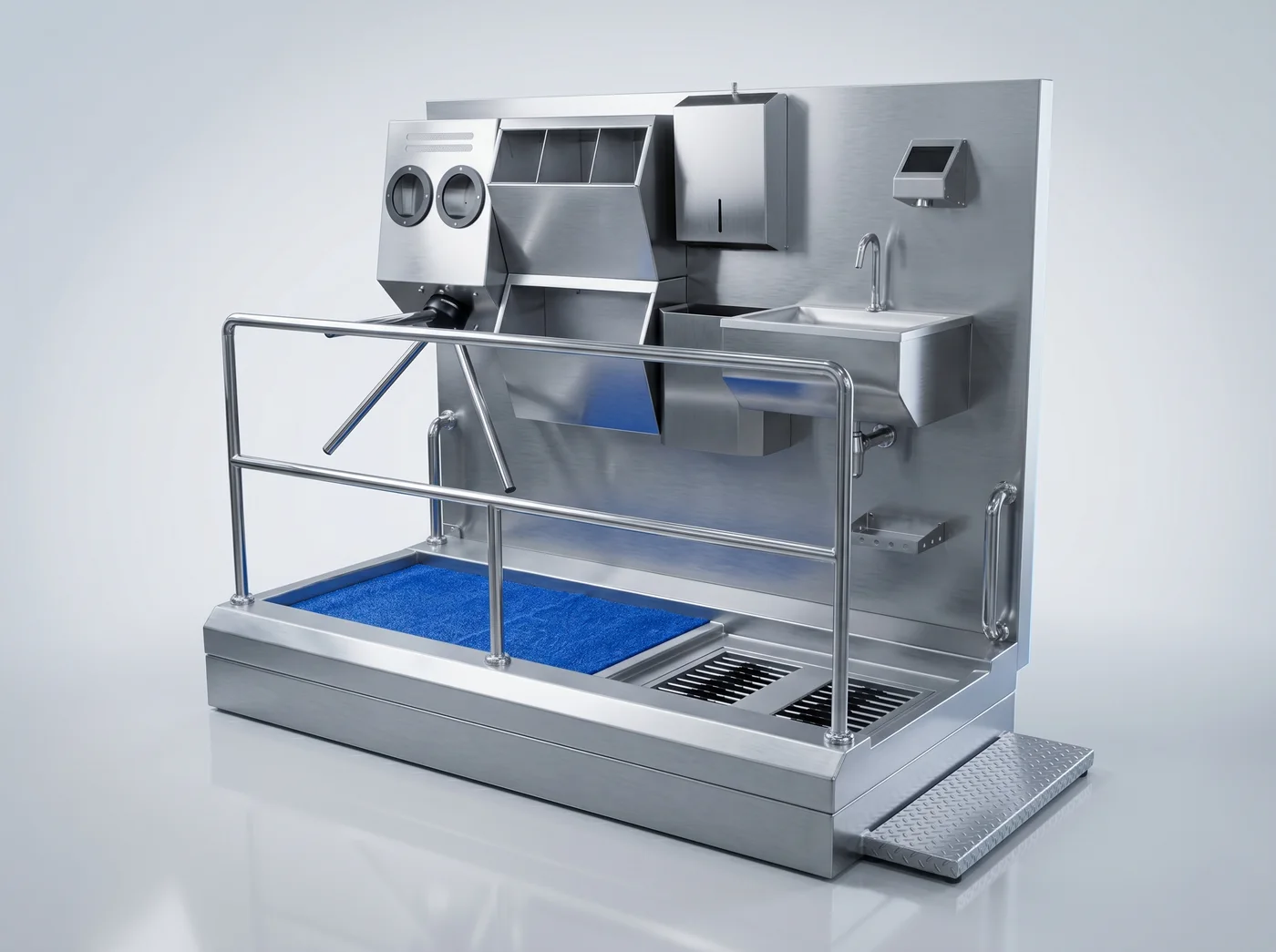
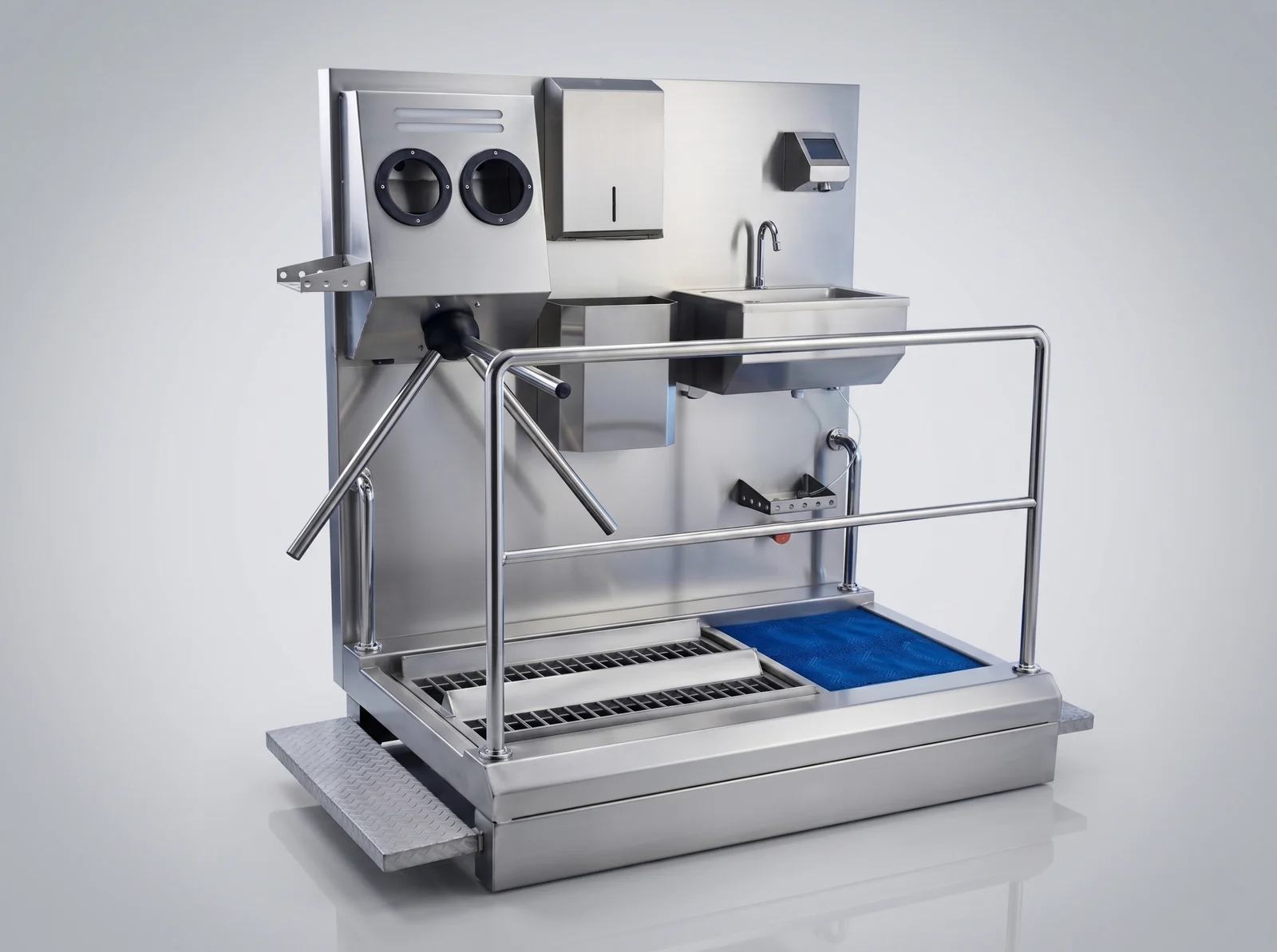
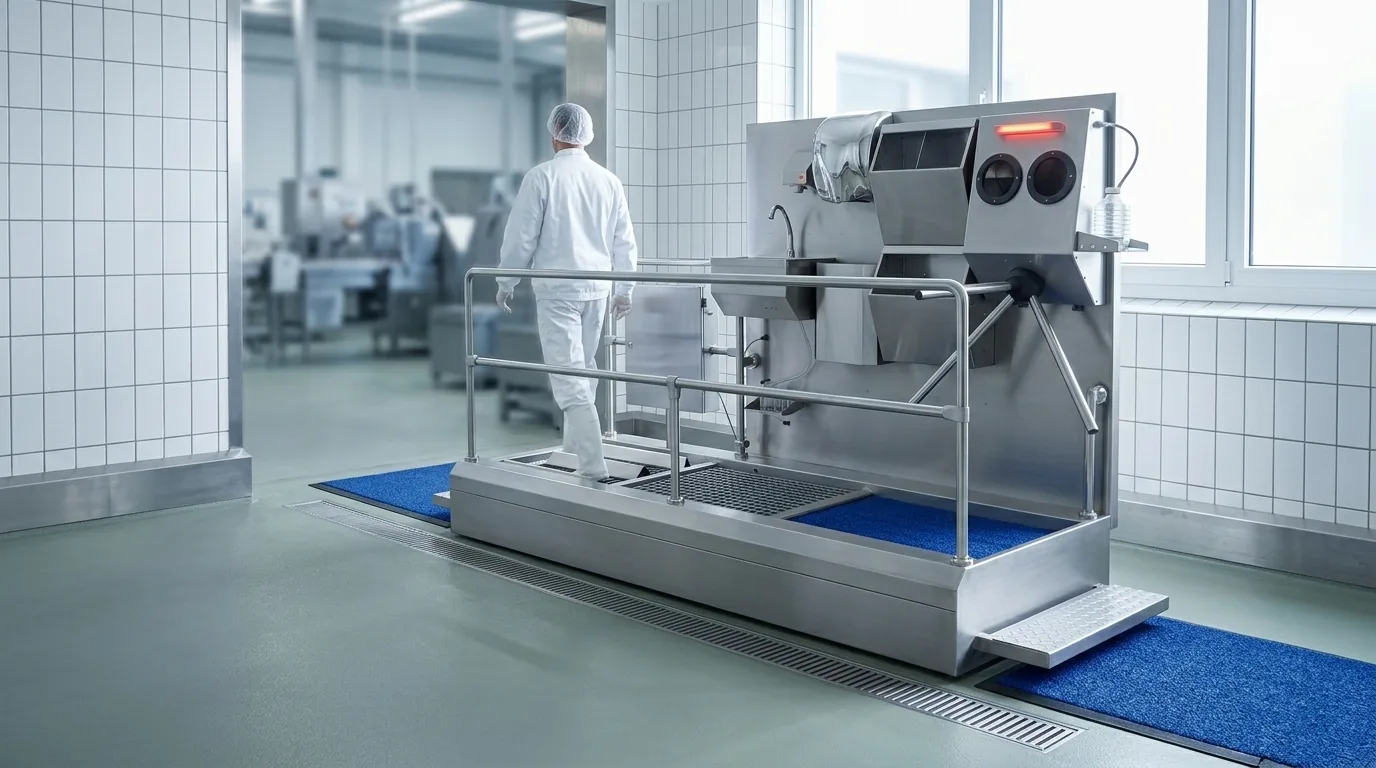
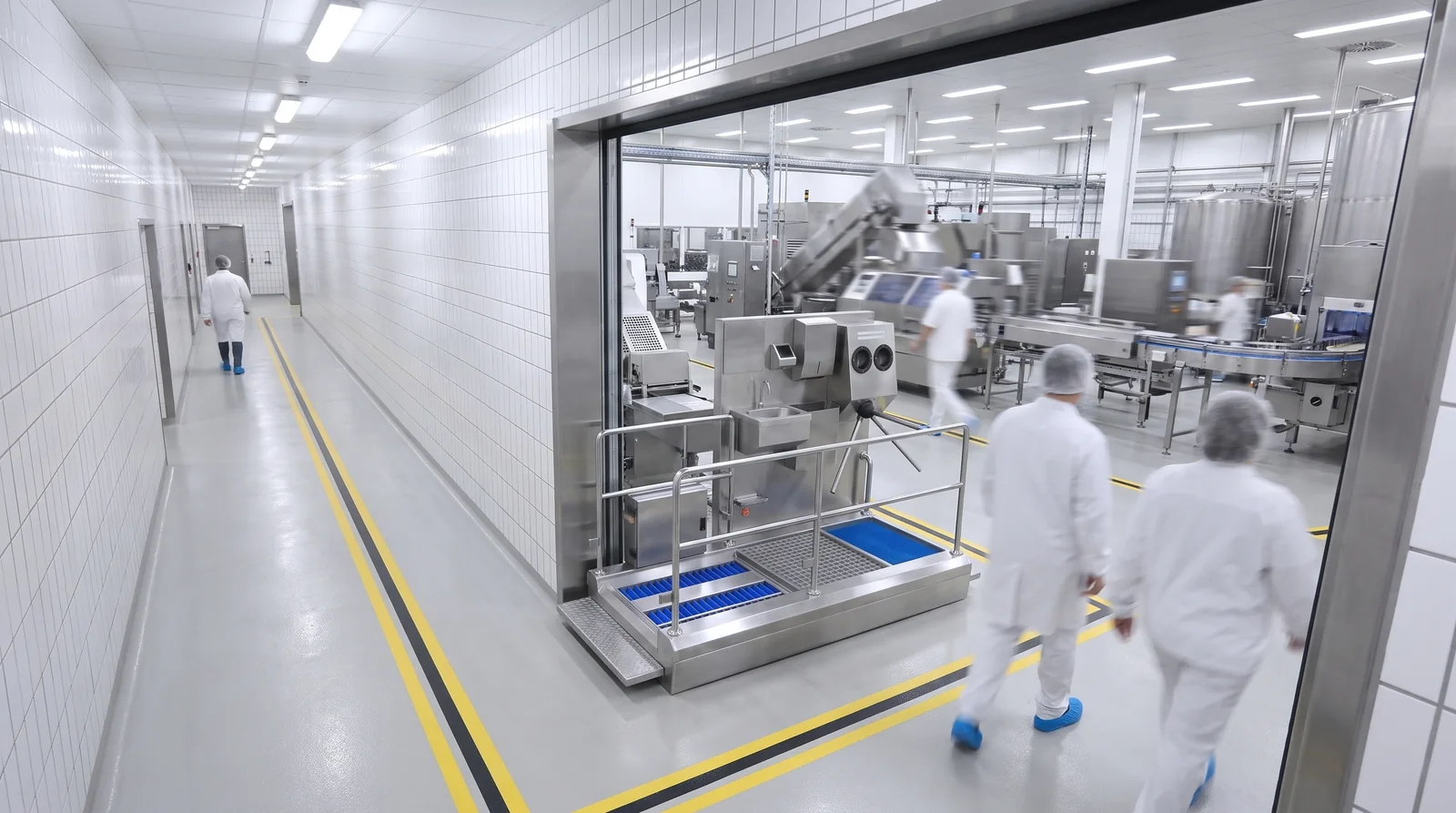
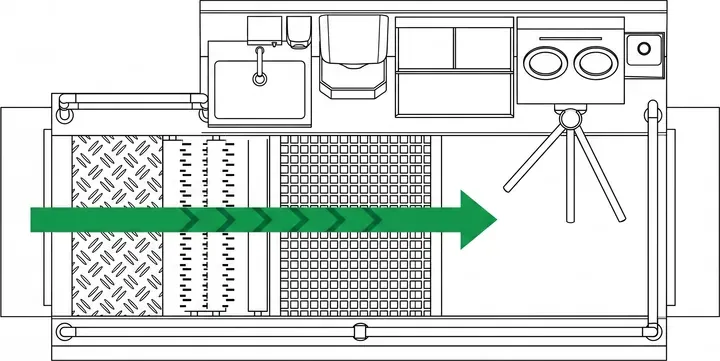
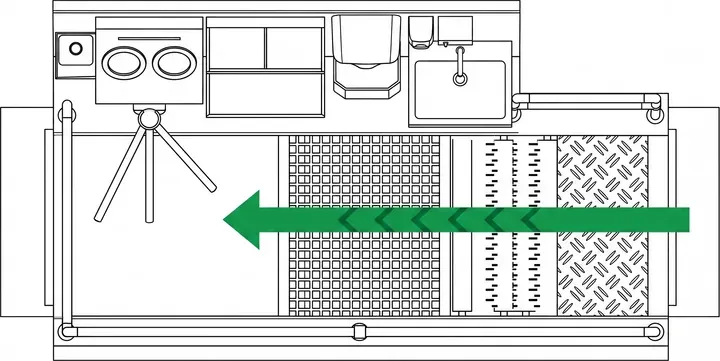
What capacity hygiene station?
How many lanes do you need for your shift-start flow? Turnstile throughput and queue-prevention math.
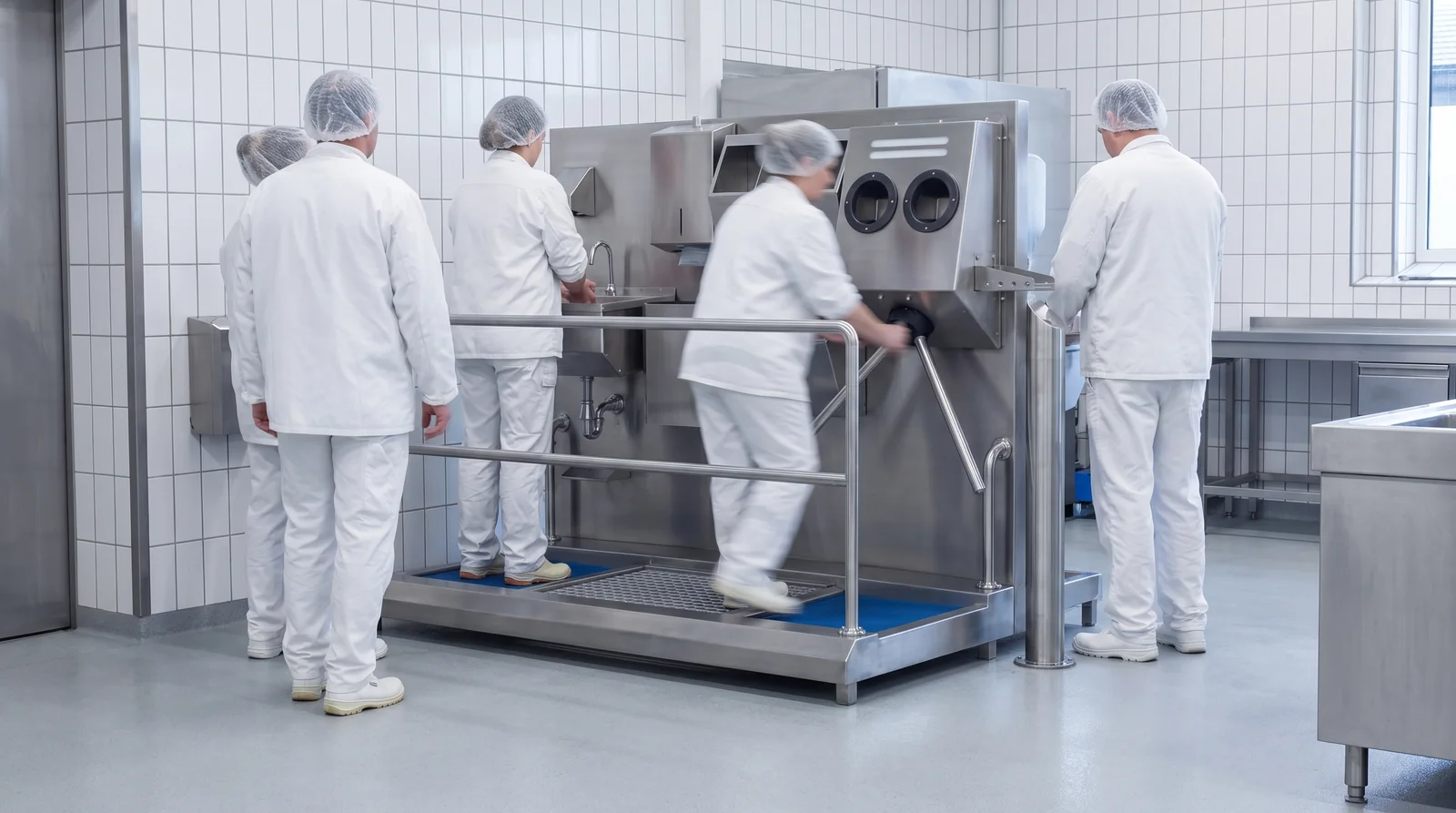
The single number that determines what capacity hygiene station you need is not your total headcount but the peak flow at the start of a shift: how many people must enter the clean area within how many minutes. The turnstile’s mechanical speed is not the line’s bottleneck; lane capacity is set by the hand-washing and disinfection cycle and confirmed by measurement at the facility. In the calculations in this article we use 5 people/min per lane as an explicitly labelled planning assumption (hand-disinfection and turnstile cycle; 2–3 people/min when the full hand-washing procedure is enforced). In this article we show, step by step, how to measure your peak flow, how to work out the number of lanes with a simple calculation, and how to prevent queues (and therefore skipped hygiene steps).
The number that determines what capacity hygiene station you need is not total headcount but the peak flow at shift start: how many people must enter the clean area within how many minutes. Three facts shape the calculation. First, the turnstile’s mechanical speed is not the line’s bottleneck; lane capacity is set by the hand-washing and disinfection cycle and confirmed by measurement at the facility. Second, proper hand washing takes about twenty seconds, with drying and disinfection on top; the calculations in this article use 5 people/min per lane as an explicitly labelled planning assumption. Third, a queue is not just lost time but a hygiene risk, because waiting staff rush through the steps. The calculation is simple: divide the peak headcount by the window in minutes, divide the result by people per minute per lane, and round up. Small and medium plants usually need one or two lanes; where hundreds enter at once, plan a multi-lane line, staggered shifts or a second entry point.
Which number determines the capacity?
The number that determines capacity is not the facility’s total headcount but the peak flow at the start of the busiest shift. In other words, if 120 people are trying to enter within the same 10-minute window on the 08:00 morning shift, you size your hygiene station not for 120 people but for a flow of "120 people in 10 minutes". Personnel usually arrive together at the start of a shift; it is therefore the peak value in this short window — not the average — that determines the critical capacity.
To find the right number, pin down three inputs: the number of people in the peak flow, the time window (min) in which this flow piles up, and the per-person hygiene cycle time (s). These three directly determine how many parallel lanes you need.
Not how many people the facility employs in total — how many people have to enter, within how many minutes, at the start of the busiest shift? Sizing starts with this single sentence.
How many people per minute does a single-lane turnstile pass?
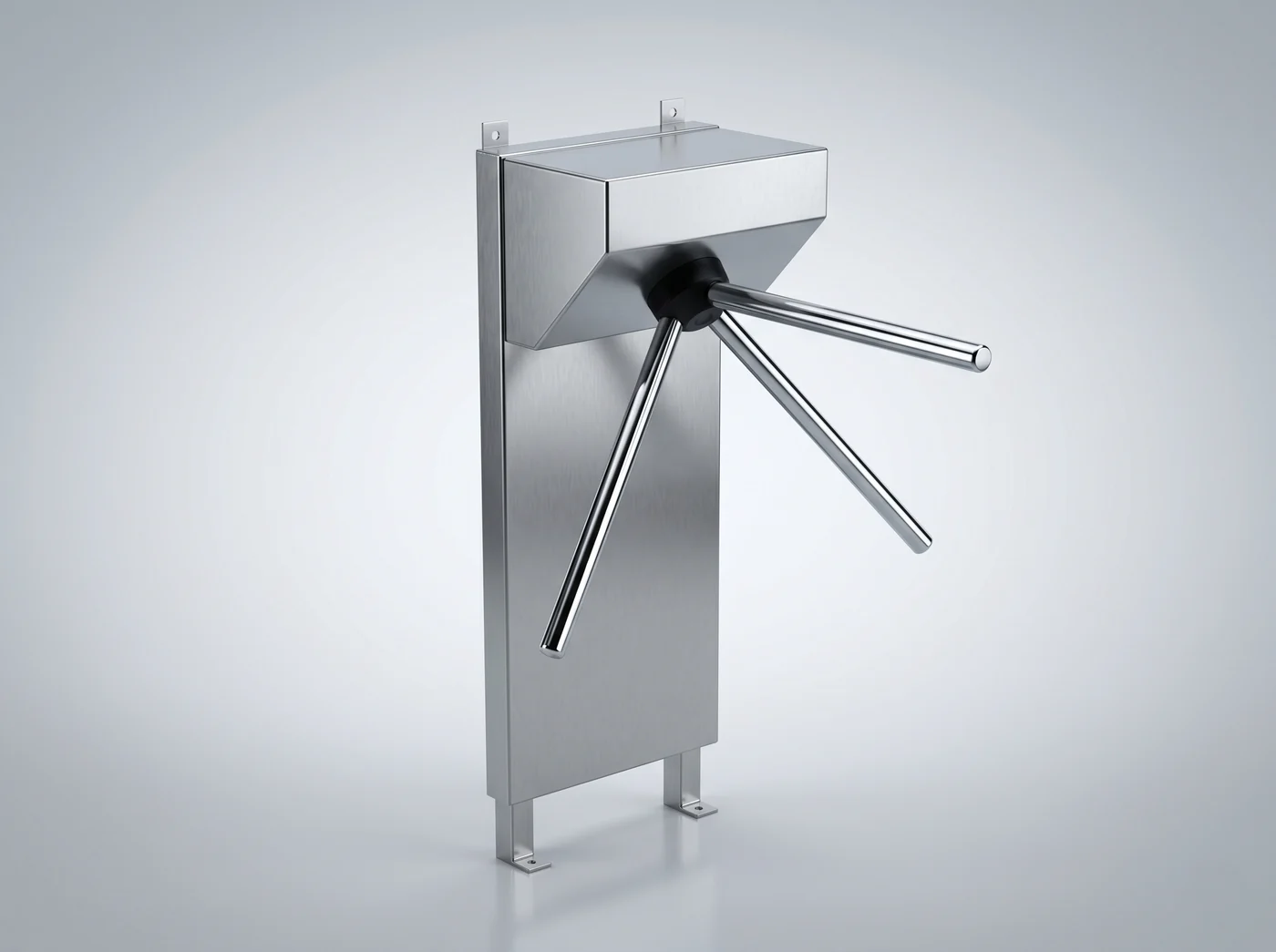
The purely mechanical passage rate of a single-lane tripod (three-arm) turnstile is a catalogue figure that matters for fast counting/entry turnstile scenarios. In a hygiene station, however, the turnstile’s mechanical speed is not the line’s bottleneck; lane capacity is set by the hand-washing and disinfection cycle and confirmed by measurement at the facility.
The real bottleneck is the hygiene cycle. When done correctly, washing hands takes about 20 seconds (the widely accepted duration in food hygiene); drying and touchless hand disinfection are added on top. In facilities that require boot cleaning, the cycle grows even longer. For this reason, in a hygiene station lane capacity is set by the hygiene cycle; this article’s planning assumption is 5 people/min per lane, and the exact value is confirmed by measurement at the facility. In other words, capacity is determined by the duration of the hygiene steps, not the speed of the turnstile.
In a hygiene station, the bottleneck is not the turnstile but the time hand washing takes. Capacity is determined by the cycle time, not the turnstile’s theoretical speed.
| Turnstile mechanical passage | Not the bottleneck — does not set lane capacity |
|---|---|
| Hand washing time (recommended) | ≈ 20 s |
| Hygiene cycle (washing + drying + disinfection) | ≈ 4–6 s flow interval, cycle ≈ 25–40 s |
| Planning assumption (lane capacity) | 5 people / min — confirmed by facility measurement |
Overlooking this distinction during planning is the most common mistake: sizing is done with the catalogue’s mechanical turnstile speed, and a queue forms on site. We compare in detail how the turnstile type (tripod or flap) affects the flow in our tripod turnstile or flap turnstile article.
How do I calculate how many lanes I need?
The number of lanes you need is found with a simple division: you divide the number of people in the peak flow by the number of people one lane can pass within the acceptable waiting time. The formula is:
Number of lanes = peak people ÷ (lane capacity [people/min] × window [min])
Let’s apply it step by step:
- 1Measure the peak flow. Count how many people enter at the start of the busiest shift (e.g. 120 people).
- 2Set the time window. Within how many minutes do you want all of these people to enter (e.g. 10 min)? If you do not want a queue, keep this window realistic.
- 3Choose the lane capacity. Use the value including the hygiene cycle — this article’s planning assumption is 5 people/min, confirmed by measurement at the facility — not the turnstile’s mechanical speed.
- 4Divide and round up. Always round any fractional result up to the next whole number — there is no such thing as half a lane.
Sample calculation
A 120-person shift, in a 10-minute window, with a planning assumption of 5 people/min per lane: one lane passes 5 × 10 = 50 people in 10 minutes. 120 ÷ 50 = 2.4 → rounded up, 3 lanes are needed. If you can stretch the window to 15 minutes (120 ÷ 75 = 1.6 → 2) a double lane is enough; if boot cleaning is added the cycle gets longer and the calculation is repeated. If the measured cycle beats the assumption, the lane count drops.
| Peak headcount | Window | Calculation | Round up | Recommendation |
|---|---|---|---|---|
| 30 people | 10 min | 30 ÷ 10 ÷ 5 = 0.6 | 1 | 1 lane |
| 60 people | 10 min | 60 ÷ 10 ÷ 5 = 1.2 | 2 | 2 lanes (1 lane over a 15-min window) |
| 120 people | 10 min | 120 ÷ 10 ÷ 5 = 2.4 | 3 | 3 lanes (2 lanes over a 15-min window) |
| 200 people | 10 min | 200 ÷ 10 ÷ 5 = 4.0 | 4 | 4 lanes or 2 lanes + staggered shifts |
| 300 people | 10 min | 300 ÷ 10 ÷ 5 = 6.0 | 6 | Multi-lane line + staggered shifts or a second entry |
The table is a starting point; the actual number of lanes varies with whether boot cleaning is included, the door width and shift discipline. We can work out the exact sizing together based on your facility’s flow.
Why is a queue a hygiene risk?
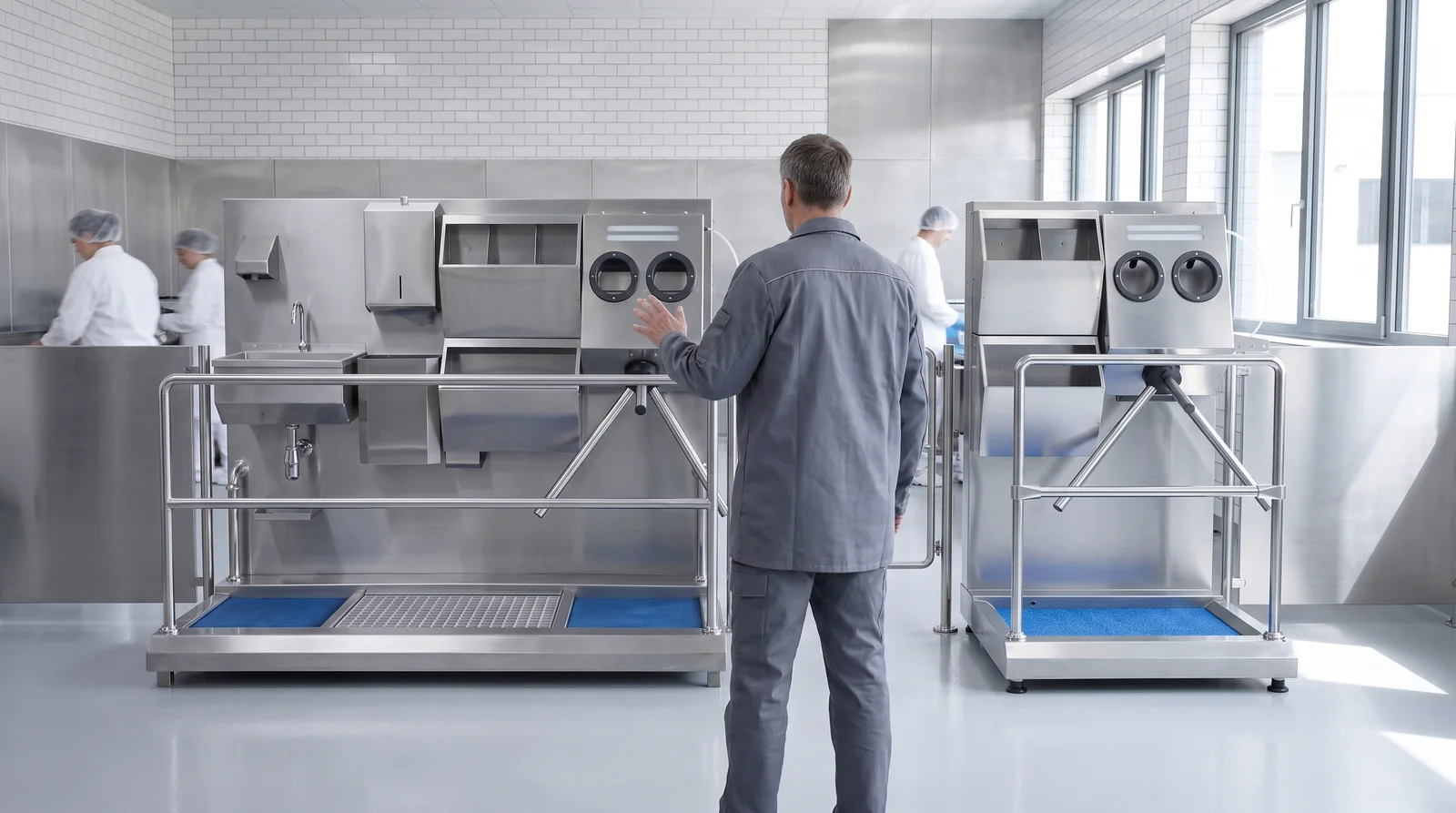
A queue is not just an efficiency problem; it is a direct hygiene risk. When a long line forms in front of the hygiene station, two bad outcomes follow: personnel either rush the steps to avoid being late (cutting hand washing short), or the turnstile gets "bypassed" under management pressure. In both cases the whole purpose of the hygiene station — the consistent and complete execution of the steps — is defeated.
Insufficient capacity erodes the hygiene culture over time. That is why the number of lanes should be chosen at the "comfortably enough" level, not "just enough". Practical ways to prevent queues:
- Leave a safety margin — if the calculation yields a single lane and the window is tight, go for a double lane.
- Spread out the entry window — staggering the shift start by 10–15 min reduces the peak load without adding hardware.
- Separate washing from the turnstile — a layout that feeds several washbasins into a single turnstile clears the washing bottleneck.
- Choose the right location — a cramped corridor makes the queue worse; the best location for a hygiene station directly affects the flow.
What affects capacity besides the number of lanes?
The number of lanes is not the only variable; even with the same number of lanes, you can shorten the cycle time and increase the effective capacity. The determining factors are:
- Boot cleaning — adding a boot-brush or footbath step lengthens the cycle and reduces capacity. We cover the impact of the boot cleaning method in our boot cleaning: boot-brush or footbath article.
- Sensor and automation speed — touchless, automatic-dosing units speed up the flow compared with manual steps.
- Turnstile type — a motorized/automatic turnstile makes the passage smoother than a manual mechanism.
- Staff habituation — new personnel are slower in the first weeks; the flow settles over time.
The number of lanes and the choice of model should be evaluated together. When selecting the configuration that suits your facility, our how to choose a hygiene station guide and our types of hygiene stations article point the way.
In summary: what capacity barrier?
In summary: the answer to "what capacity barrier" lies not in the total headcount but in the peak flow. Measure the number of people in the busiest window at the start of the shift, divide by the measured cycle capacity per lane (planning assumption: 5 people/min), and round up while leaving a safety margin. For most SME-scale food facilities, a single or double lane is sufficient; large facilities where hundreds of people enter at the same time call for multiple lanes or staggered entry.
Calculate with 5 people/min per lane, round the result up and leave one step of margin. If you are unsure about the sizing, share your shift flow; let’s determine the right number of lanes together and move on to the Request a Quote step.
Note: the Codex Alimentarius General Principles of Food Hygiene (CXC 1-1969) and ISO 22000:2018 require hand-washing facilities to be adequate in number and suitably located; they do not define a numeric threshold such as people per minute. Lane count is therefore derived from the facility’s own measurement, not from the standard.
Sources
- Codex Alimentarius — General Principles of Food Hygiene (CXC 1-1969) — FAO/WHO Codex Alimentarius Commission
- ISO 22000:2018 — Food safety management systems — International Organization for Standardization (ISO)
Frequently asked questions
How many people per minute does a single-lane hygiene station pass?
The turnstile’s mechanical speed is not the line’s bottleneck; lane capacity is set by the hand-washing and disinfection cycle and confirmed by measurement at the facility. Sizing should use the measured cycle value (planning assumption: 5 people/min), not the turnstile’s theoretical speed.
How do I calculate how many lanes I need?
Divide the number of people in the peak flow by the number of people one lane passes within the acceptable waiting window: number of lanes = peak people ÷ (lane capacity × window in minutes). Take the lane capacity as a planning assumption of 5 people/min and always round the result up to the next whole number.
Should I size the capacity by total headcount?
No. What matters is not the total headcount but the peak flow at the start of the busiest shift — that is, how many people enter within how many minutes. Because personnel usually arrive together, the peak value in this short window determines the critical capacity.
How many lanes does a 120-person shift require?
With a planning assumption of 5 people/min per lane, one lane passes 50 people in 10 minutes; a 120-person peak needs 120 ÷ 50 = 2.4 → 3 lanes. If the window can be stretched to 15 minutes a double lane is enough; if boot cleaning is added the cycle gets longer and the calculation is repeated. If the measured cycle beats the assumption, the lane count drops.
Does boot cleaning reduce capacity?
Yes. When a boot cleaning step such as a boot-brush grate or a disinfectant footbath is added, the cycle time per person grows, so the number of people per minute per lane drops. Facilities that require boot cleaning should plan more lanes or a wider entry window for the same flow.
Why is sizing capacity right at the limit risky?
If capacity is chosen right at the limit, a queue forms at peak moments; personnel either rush hand washing or are pushed to skip the turnstile. Both defeat the purpose of the hygiene station. That is why the number of lanes should be chosen with a safety margin at the "comfortably enough" level, not "just enough".