304 vs 316 stainless for hygiene
AISI 304 vs 316: chromium, nickel, molybdenum, corrosion and cost. Which is right for hygiene equipment?
For the vast majority of personnel-entry hygiene equipment, the right choice is AISI 304 stainless steel; AISI 316 is only necessary for aggressive environments with continuous chloride exposure. The single critical difference between the two alloys is molybdenum: the roughly 2–3% molybdenum in 316 markedly improves resistance to pitting and crevice corrosion in chloride-bearing environments — but in return, 316 is typically about 25% more expensive. In this article we compare the chemical composition of 304 and 316, their passive-layer and cleanability behaviour, their corrosion resistance and their cost, clarifying from a manufacturer’s perspective which one is right in which situation.
What is the difference between 304 and 316?
The fundamental difference is that 316 contains molybdenum in its composition and a higher nickel content. Both alloys belong to the austenitic stainless steel family; that is, they are non-magnetic and have good formability and weldability. AISI 304 typically contains roughly 18% chromium and 8% nickel, with no significant molybdenum. AISI 316, on the other hand, contains roughly 16–18% chromium, 10–14% nickel and, as its distinguishing element, 2–3% molybdenum. The chromium contents are close to one another; the real determining difference is molybdenum and the higher nickel.
In practice, this small difference in composition translates into a large difference in behaviour. Molybdenum keeps the protective (passive) surface layer stable against chloride attack; as a result, 316 lasts longer than 304 in environments containing salt, brine or chlorine-based disinfectants. We cover why stainless steel is the default material for hygiene equipment in our what is a hygiene barrier article; here we focus on the choice between the two grades.
What does molybdenum do?
Molybdenum strengthens resistance to pitting corrosion, which is stainless steel’s weakest point in chloride-bearing environments. Chloride ions (salt, brine, bleach / chlorine-based disinfectants) can locally puncture the thin protective surface layer, opening small but deep pits; these pits are hard to spot with the naked eye, difficult to clean and can over time turn into bacteria-harbouring sites. The molybdenum in 316 keeps the passive layer stable against this localized attack, delaying pit formation.
A common way to quantify this difference is the PREN (Pitting Resistance Equivalent Number) value. Because molybdenum enters the PREN formula with a high coefficient, the PREN value of 316 is markedly above that of 304 (typically 304 ≈ 18–20, 316 ≈ 23–28). The higher the PREN, the later the material pits in a chloride-bearing environment. In practice, this means longer life and lower corrosion risk for 316 on a line that is continuously chlorine-cleaned or that contains salt/brine.
What wears out hygiene equipment is often not the product but the cleaning chemical. Chlorine-based (sodium hypochlorite) disinfectants are powerful but carry a high chloride load; if not rinsed well, they increase the risk of staining and pitting on a 304 surface. In most cases the right solution is not switching to 316, but choosing a chloride-free disinfectant and rinsing thoroughly with plenty of water.
What is the passive layer, and why is it critical for hygiene?
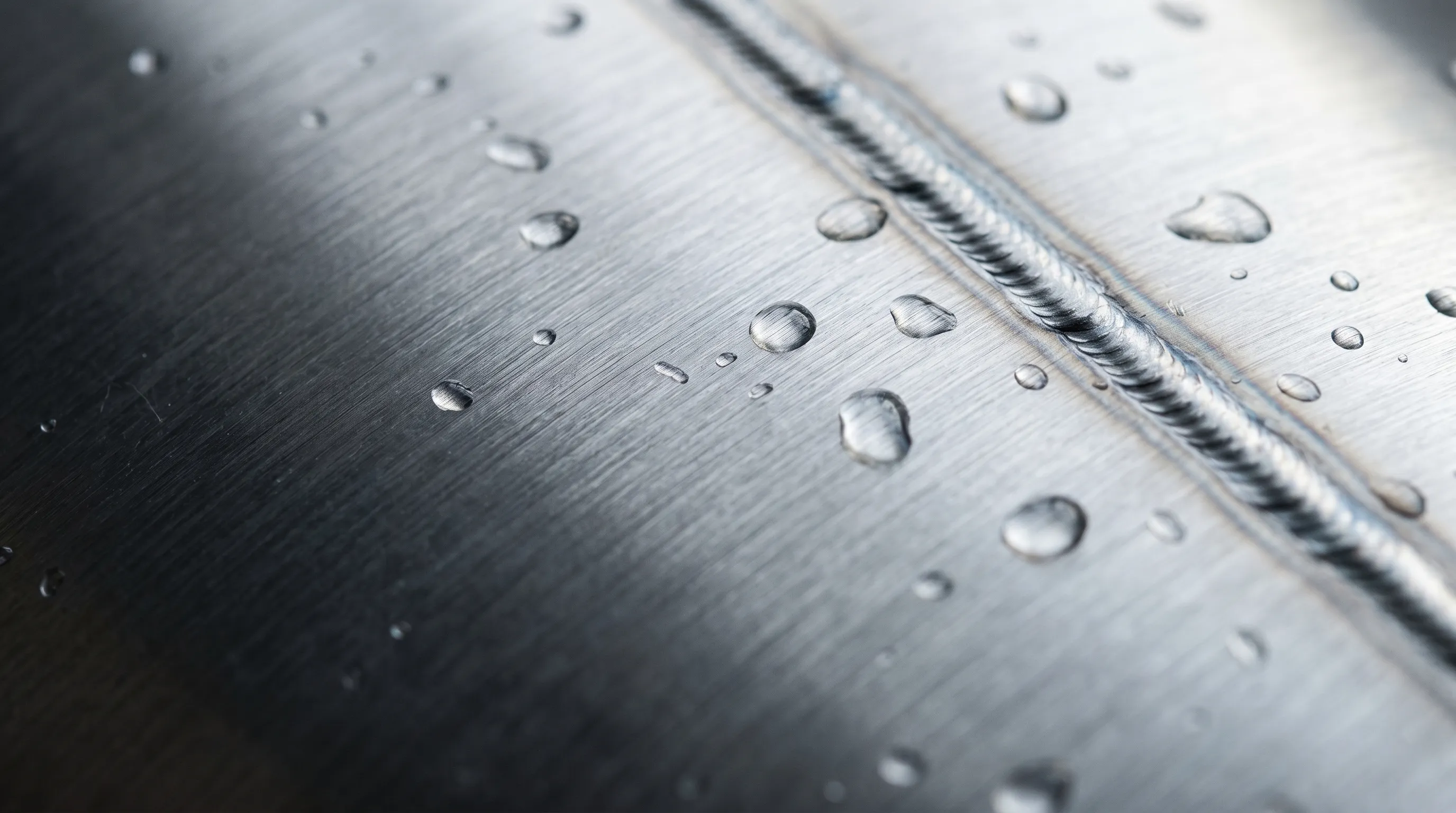
The passive layer is what truly makes stainless steel “stainless”: a very thin chromium-oxide film that forms spontaneously on the surface thanks to chromium (typically only on the order of a few nanometres / tens of angstroms). This film is non-porous, repairs itself on contact with atmospheric oxygen, and protects the underlying metal from corrosion. Even if scratched, it re-forms quickly as long as there is enough oxygen in the environment — this is the real secret behind stainless steel’s durability.
For hygiene this layer has two consequences. First, because the surface is non-porous and smooth, it does not retain bacteria or organic residue; a stainless surface with the right roughness (low Ra) is easy to clean and disinfect. Second, it is resistant to caustic (high-pH) cleaning chemicals; the alkaline foam cleaning common in food facilities does not damage this surface. The problem is not caustic but chloride: a regime with a high chloride load and poor rinsing consumes the passive layer faster than it can re-form, increasing the risk of pitting.
This is exactly where the choice between 304 and 316 becomes meaningful: both work on the same passive-layer principle, but 316 keeps that layer more stable under chloride. Surface quality also directly affects this behaviour: a well-polished surface with low roughness (low Ra) preserves the integrity of the passive layer and reduces residue and chloride build-up; a rough or scratched surface is both harder to clean and more prone to pitting.
When to use 304 and when to use 316?
The practical rule is clear: for personnel entry in standard food, pharmaceutical and healthcare facilities, 304 is sufficient and the right choice; 316 is necessary only for special environments with continuous and intense chloride exposure. The distinction below gives direction for most facilities.
Situations where AISI 304 is sufficient
- Dry or general food areas — low-chloride-load environments such as flour, bakery, ready meals and beverage filling.
- Standard personnel entry hygiene — the body of hand-wash, disinfection and turnstile entrance units.
- Pharmaceutical and cosmetics cleanroom entry — controlled environment, chloride-free cleaning regime.
- Hospitals and healthcare facilities — staff and visitor hygiene stations.
Situations where AISI 316 is worth considering
- Continuous chloride exposure — the direct-contact zones of brine, pickling, seafood and high-salt-load lines.
- Intensive chlorine-based disinfection — areas with an aggressive sanitation regime where rinsing cannot be guaranteed.
- Coastal / high-humidity environment — special installations where salty air condenses continuously.
- Critical contact surfaces — instead of the whole body, hybrid use on only the most heavily stressed parts is also possible.
The right grade is determined not by the steel itself, but by the facility’s cleaning chemical and chloride load.
Let us note an important distinction: switching to 316 “just in case” is often an unnecessary cost. If staining appears on a 304 surface, the problem is usually not the material but the cleaning regime (chloride-bearing chemicals, insufficient rinsing, iron contamination). Fixing the regime first is both cheaper and more correct than blindly switching to 316. In contrast, in the direct-contact zones of facilities with a genuinely high chloride load — such as brine, pickling and seafood — 316 is a well-placed investment.
How much more expensive is 316?
Compared with an equivalent 304 product, 316 is typically about 25% more expensive; however, this ratio is not fixed and varies with the market. The difference stems from 316’s higher nickel content and its molybdenum, an expensive alloying element. When the exchange prices of nickel and molybdenum rise, the gap between the two grades widens; moreover, because processing 316 (rolling, welding) is somewhat more demanding, its production cost is also higher.
Material selection is therefore a cost decision: choosing 316 when it is not needed means paying a significant premium per unit. Conversely, insisting on 304 in a genuinely high-chloride-load environment comes back as early corrosion and replacement cost. We assess the impact of stainless grade on total price, alongside the other line items, in our factors that affect the price of a hygiene barrier article.
First determine your cleaning chemical and chloride load. Under a standard regime, choose 304 and allocate the budget to the right capacity and to sensor/automation quality. If there is continuous chloride exposure, discuss 316 or a hybrid solution on the most heavily stressed parts. If you are not sure, share your facility’s flow and cleaning regime; let us determine the right grade together.
Material is only one part of the choice; the right capacity, turnstile type and configuration matter at least as much. For a holistic view, take a look at our types and models of hygiene barriers guide and, before purchasing, our 10 critical points when buying a hygiene barrier checklist.
Conclusion: 304 or 316?
For most personnel-entry hygiene applications, the answer is AISI 304: it offers a corrosion-resistant, non-porous, easy-to-clean surface that withstands caustic cleaning — and it does so without the extra cost of 316. The single critical advantage that sets 316 apart is the chloride/pitting resistance molybdenum brings, and this advantage makes a real difference only in environments with continuous chloride exposure. The decision is not about choosing the “better” steel, but about choosing the one suited to your facility’s cleaning regime and chloride load. To clarify the right grade for your facility, you can request a quote from us.
Frequently asked questions
Is 304 or 316 better for a hygiene barrier?
For personnel entry in most food, pharmaceutical and healthcare facilities, AISI 304 is sufficient and the right choice. 316 is considered only in aggressive environments with continuous chloride exposure (brine, seafood, intensive chlorine-based disinfection). “More expensive is better” is not a correct approach; the right grade is determined by the facility’s cleaning regime.
What is the fundamental difference between 304 and 316?
The fundamental difference is molybdenum. 304 contains roughly 18% chromium and 8% nickel, with no molybdenum. 316 contains roughly 16–18% chromium, 10–14% nickel and, as its distinguishing element, 2–3% molybdenum. Molybdenum markedly increases resistance to pitting and crevice corrosion in chloride-bearing environments.
How much more expensive is 316?
Compared with an equivalent 304 product, 316 is typically about 25% more expensive, but this ratio is not fixed and varies with the market depending on nickel/molybdenum prices. The difference stems from 316’s higher nickel and molybdenum content.
Does 304 stainless steel rust?
Used correctly, no. 304 is corrosion-resistant thanks to the self-repairing chromium-oxide (passive) layer on its surface. If staining appears, the problem is usually not the material but the cleaning regime: chloride-bearing chemicals, insufficient rinsing or iron contamination. Fixing the regime first is sufficient in most cases.
Does chlorine-based disinfectant damage a 304 surface?
It can if rinsing is insufficient. Chlorine-based (sodium hypochlorite) disinfectants carry a high chloride load and, under prolonged contact, increase the risk of staining and pitting on a 304 surface. In most cases the solution is not switching to 316, but choosing a chloride-free disinfectant and rinsing thoroughly with plenty of water. If chloride contact is unavoidable, 316 is considered.
What is the passive layer?
The passive layer is the very thin, non-porous and self-repairing chromium-oxide film that chromium forms on the surface. It is the essential element that protects stainless steel from corrosion, retains no bacteria because it is non-porous, and withstands caustic cleaning. Both 304 and 316 work on this principle; 316 keeps this layer more stable under chloride.