Hygiene barriers in meat plants
Staff entry hygiene in meat plants: the right barrier against organic load, cold chain and cross-contamination.
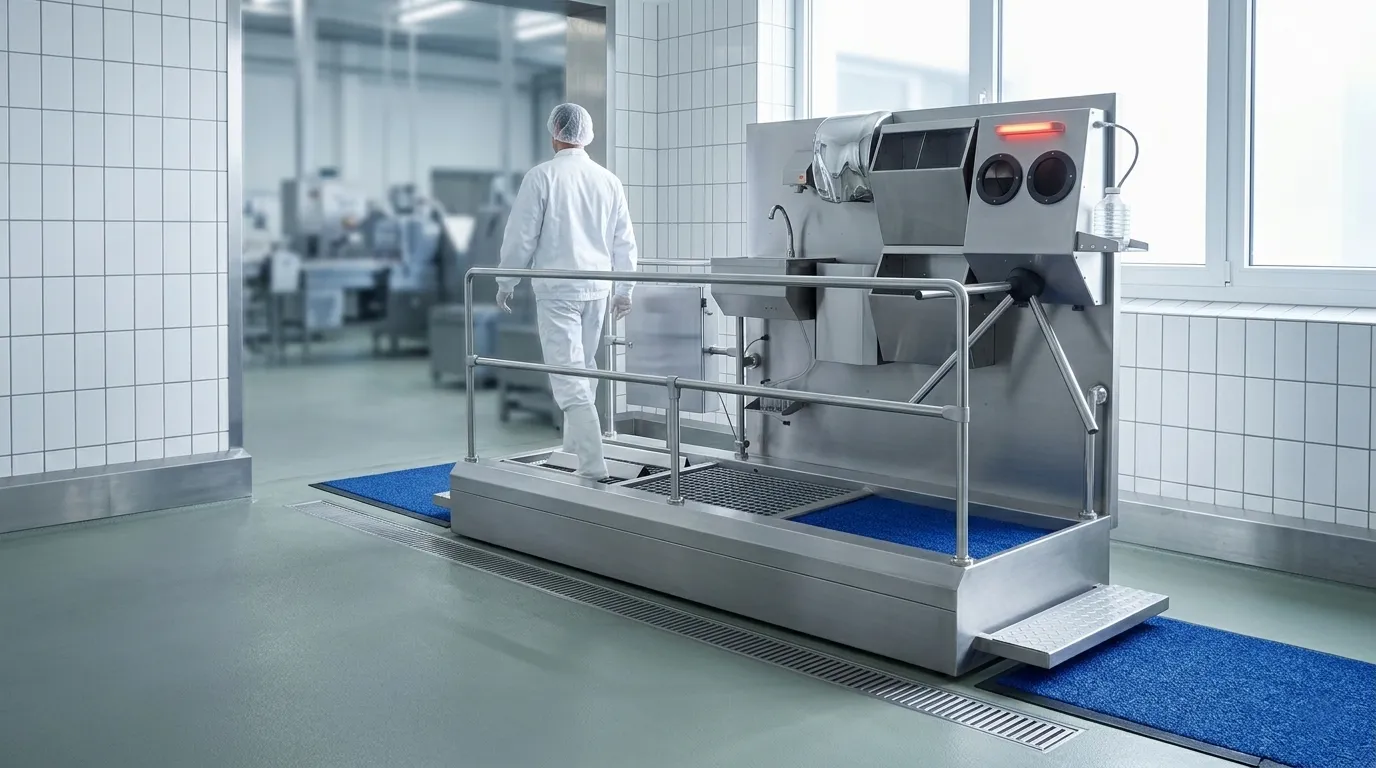
A hygiene barrier in a meat processing plant is the staff entry system that stops the highest contamination risk right at the door — before boots loaded with blood, fat, soil and pathogens reach the production area. The meat and meat products sector is one of the most demanding hygiene environments in food, owing to its high organic load, cold chain sensitivity and cold-tolerant pathogens such as Listeria. In this article we explain, from a manufacturer’s point of view, the risks specific to meat plants, the right barrier configuration (especially boot cleaning), material selection, and why the transition between high- and low-hygiene zones is so critical.
Why is a hygiene barrier so critical in meat plants?
Because meat processing is one of the food sectors with the highest level of staff-driven cross-contamination. In slaughter, cutting, deboning and packaging areas the environment is coated with heavy organic residue — blood, fat, tissue remnants and liquids. This residue builds up on the floor, sticks to staff boots and is carried into a clean zone at the next step. People are the most effective vector for moving contamination from one zone to another; hands, gloves and especially footwear carry the highest microbial load.
The second factor that magnifies the risk is the cold chain. Meat plants operate largely in refrigerated areas, and pathogens such as Listeria monocytogenes can multiply even at around 0 °C; they cling stubbornly in cold, damp environments, drainage channels and condensation points. Chilling and low temperatures slow microbial growth but do not eliminate it. That is why the measure taken at the entrance of a meat plant is the most effective way to reduce the pathogen load entering the production area from the very start.
In a meat plant, contamination is most often carried not by the line itself but by the staff step that reaches from a dirty boot into a clean zone.
What hygiene risks are specific to the meat sector?
The hygiene profile of meat plants differs markedly from dry or low-load food sectors. Before choosing the right barrier, you need a clear view of these risks:
- High organic load — blood, fat and tissue remnants form biofilm on surfaces; a simple rinse is not enough, mechanical brushing and disinfection are required.
- Heavy boot soiling — the sole of the boot carries the highest microbial and physical load; hand hygiene alone is inadequate in this sector.
- Cold-tolerant pathogens — agents such as Listeria persist in cold, damp, low-temperature environments; frequent and effective disinfection is essential.
- Chloride and harsh chemical load — heavy soiling is cleaned with chlorine-based disinfectants and frequent washing, which puts the equipment material under strain.
- Zoning — the transition from a low-hygiene area (receiving, slaughter) to a high-hygiene area (packaging, slicing) is the most critical moment for cross-contamination.
Each of these risks directly affects the barrier configuration. We cover the general logic of stopping contamination at the entrance in our article on what a hygiene barrier does; here our focus is the meat sector’s own particular solution.
How is the right hygiene barrier configured for a meat plant?
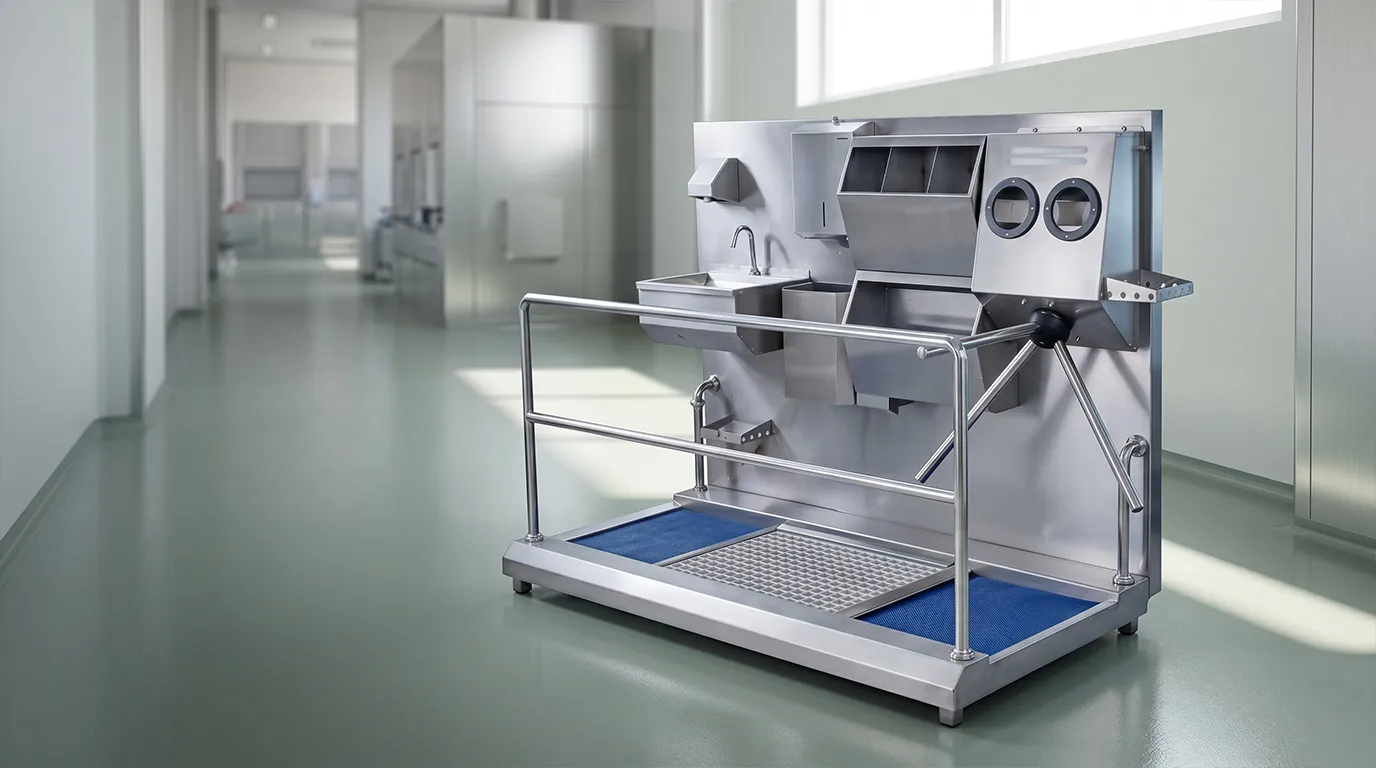
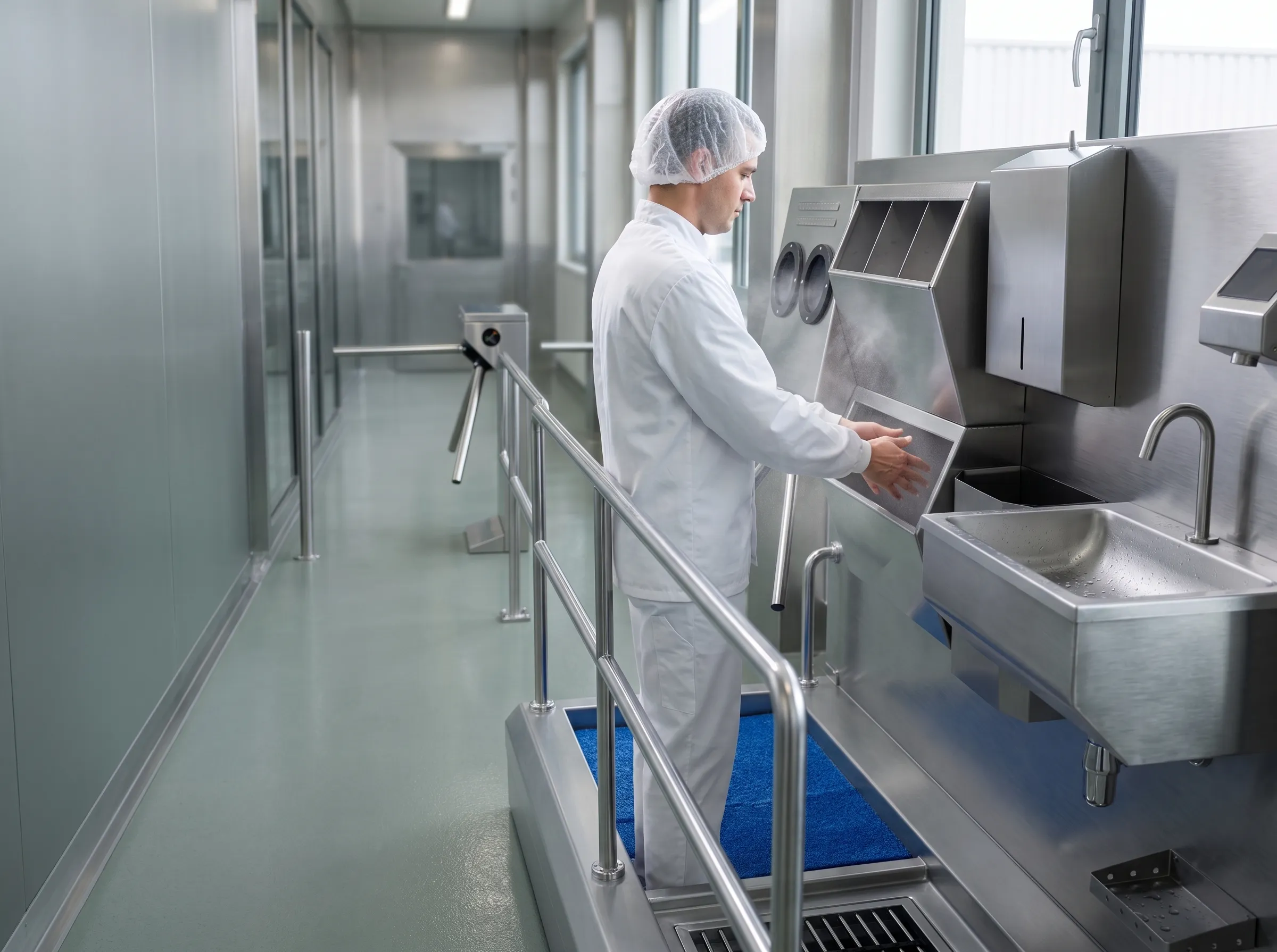
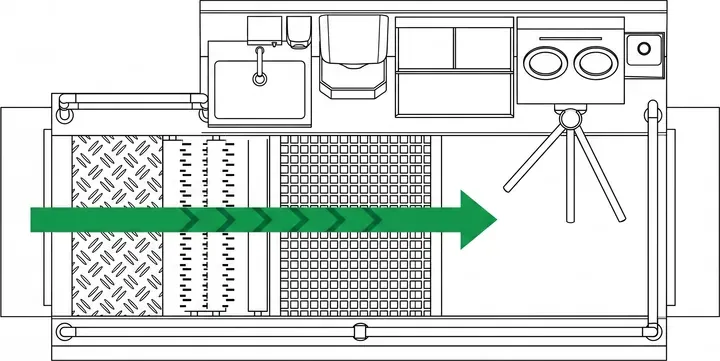
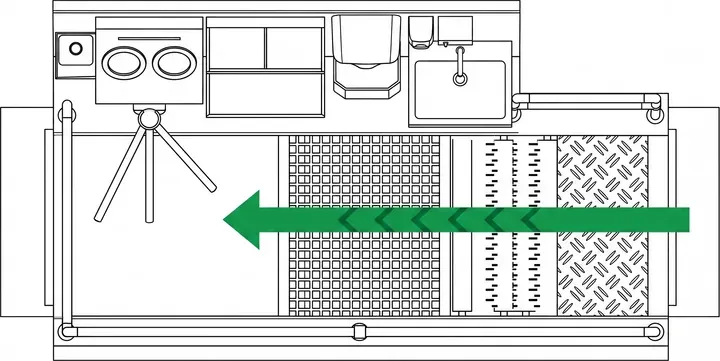
The right configuration for a meat plant means a complete line built around boot cleaning — hand washing and disinfection alone are not enough. Because of the high organic load and boot soiling, the typical component set recommended in this sector is as follows:
- Sensor-activated hand wash sink — with a touchless tap, liquid soap and paper towels; hands are dried before disinfection.
- Touchless hand disinfection unit — an auto-dosing dispenser applied to dry hands.
- Brush + basin boot cleaning — a grille that mechanically brushes the sole and side surfaces, followed by a disinfectant basin; with an organic load, a basin alone is inadequate.
- Turnstile (interlock) — a single-direction locked passage that does not open until the hygiene steps are verified.
- AISI 304 stainless steel body — a non-porous, washable surface resistant to frequent disinfection.
Because the boot sole carries the highest soiling in this sector, the heart of the barrier is boot cleaning. A disinfectant basin alone cannot break down sticky organic residue; the order must be mechanical brushing first, then disinfection. We compare the difference between brush and basin methods in our article on boot washing methods.
Why is boot cleaning at the centre of a meat plant?
Because the blood, fat and tissue remnants that build up on the floor stick directly to the boot, and this load spreads step by step throughout the production area. Applying only hand hygiene in a meat plant means leaving the biggest carrier — the boot sole — uncontrolled. Correct boot cleaning has two stages: first, rotating or fixed brushes mechanically remove the solid residue on the sole, then a disinfectant basin reduces the remaining microbial load.
The location of the boot cleaning station is at least as important as the method. In good practice these stations are placed at every staff entrance into the production area; additional points added at the exits of high-risk zones (packaging, slicing) prevent internal cross-contamination. To keep zoning working clearly, many meat plants also use zone-specific colour-coded boots and clothing — so that crossing into the wrong zone is visible at a glance.
AISI 304 or 316 stainless steel in a meat plant?
For most meat plant staff entrances, AISI 304 is the adequate and correct choice; it is non-porous, corrosion-resistant and durable under frequent disinfection. The meat sector does, however, have one peculiarity: areas with intensive use of brine, salt and chlorine-based disinfectants and constant chloride contact. At these aggressive points AISI 316 is considered; the roughly 2–3% molybdenum it contains markedly increases resistance to the pitting and crevice corrosion caused by chloride.
The decision is not to upgrade the material everywhere, but to choose the right grade at the right point: a mixed solution with a 304 body and 316 at the contact zones with the highest chloride load is usually the most sensible. We cover the technical difference between the two grades in detail in our article on choosing AISI 304 or 316 hygiene steel.
Which standards require staff hygiene in a meat plant?
No standard explicitly mandates purchasing a "hygiene barrier" by name; however, all of the food safety standards meat plants are subject to make staff hygiene and the availability of hand washing/disinfection a mandatory prerequisite. A hygiene barrier is the tool that meets these obligations in the most consistent and auditable way — it creates a control point that can be demonstrated during an audit and recorded.
Good hygiene practices (GHP), which form the basis of HACCP, ISO 22000, the ISO/TS 22002-1 that details food production prerequisites, and the GFSI-recognised standards such as BRCGS and IFS Food, which are critical for retail meat, all explicitly expect staff hygiene facilities, hand hygiene and cross-contamination control at the transition from a low-hygiene area to a high-hygiene area. In Türkiye, food hygiene legislation also requires that adequate hand washing facilities be provided. We explore the relationship between HACCP and the staff hygiene station in greater depth in a separate article.
How many lanes does a barrier in a meat plant need?
What determines the number of lanes is not the total headcount but the peak flow at shift start. In meat plants many staff start work at the same time; a single-lane passage can form a queue at shift start and lead to hygiene steps being skipped in haste. A single-lane tripod turnstile typically lets about 25–30 people through per minute; once the boot cleaning step is added the passage time lengthens and the real capacity drops.
For this reason a double- or multi-lane configuration is often preferred in meat plants with busy shifts. We cover the correct per-person capacity calculation in our article on how many people a hygiene barrier should serve, and we summarise placing the barrier in the most suitable location in the plant in the where a hygiene barrier should be positioned in the plant section.
Conclusion
In a meat processing plant, the hygiene barrier is the first and most effective control point that cuts off contamination at the entrance in an environment full of high organic load and cold-tolerant pathogens. In this sector the heart of the barrier is boot cleaning: mechanical brushing first, then disinfection. AISI 304 is the right choice for the body in most cases; 316 is considered at aggressive points with constant chloride contact. When built with the right configuration, the right capacity and the right location, a hygiene barrier reduces cross-contamination, produces evidence during audits and keeps hygiene consistent on every shift. We can determine the configuration tailored to your meat plant together.
Frequently asked questions
Is hand washing alone enough in a meat plant?
No. In meat processing the boot sole carries the highest microbial and organic load; blood, fat and tissue remnants stick directly to the boot. That is why, in addition to hand washing and disinfection, brush + basin boot cleaning is essential in meat plants.
Should I use AISI 304 or 316 stainless steel in a meat plant?
For a standard staff entrance, AISI 304 is adequate and economical in most cases. In aggressive areas with constant contact from brine, salt or chlorine-based disinfectants, 316 — which contains molybdenum and is more resistant to chloride corrosion — is considered. 316 is typically about 25% more expensive.
For boot cleaning, is a brush or a basin better?
In a meat plant both are needed together. Because of the high organic load, mechanical brushing first removes the sticky residue on the sole, then a disinfectant basin reduces the remaining microbial load. A basin alone is inadequate against heavy soiling.
Is a hygiene barrier mandatory for HACCP in a meat plant?
No standard explicitly mandates purchasing a "hygiene barrier" by name; however, standards such as HACCP, ISO 22000, BRCGS and IFS make staff hygiene, the availability of hand washing/disinfection and cross-contamination control between zones a mandatory prerequisite. A hygiene barrier meets these requirements in an auditable way.
How does a barrier reduce Listeria risk in a refrigerated meat plant?
Listeria is a pathogen that can multiply even in the cold and persists in damp environments; the cold chain does not eliminate it. A hygiene barrier reduces the pathogen load at the entrance to the production area, lowering the chance of the risk being carried into a clean zone. The boot and hand hygiene applied at the transition from a low-hygiene area to a high-hygiene area brings the most critical link of contamination spread under control.
How many lanes does a barrier in a meat plant need?
The number of lanes is determined by the peak flow at shift start. A single-lane tripod turnstile lets about 25–30 people through per minute; the boot cleaning step lengthens this time. In meat plants where many staff start work at the same time, a double- or multi-lane configuration prevents queuing and skipped steps.