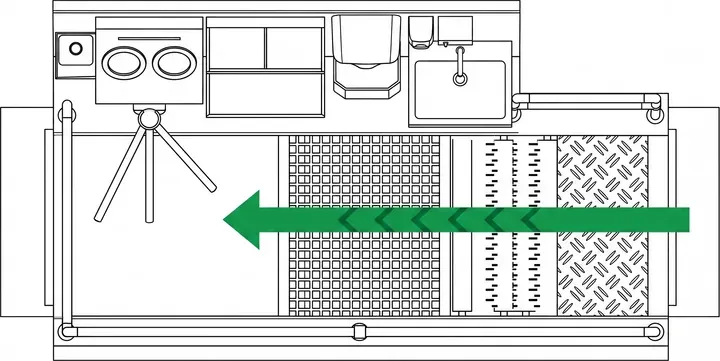
IP69K in hygiene equipment
What IP67, IP68 and IP69K mean — choosing washdown-proof sensors and hygiene equipment.
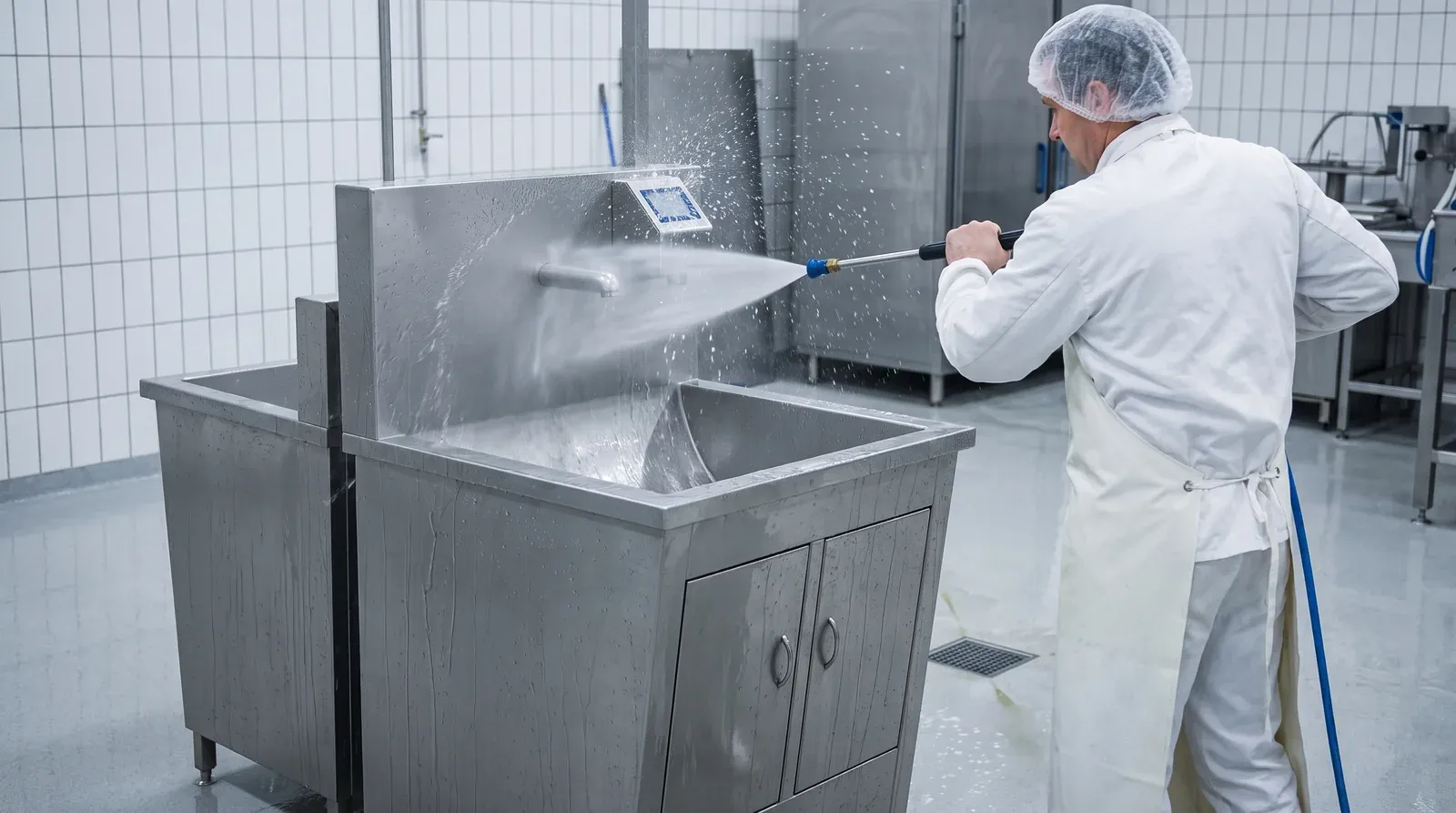
IP69K is the highest protection rating, indicating that a device is fully dust-tight and withstands washdown with high-pressure, high-temperature water jets. In food, meat and dairy facilities, equipment is washed at the end of every shift with ~80 °C water at ~80–100 bar, so the photocells, sensors and dosing units on a hygiene barrier cannot make do with a vague “waterproof” label. In this article we explain, from a manufacturer’s perspective, what the IP digits tell you, the critical difference between IP67 and IP69K, and why a given protection rating matters in hygiene equipment.
What is an IP protection rating (IP code)?
The IP code is an international rating that shows how well the enclosure of an electrical device is protected against solid objects and water. Standing for Ingress Protection, the IP code is defined according to the IEC 60529 standard. Unlike vague marketing phrases such as “waterproof”, the IP code is a measurable and tested value; this makes it a concrete criterion you can rely on when choosing hygiene equipment.
The IP code consists of two digits (e.g. IP69K). The first digit describes protection against solid objects and dust, and the second digit describes protection against water. Protection increases as the digit rises — but a “higher number = better in every respect” is not always the case, because different digits test different threats (immersion versus a high-pressure jet).
What do the digits in the IP code tell you?
The first digit in the IP code gives the level of protection against dust and the second against water. In hygiene equipment the highest first digit (6 — full dust-tightness) is almost always targeted; the real differentiation lies in the second digit, that is, the level of protection against water. In brief, the two digits mean:
- First digit — dust/solids (0–6): 5 means “dust-protected” (limited dust ingress is allowed), while 6 means “dust-tight” (no dust enters). In hygiene equipment the target is always 6.
- Second digit — water (0–9/9K): a higher digit means increasing protection, from dripping and spraying to water jets and immersion. For hygiene washdown, the critical range is levels 6, 7, 8 and 9K.
Sometimes you see a code containing an X, such as IPX7. The X means that property was not tested/not stated — IPX7 declares only water (7) protection, with no dust protection declared. In hygiene equipment it is preferable for both digits to be explicit (e.g. IP69K).
What are the levels of water protection (second digit)?
The second digit tells you which kind of water contact the device withstands, and it is the heart of hygiene equipment selection. The table below summarises the most important levels for a washdown environment. Your facility’s cleaning regime (a low-pressure hose or a high-pressure steam jet) directly determines which level is required:
The critical point is this: these levels do not stack on top of one another. 7 and 8 test “immersion in still water”, while 9K tests “a moving, high-pressure hot jet” — these are different physical threats. That is why the next section needs to address IP67 and IP69K separately.
What is the difference between IP67 and IP69K?
The most important difference is this: IP67 tests immersion, while IP69K tests high-pressure hot water jets; the two are different threats and one does not cover the other. An IP67-certified sensor can stay underwater at 1 metre depth for 30 minutes, but it is not guaranteed to withstand a washing jet coming from close range at 80–100 bar and ~80 °C. The reverse is also true: an IP69K device withstands high-pressure washing, but unless it also carries an IP67/IP68 marking for prolonged immersion, it is not deemed suitable for staying continuously underwater.
The IP69K test derives from ISO 20653 (formerly known as DIN 40050-9) and today is also included within IEC 60529. The test consists of spraying high-pressure hot water from four different angles with a close-held nozzle while the device is turned on a rotating table. The typical test conditions are:
IP67/IP68 = “can be immersed in water”; IP69K = “can be washed with a high-pressure hot jet”. In food hygiene equipment, what is decisive is usually not immersion but washdown resistance.
Why does IP69K matter in hygiene equipment?
Because in food facilities, cleaning is the most demanding moment for the equipment. In meat, dairy, poultry and seafood facilities, lines and equipment are washed at the end of every shift with high-pressure, hot water and caustic/acidic chemicals. This washing lands directly on the most sensitive parts of a hygiene barrier — photocells, proximity sensors, disinfectant dosing units and turnstile control electronics. If these parts are not in a suitable protection rating, water leaks in; failure, corrosion and gaps in the hygiene record begin.
Because a hygiene barrier verifies the hygiene steps with sensors and opens the turnstile accordingly, the reliability of the sensor is directly the reliability of the system (how a hygiene barrier works). A photocell that takes in water during washing misfires, jams or fails entirely — which either stops the line or, worse, allows passage before the hygiene step is completed. That is why sensors and connections in a washdown environment being in a high protection rating is not a comfort but a safety requirement.
- Sensor/photocell: the direct target of the washing jet. In a washdown area a high water protection rating is expected (typically IP67 and above; IP69K for intensive washing).
- Dosing and pump units: the electronics of soap/disinfectant dispensers must be protected from moisture and jets.
- Cable entries and connectors: the weak link is often not the sensor itself but the gland where the cable enters; seals and cable glands must also be in a suitable rating.
- Control box (PLC/board): usually placed in the area that does not get wet; even so, its enclosure’s protection rating is chosen to suit the cleaning regime.
How do you choose the right IP rating for hygiene equipment?
The right rating is chosen not by “how much water the equipment will go into” but by “how it will be cleaned”. First clarify the facility’s cleaning regime, then set the protection rating accordingly. A practical decision checklist:
- 1Determine the cleaning method: wiping/a low-pressure hose, or a high-pressure (≥ ~80 bar) hot water jet? If there is high-pressure hot washing, the target is IP69K.
- 2Separate the wet zone: classify the sensor/dosing zone that the jet hits directly and the control zone that stays dry differently; IP69K is not required everywhere.
- 3Check both digits: pay attention not only to the water digit but also to the dust digit (6); this matters in dusty flour/feed environments.
- 4Ask about immersion separately: if a part will stay continuously underwater (e.g. inside a footbath), IP69K is not enough; an IP68 marking is also needed.
- 5Do not forget the body material: as much as a high IP rating, the body must also resist corrosion; that is why hygiene equipment is typically stainless steel (304 or 316).
An IP rating is not a label but a promise: the assurance that the equipment will withstand cleaning day — the moment it is most strained.
The protection rating should be considered together with the right stainless steel choice, regular maintenance and cleaning and an auditable passage design (making the hygiene passage auditable). This whole ensures that the equipment runs reliably for years and that no gaps remain in the hygiene record.
Conclusion
IP69K does not mean “the highest protection” for hygiene equipment; it means “protection that withstands the toughest cleaning — high-pressure hot washing”. Because in food, meat and dairy facilities the decisive threat is not immersion but washdown, the sensors, dosing and connection elements on a hygiene barrier being in a protection rating suited to the cleaning regime directly determines the reliability of the system. The right rating choice, together with the right material and the right design, protects the equipment’s lifespan and your hygiene assurance. We can determine together the configuration suited to your facility’s cleaning regime.
Frequently asked questions
What does IP69K mean?
IP69K indicates that a device is fully dust-tight (first digit 6) and withstands washdown with high-pressure, high-temperature water jets (9K). The test is typically done with ~80 °C water at ~80–100 bar, spraying from four angles at close range. In food and hygiene equipment it is the most suitable water protection level for intensive washdown environments.
Is IP69K better than IP67?
Because they test different threats, one cannot say directly that it is “better”. IP67 shows that the device withstands immersion at 1 metre for 30 minutes, while IP69K shows it withstands high-pressure hot water jets. If a device is required to withstand both continuous immersion and high-pressure washing, the IP68 and IP69K markings must be present together (e.g. IP68/IP69K).
What IP rating should the sensors on a hygiene barrier have?
For photocells and sensors that the washing jet hits directly, IP67 and above is typically expected; in intensive food environments washed with high-pressure hot water, IP69K is targeted. For the control box that stays dry, a lower rating may be sufficient. The right choice is made according to how wet the sensor gets and the facility’s cleaning method.
Can an IP69K device be immersed in water?
Not necessarily. IP69K tests only resistance to high-pressure hot water jets; it does not cover staying underwater continuously or at depth. If immersion is required, the device must also carry an IP67 (temporary immersion) or IP68 (continuous immersion) marking.
What do the two digits in the IP code show?
The first digit (0–6) shows protection against solid objects and dust, and the second digit (0–9/9K) shows protection against water. For example, in IP69K, 6 means “dust-tight” and 9K means “resistant to high-pressure/high-temperature jets”. If there is an “X” instead of a digit (e.g. IPX7), that property has not been declared.
Which standard defines IP69K?
The IP69K test comes from the ISO 20653 standard (formerly known as DIN 40050-9) and today is also included within IEC 60529. It was originally developed for vehicles that require intensive washing and was later widely adopted in the food and beverage sector.