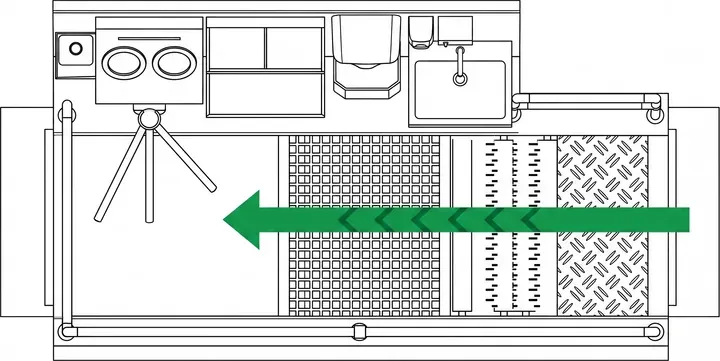
Making hygiene transit auditable
Auditable transit systems that prevent skipped hygiene steps via turnstile locks, counters and sensors.
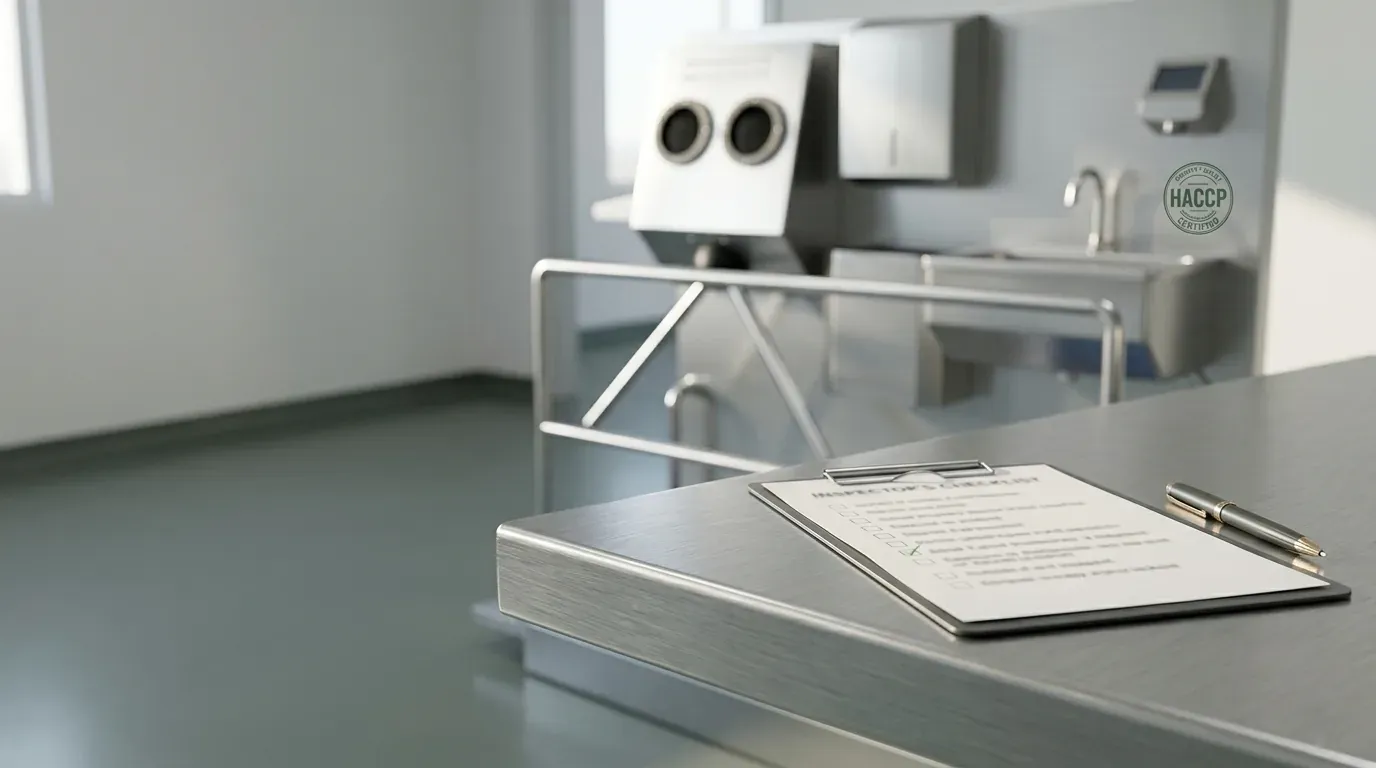
Making a hygiene passage auditable means being able to prove that every employee completed the hand washing and disinfection steps without skipping any. Three elements make this possible: a turnstile lock (interlock) that does not open until the steps are verified, counters that tally every passage and every dose, and sensors that see that the steps were actually performed. Working together, they take hygiene out of the realm of a "done" claim and turn it into concrete records that can be shown in HACCP, BRCGS and IFS audits. In this article we explain, from a manufacturer’s perspective, the technical logic of auditability and how it produces evidence during an audit.
What does an auditable hygiene passage mean?
An auditable hygiene passage is a passage arrangement in which the hygiene steps an employee performs to enter the clean area turn into a record that can be shown afterwards. An ordinary hygiene station only provides the means — the washbasin is there, the disinfectant is there, but whether they were used is uncertain. An auditable passage does two things at once: it physically blocks passage until the steps are completed, and it converts every completed step into time-stamped data.
The difference lies in the core question of food safety management: it is not enough for a control simply to exist, it must be proven to work. The auditor does not ask "do you provide a means of hand washing?" but "how do you show that this means is used on every shift?" An auditable passage is designed to produce an answer to this second question.
What is valuable in an audit is not that hygiene exists, but that it can be proven to have been applied at every passage.
How does the system prevent skipped steps?
The mechanism that prevents skipped steps is called interlock (locked, enforced routing). The turnstile is normally locked and releases a single turn only when the hygiene steps are verified by sensors. In other words, even if the employee says "I did it", the system does not allow passage without seeing the steps actually completed. This is the fundamental distinction between a door that leaves hygiene to the individual’s discipline and a barrier that ties every passage to the same standard. We cover the details of the interlock logic in our how a hygiene barrier works article.
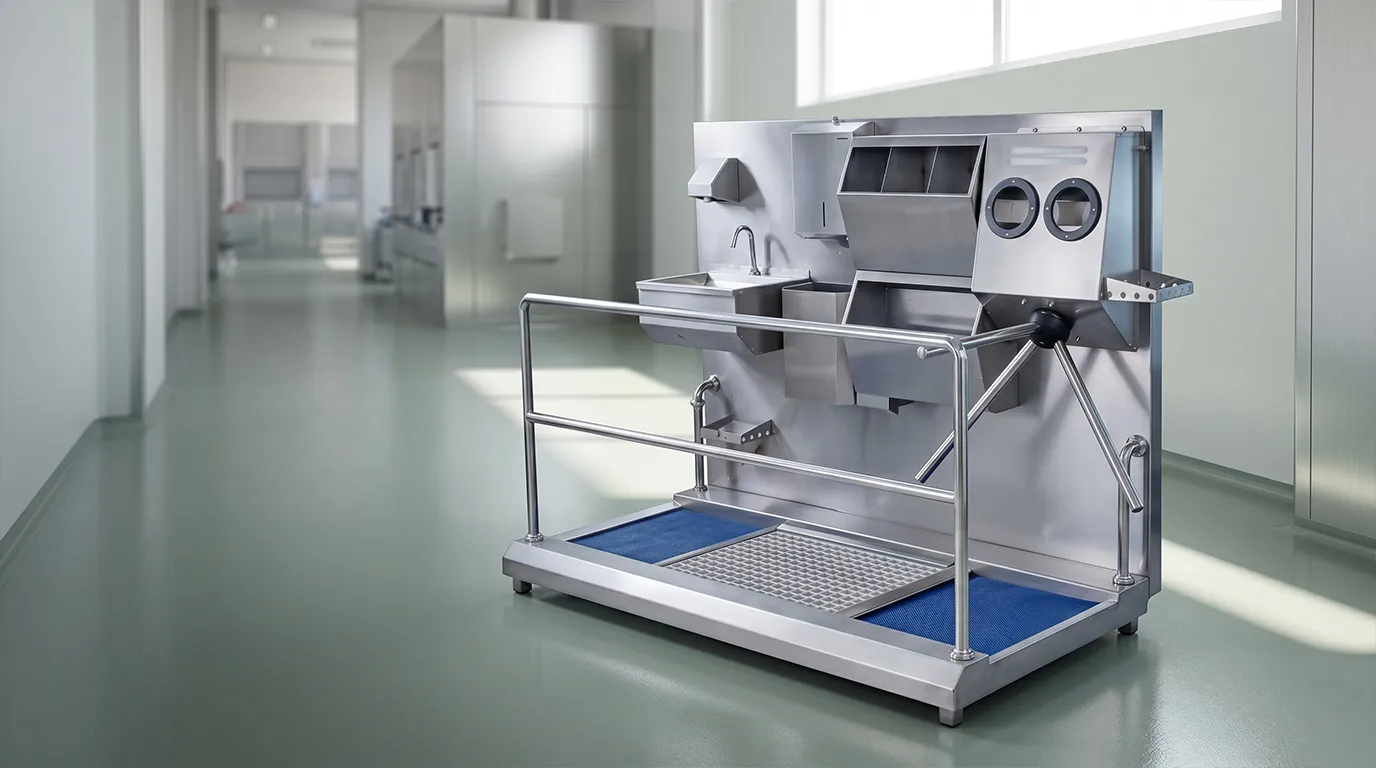
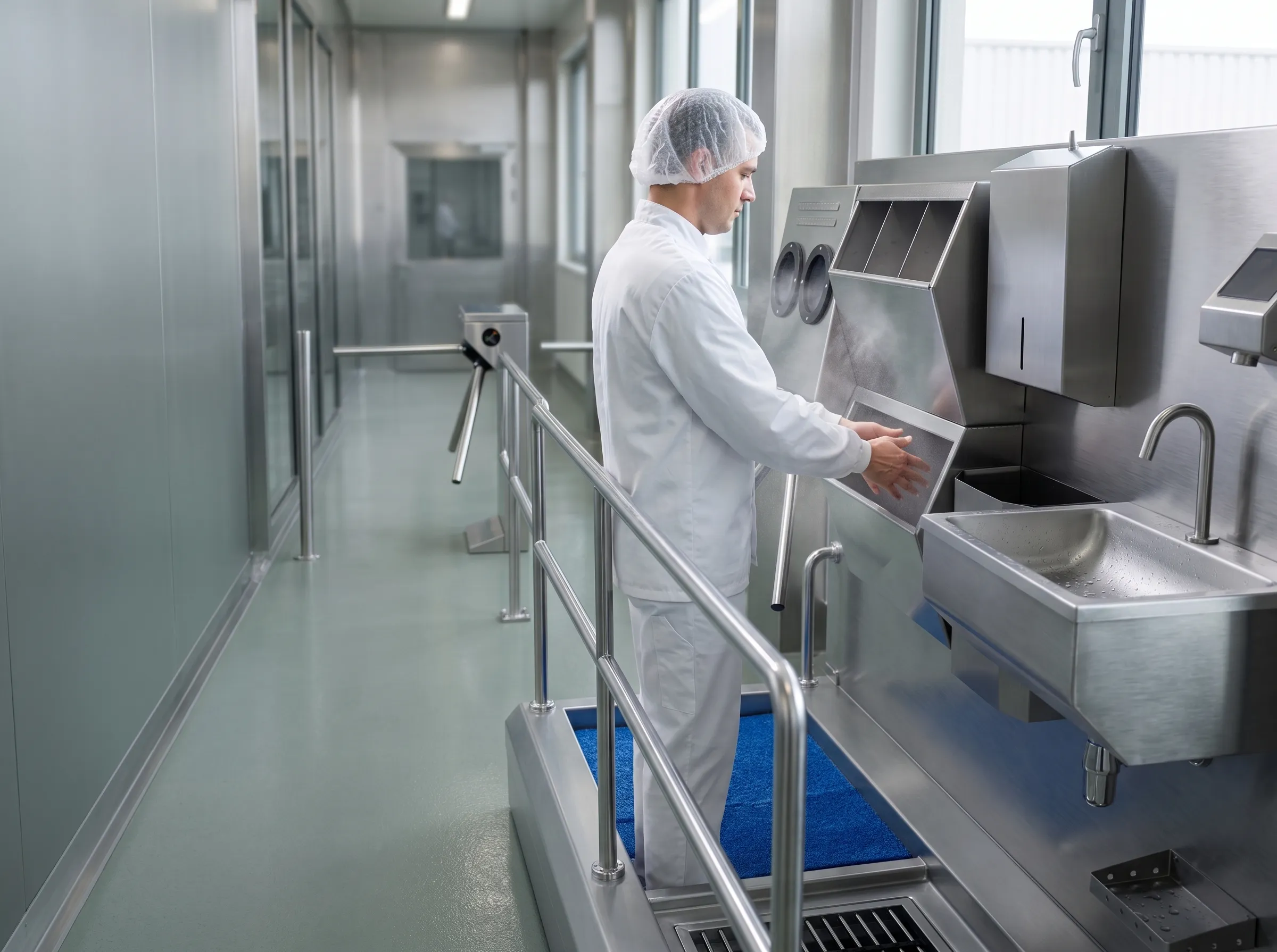
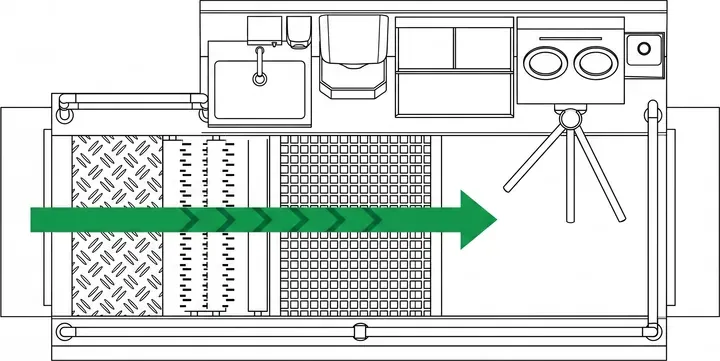
In a typical auditable passage the steps follow this order; each step depends on the previous one, and if a step is missing the turnstile stays locked:
- 1The employee approaches the unit; if present, identity is read via a card/reader and the passage is linked to the person.
- 2Hands are washed at the sensor-operated tap; the soap dose is logged by a counter.
- 3Hand disinfection is applied from a touchless unit; each dose generates a separate signal.
- 4Where required, the boot washing or disinfection step is verified.
- 5The control board/PLC confirms that all steps are complete; the turnstile unlocks and the employee passes in one direction.
- 6The moment of passage (person, time, direction) is logged as a passage record.
Passage is usually one-way: uncontrolled back-flow from the clean area to the dirty area is also prevented. This both reduces cross-contamination and keeps the passage count consistent — an employee is counted on entry and processed via a separate door/direction on exit.
Which data can be recorded?
The level of auditability varies with the unit’s depth of automation and integration. At the most basic level, even a mechanical turn counter answers the question "how many passages were there"; in more advanced setups, every hygiene step can be recorded individually. The commonly tracked data are:
- Passage count — the total number of people through the turnstile; per shift or per day.
- Time stamp — the date and time of each passage; peak hours and start-of-shift build-up become visible.
- Dose count — how many times the soap and disinfectant units were triggered; compared against the passage count.
- Person identity — if a card/reader is present, the passage is linked to a specific employee (who passed, and when).
- Blocked/incomplete passage attempts — events where the turnstile did not open because a step was skipped can leave a trace on the appropriate hardware.
The power of this data comes from the fact that it can be compared against itself. For example, consistency between the passage count and the disinfectant dose count within a shift gives a practical indicator that steps were not skipped; a large gap between the two points to a deviation that needs to be investigated.
The table above is an illustrative framework; the actual configuration is determined by the facility’s audit expectation, existing access-control infrastructure and budget. For most SME-scale food facilities, the counter + time-stamp level is more than adequate for an audit; card integration is meaningful for facilities that require person-level traceability.
How do these records become evidence in an audit?
These records become evidence in an audit because the shared expectation of food safety standards is "documenting the practice". No standard requires a hygiene barrier as a named device; however, they all require personnel hygiene as a prerequisite programme (PRP) and expect records showing that these prerequisites are monitored and that corrective action is taken when a deviation occurs. The turnstile counter and dosing logs produce this monitoring evidence systematically, without relying on manual forms.
In the HACCP approach, personnel hygiene is part of good hygiene practices (GHP) and is expected to be monitored. ISO 22000 and ISO/TS 22002-1, which details the prerequisites for food manufacturing, explicitly address personnel hygiene facilities and hand washing provisions; the standard also requires that monitoring and verification activities be recorded. In GFSI-recognised standards such as BRCGS and IFS Food, the essence of the audit is the integrity of the records kept: a missing or blank monitoring record is among the most frequently seen types of non-conformity. This is exactly where an automatic passage record leaves a far more reliable trail than manual sign-off sheets.
- Consistent record — passages are logged systematically, without depending on human error and forgetfulness.
- Deviation visibility — comparing passage and dosing data surfaces the points requiring corrective action early.
- Trend analysis — passage intensity per shift reveals capacity and queuing problems with data.
- Audit readiness — the evidence to show the auditor is already accumulated, rather than being scrambled for on audit day.
We address the standard-by-standard expectations in detail in our HACCP and the personnel hygiene station, ISO 22000 and personnel entrance hygiene, BRCGS personnel hygiene requirements and hand hygiene and entrance control in IFS Food articles.
What to watch for when setting up an auditable passage?
Auditability should not be bought with hardware and left at that; the system producing reliable evidence depends on a few practical conditions. Review these points during installation and selection:
- Sensor protection — in a washdown environment the sensors must withstand wetness and pressurised water; the IP69K protection class is decisive here.
- Lanes matched to capacity — if a queue forms at the start of a shift, personnel tend to bypass the system; the right capacity and number of lanes preserves auditability.
- Data ownership — where the record is written, how long it is retained and how it will be reported must be clear from the outset.
- Reducing bypass risk — if side doors and alternative entrances are not brought under control, the record stays incomplete.
- Compatibility with existing infrastructure — the turnstile’s ability to connect to the existing access-control or time-and-attendance system via an interface such as dry contact/RS-485.
If a person-level passage record is to be kept, this is a personal-data processing activity; employees must be informed and the data must be retained for a limited time and purpose. For scope and implementation, follow your facility’s data-protection/compliance process.
Conclusion
An auditable hygiene passage arises from the combination of three simple ideas: a lock that does not open until the steps are done, a counter that tallies every passage and every dose, and sensors that see the steps. This combination takes hygiene out of the realm of a "done" claim and turns it into a systematic record that can be shown in HACCP, ISO 22000, BRCGS and IFS audits. We can determine together the auditability level suited to your facility’s audit expectation and existing infrastructure, and you can request a quote for the right configuration.
Frequently asked questions
What is the difference between an auditable hygiene passage and an ordinary hygiene station?
An ordinary station only provides the means; whether it was used is uncertain. An auditable passage, on the other hand, does not open the turnstile until the steps are completed and converts the completed steps into a time-stamped record. This way, that hygiene was applied can be proven afterwards.
Does the turnstile lock really prevent skipped steps?
Yes. In the logic called interlock, the turnstile is normally locked and releases a single turn only when the hygiene steps are verified by sensors. If the employee skips a step, the turnstile stays locked and no passage takes place; passage is usually one-way.
Can the system keep person-level information on who passed?
When a card reader or similar identity recognition is added, yes — every passage can be linked to a person, date and time. Because this means personal-data processing, employees must be informed and the data must be retained for a limited purpose.
Are these records accepted in a HACCP or BRC audit?
The standards do not require a specific device; however, they expect records showing that personnel hygiene is monitored. Automatic passage and dosing records offer more consistent monitoring evidence than manual sign-off sheets and can be shown for this purpose during an audit.
What is enough for the simplest auditability?
Even a mechanical turn counter gives the total passage count. One step beyond that is a time-stamped electronic counter and dosing signals; this level is more than adequate for an audit in most SME-scale food facilities. Card integration is added only if person-level traceability is required.
Will it connect to my existing time-and-attendance or access-control system?
Usually yes. Hygiene turnstiles can be integrated into existing access-control or time-and-attendance systems via common interfaces such as dry contact, RS-485 or Wiegand. Compatibility is engineered according to the existing hardware at the facility.