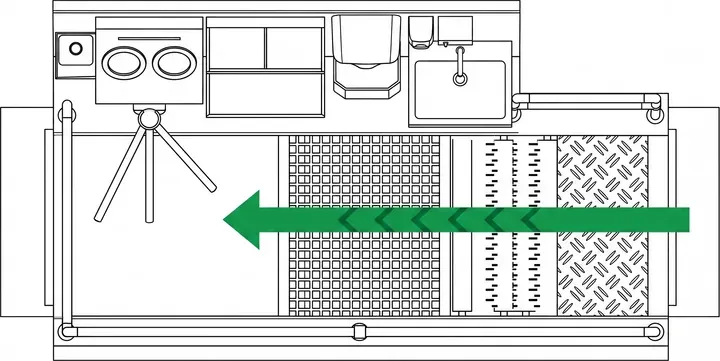
Tripod or flap turnstile?
Tripod vs flap turnstile in a hygiene barrier: throughput, safety and hygiene compared.
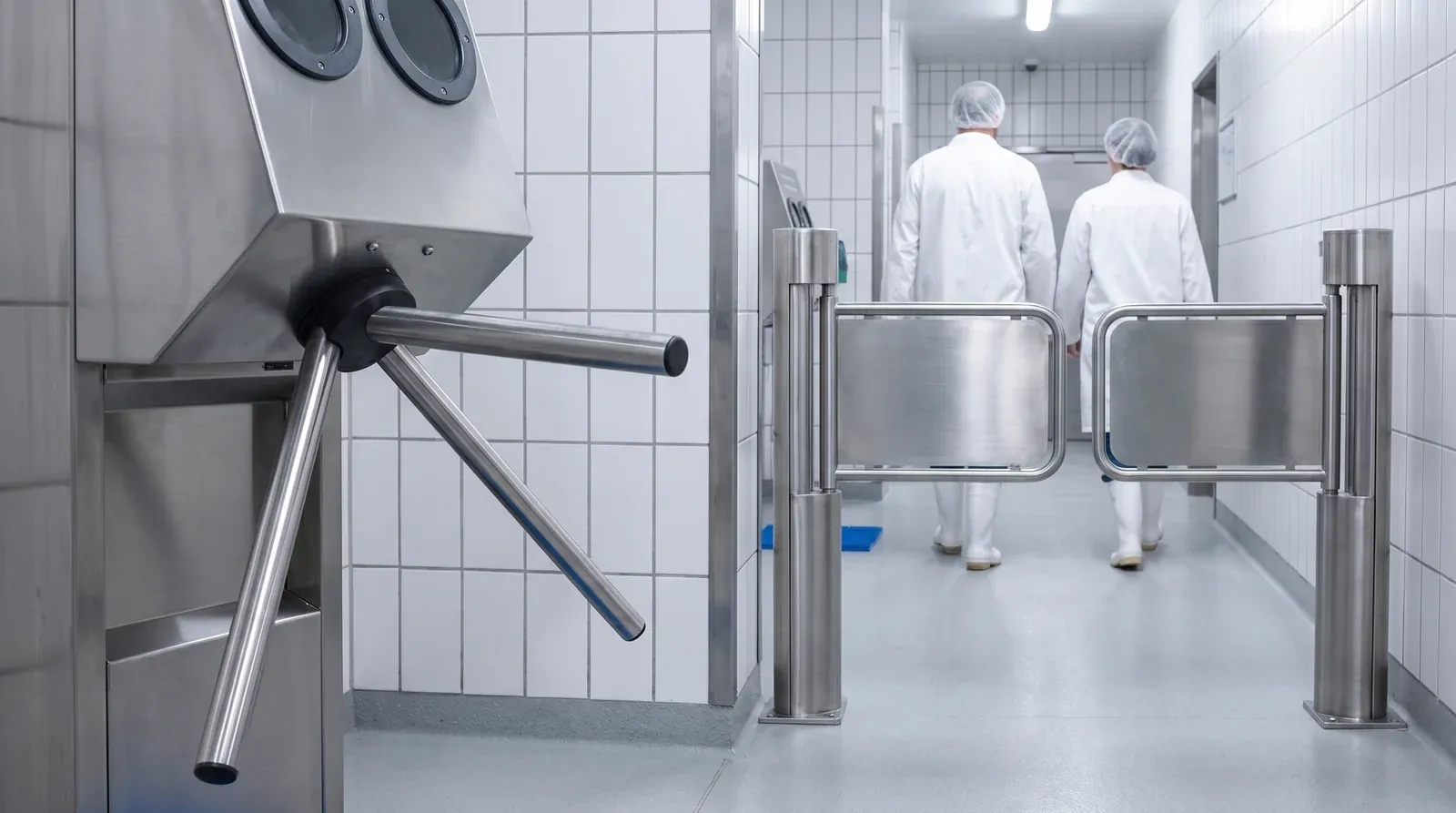
In most facilities, the preferred choice for a hygiene barrier is the tripod turnstile: it integrates with the stainless steel body, withstands wet, washdown environments, costs less and, when power is lost, its arm drops to clear the way for evacuation. The flap turnstile, on the other hand, offers higher throughput and a wider passage width, which makes it stand out at entrances with heavy shift flow, wet boot traffic or wheeled access requirements. In this article we compare the two turnstile types in terms of throughput, safety (emergency egress), hygiene, cost and footprint, and clarify which one suits which scenario.
What is the difference between a tripod and a flap turnstile?
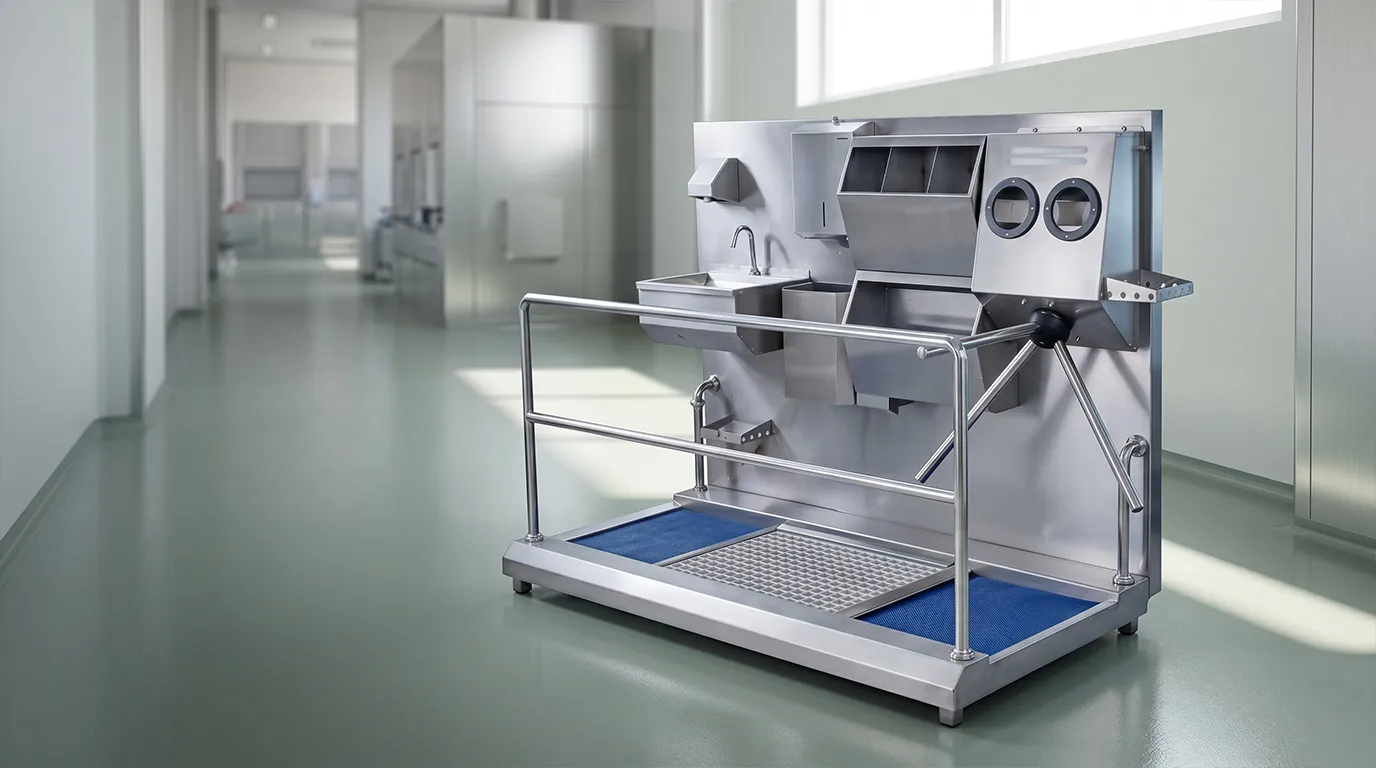
The fundamental difference lies in the mechanism that stops the passage: a tripod turnstile uses a three-armed rotating hub at waist height (usually Ø38 mm stainless steel), while a flap turnstile blocks the way with wings that open and close from the cabinet. The tripod is a compact, mechanically simple and economical passage; the employee pushes the arm and people pass one at a time. The flap, with its motorized wings, provides a smoother, wider and higher-capacity passage, but is more complex and more costly.
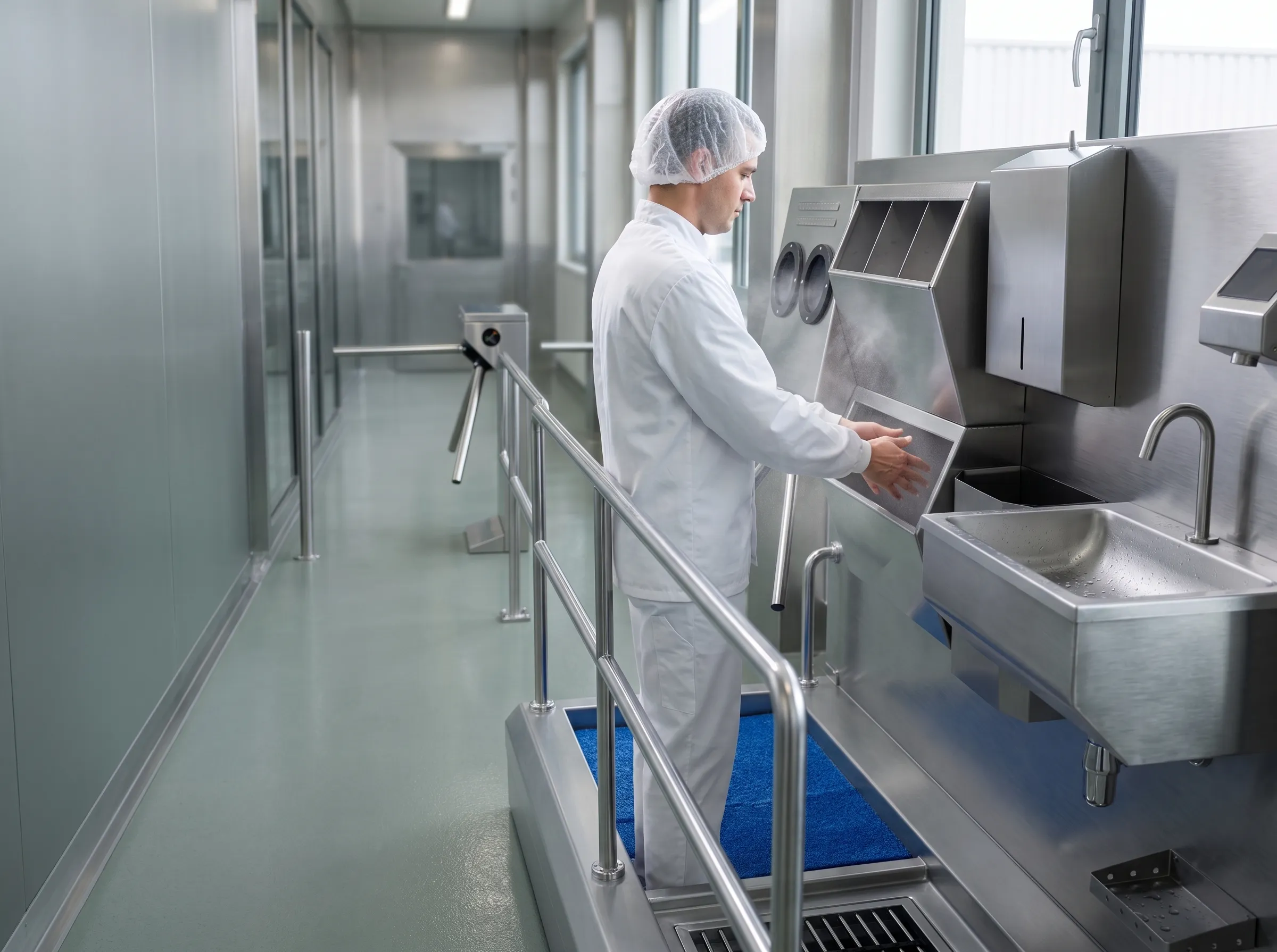
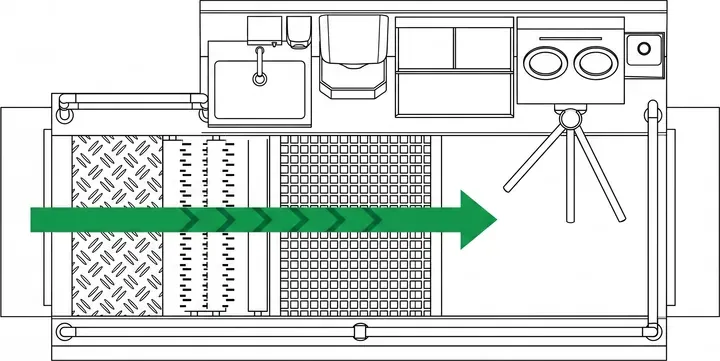
In the hygiene barrier context this difference becomes critical: the turnstile is the key component that determines how a hygiene barrier works. The turnstile stays locked until the hand washing and disinfection steps are completed (interlock logic); the right turnstile type directly affects both the throughput and the auditability of the passage.
Which one has higher throughput?
On throughput, the flap turnstile leads. A single-lane tripod turnstile typically lets through about 25–40 people per minute; semi-automatic models (where the employee pushes the arm) sit at the lower end, fully automatic models at the upper end. A flap turnstile, thanks to its motorized wings, can typically reach about 30–60 people per minute. In practice, the real bottleneck in a hygiene barrier is not the turnstile itself but the duration of the hand washing and disinfection steps — so raw turnstile throughput alone can be misleading.
When an employee washes, dries and disinfects their hands properly, a single passage can take 15–25 seconds. In that case, switching the turnstile from tripod to flap does not shorten the queue; the solution is usually to add a parallel lane (double line). We calculate how many lanes and what capacity are required in our what capacity hygiene barrier do you need article.
Which one is safer in an emergency evacuation?
Both can provide safe passage in an emergency when configured correctly, but their mechanisms differ. In a fire alarm or a power failure, the tripod turnstile’s arm drops to the horizontal position (drop-arm) once the electromagnet holding it loses power, and the way is clear. In a flap turnstile, when the motor drive is released the wings retract into the cabinet via a spring-return mechanism and the lane opens to its full width. Both types can be ordered to operate in "fail-safe" mode when this feature is requested.
An important distinction: fail-safe (opens when power is lost) is for evacuation compliance; fail-secure (locks when power is lost) is for high-security restricted zones. For most food and pharmaceutical personnel entrances, a turnstile located on the evacuation route is expected to be specified as fail-safe. This is a design decision independent of the turnstile type and must be compatible with your fire escape plan.
Which one is more suitable in terms of hygiene?
In the hygiene barrier context, the tripod turnstile is usually the more suitable choice. The tripod’s body and arm are typically made of AISI 304 stainless steel; its non-porous, washable and corrosion-resistant surface stands up far better to wet, disinfectant-based cleaning. Flap turnstiles, by contrast, often come with glass or acrylic wings and more delicate motor/sensor electronics; these components are not as resistant to an intensive washdown regime and constant humidity as a tripod.
Truly touchless hygiene comes less from the turnstile type than from the control logic: the passage opens automatically when the hand washing and disinfection steps are verified by sensors, without the employee touching the turnstile. Even so, the body material and protection class matter — in washdown areas, high protection (for example IP69K-rated components) is preferred. We detail this in our what is IP69K and 304 or 316 articles.
Tripod vs flap turnstile comparison table
The table below summarises the two types in the hygiene barrier context, by the main decision criteria. The values are typical ranges; actual figures vary by model, automation level and configuration.
How big is the difference in cost and footprint?
On cost and footprint, the tripod turnstile has the advantage. Because the tripod is mechanically simpler, both the initial investment and the maintenance cost are low; its compact cabinet also fits narrow entrances. The flap turnstile, with its motorized wings, sensors and usually longer cabinet body, is a more expensive solution that takes up more space. In a hygiene barrier, the total budget is determined not by the turnstile alone but by the washbasin, boot cleaning and the number of lanes.
The turnstile type is only one of the many items that affect the total price. We cover all the factors that determine the price in our factors affecting the price of a hygiene barrier article, and your model options in our hygiene barrier types and models article.
Which one should you choose for a hygiene barrier, and when?
The short rule: for the vast majority of standard food and pharmaceutical personnel entrances, the tripod turnstile is the right choice; the flap turnstile is considered when special needs such as high throughput, a wide passage or wheeled access dominate.
Choose a tripod turnstile when
- The environment is wet, disinfectant-laden and intensively washed down (stainless durability is the priority).
- The budget and maintenance cost need to be kept low.
- The entrance area is narrow and a compact solution is required.
- The passage speed is determined by the duration of the hygiene steps, not by the turnstile.
Consider a flap turnstile when
- A very heavy, fast flow and high throughput are needed at the start of a shift.
- There is a need for a wide passage, wet/dirty boot traffic or wheeled/vehicle access.
- A smoother, touch-free, modern passage experience is your priority.
- A suitable protection class (high IP) can be provided to protect the electronics and the wings.
The right turnstile is not the most expensive one; it is the one best suited to the facility’s flow, wetness and evacuation plan.
Conclusion
Tripod and flap turnstiles do the same job — tying passage to the hygiene step — with different trade-offs. The tripod, with its low cost, compact build, stainless durability and drop-arm, is the default and safe choice for most hygiene barriers. The flap comes into play when high throughput, a wide passage and a modern flow are wanted. The turnstile type should be evaluated not on its own but together with the washbasin, boot cleaning, number of lanes and evacuation plan. For the right choice, see our 10 critical points when buying a hygiene barrier article; let us determine the most suitable configuration for your facility together and provide a quote.
Frequently asked questions
Is a tripod or a flap turnstile better in a hygiene barrier?
In most standard food and pharmaceutical personnel entrances, the tripod turnstile is better: with its stainless steel body it withstands the wet/washdown environment, and it is economical and compact. The flap turnstile stands out for special needs such as high throughput, a wide passage or wheeled access.
How much faster is a flap turnstile than a tripod?
A single-lane tripod typically lets through about 25–40 people per minute, a flap turnstile about 30–60. In a hygiene barrier, however, the real speed usually depends on the duration of hand washing and disinfection; so the most effective way to shorten the queue is often to add a parallel lane.
How does turnstile passage open in an emergency?
In a fire alarm or a power failure, on a turnstile configured fail-safe, the tripod’s arm drops to the horizontal position; on a flap unit, the wings retract into the cabinet and the lane opens to its full width. A turnstile on the evacuation route is expected to be specified fail-safe, in line with your fire escape plan.
Is it possible to pass without touching the turnstile?
Yes. Touchless passage comes less from the turnstile type than from the control logic: when the hand washing and disinfection steps are verified by sensors, the turnstile opens automatically and the employee passes without touching the arm. In washdown areas the body material (AISI 304) and a high protection class (such as IP69K) become important.
What material is a tripod turnstile made of?
In hygiene applications, the body and arm of a tripod turnstile are typically made of AISI 304 stainless steel. Its non-porous, corrosion-resistant and washable surface suits disinfectant-based, humid cleaning; this gives it an advantage in wet environments over flap turnstiles with glass/acrylic wings.
Is a flap turnstile suitable for a food facility?
It can be, but care is needed. A flap turnstile’s glass/acrylic wings and delicate electronics are not as resistant to an intensive washdown regime as a tripod. If a flap is chosen for reasons such as high throughput or a wide passage, it is important to provide measures such as a protection class suited to the wet environment and a stainless body.