BRCGS personnel hygiene
Personnel hygiene, handwashing and entry-control expectations in the BRCGS food safety standard.
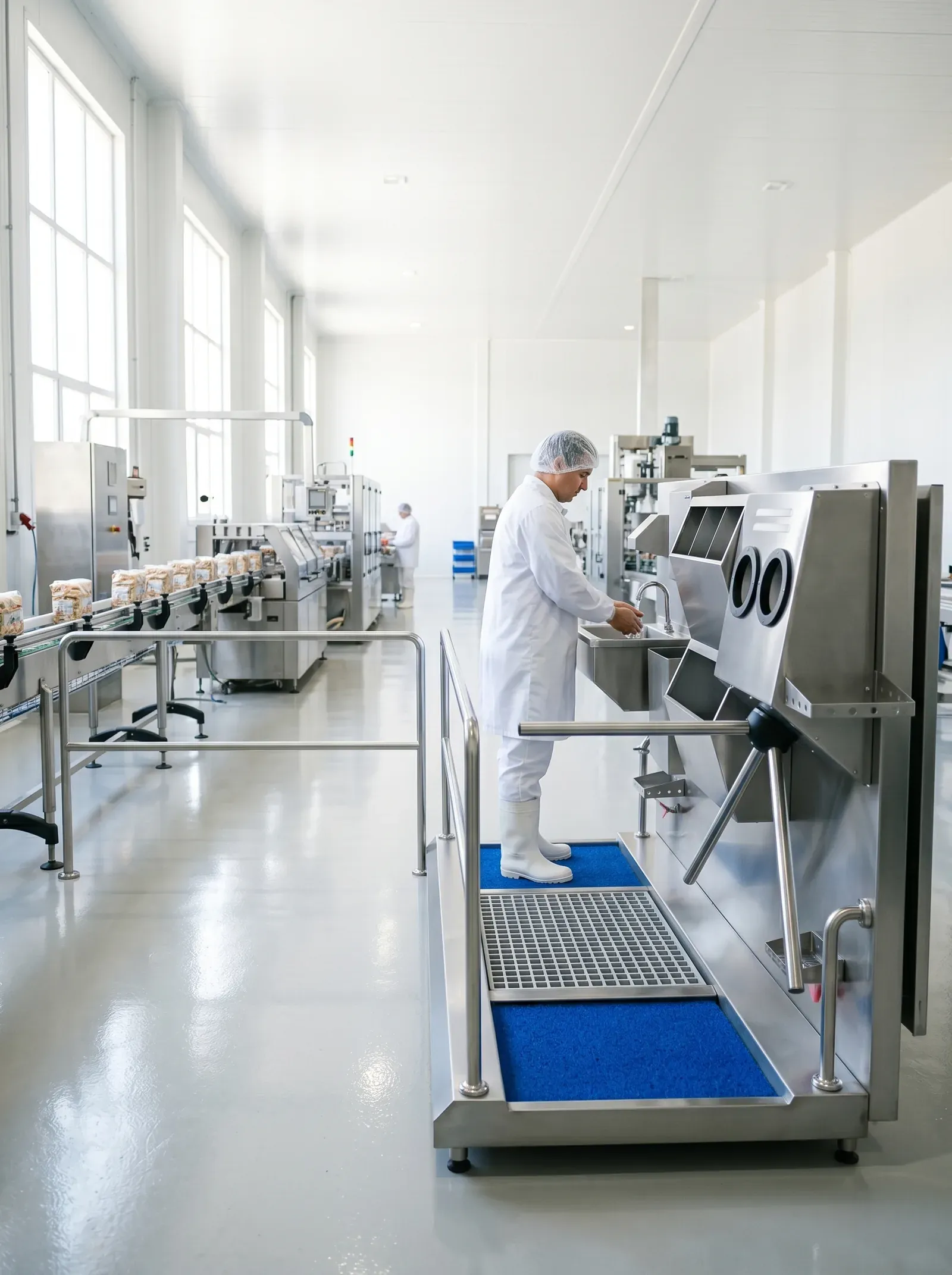
The BRCGS Food Safety Standard treats personnel hygiene not as an option but as a mandatory control: everyone entering the site — including the company’s own staff, contractors and visitors — is expected to wash their hands, put on the required protective clothing and complete additional hygiene steps before passing into the production area or entering high-risk zones. The standard does not require a device called a "hygiene barrier" by name; however, it does require the means for hand washing/disinfection, entry control and proof that these are applied in an auditable way. In this article we explain, from a manufacturer’s perspective, what BRCGS expects for personnel hygiene, what auditors look for and how a hygiene access unit turns these expectations into concrete evidence.
What is BRCGS, and is it the same as BRC?
BRCGS and BRC are two names for the same standard; "BRC" is the former name of what is today called BRCGS. The standard was developed by the British Retail Consortium; the first food safety standard was published in 1998 and was renamed BRCGS (Brand Reputation Compliance Global Standards) in 2019. Today the BRCGS Food Safety Standard is applied at tens of thousands of sites in more than 130 countries and is one of the certification programmes recognised by GFSI (Global Food Safety Initiative).
In practice, GFSI recognition means this: BRCGS shares the same core expectations as the other GFSI standards such as ISO 22000 + FSSC 22000, IFS Food and SQF. That is why the personnel hygiene requirements largely overlap; reading this alongside our ISO 22000 personnel entrance hygiene and IFS Food hand hygiene and entry control articles shows that the same infrastructure works whichever standard you are targeting.
What does BRCGS require for personnel hygiene?
BRCGS gathers personnel hygiene in a dedicated section (under the Personnel heading) and requires documented hygiene rules, communicated to all staff, designed to minimise the risk of product contamination from personnel. These rules cover not only permanent staff but also contractor employees, temporary/agency personnel and visitors. The topics the standard typically addresses under its personnel hygiene heading are:
- Hand washing and hygiene — hand washing at the entrance to the production area and hand disinfection where needed; stations in the right location, in sufficient numbers and with the right equipment.
- Protective clothing — a hairnet, a snood for beards, clean work clothes and dedicated footwear where required; keeping the clothing clean and using it correctly.
- Jewellery and personal items — jewellery restrictions (typically only a plain wedding band and medical alert bracelets); a ban on smartwatches/wearables, and rules on fingernails and perfume.
- Health screening — declaration of infectious diseases on hiring and on return to work; keeping sick personnel away from production.
- Training and application — having the rules in writing, teaching them to everyone and verifying that they are actually applied on the floor.
A BRCGS auditor wants to see what happens on the floor, not your procedure file. An instruction that says "hands shall be washed" is not enough on its own; the auditor wants to see that everyone actually washes on every shift, and that you can prove it.
Where and how does BRCGS require hand washing?
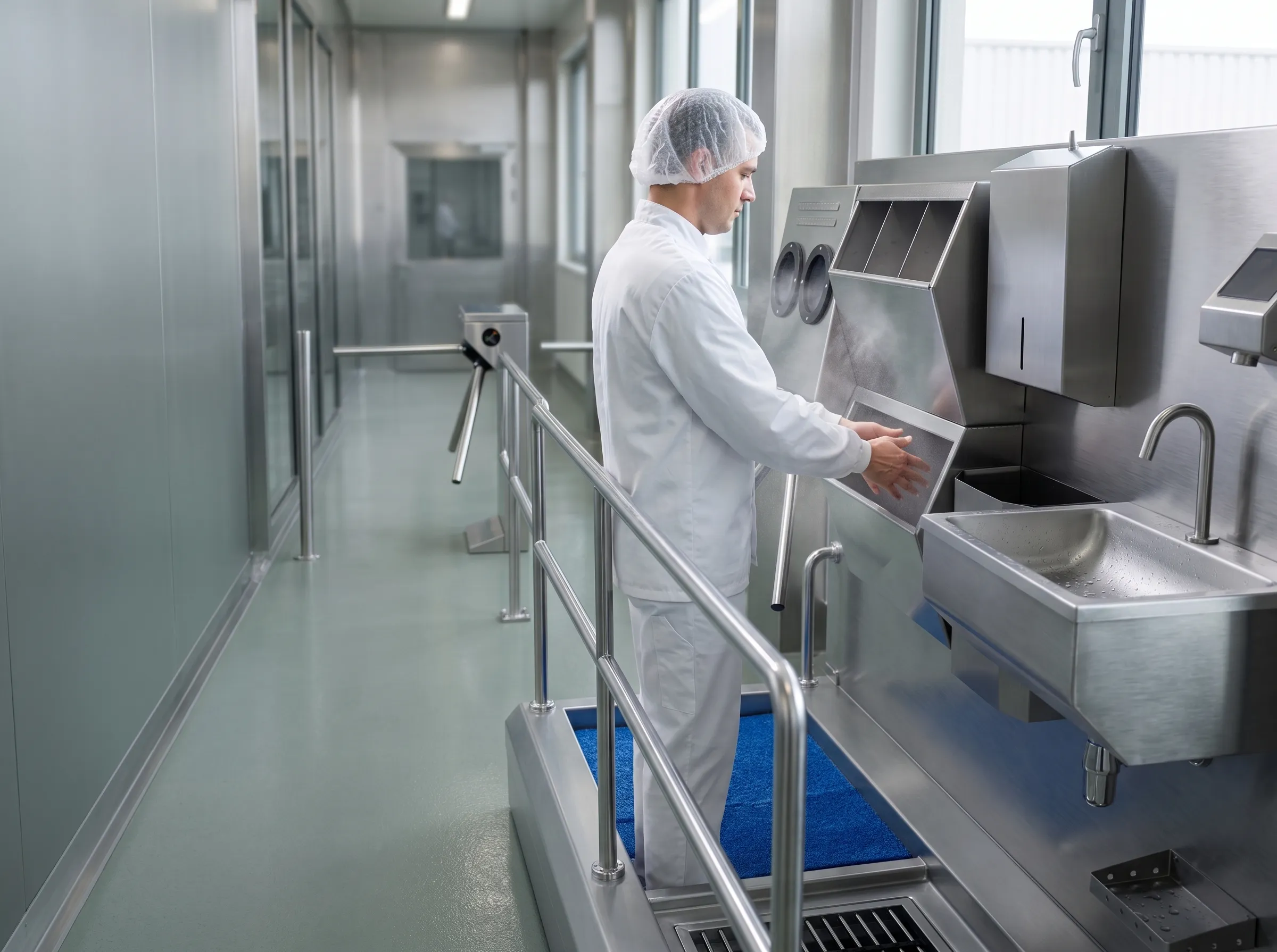
BRCGS requires hand washing to take place at the entrance to the production area and to be repeated at a frequency that minimises the contamination risk. Hand washing stations must be positioned at the entry point so that personnel cannot bypass the unit, and must be supported with the right equipment (hot/warm water, liquid soap, touchless drying and a disinfectant where required). Because wet hands reduce the effectiveness of the disinfectant, the drying step must not be skipped.
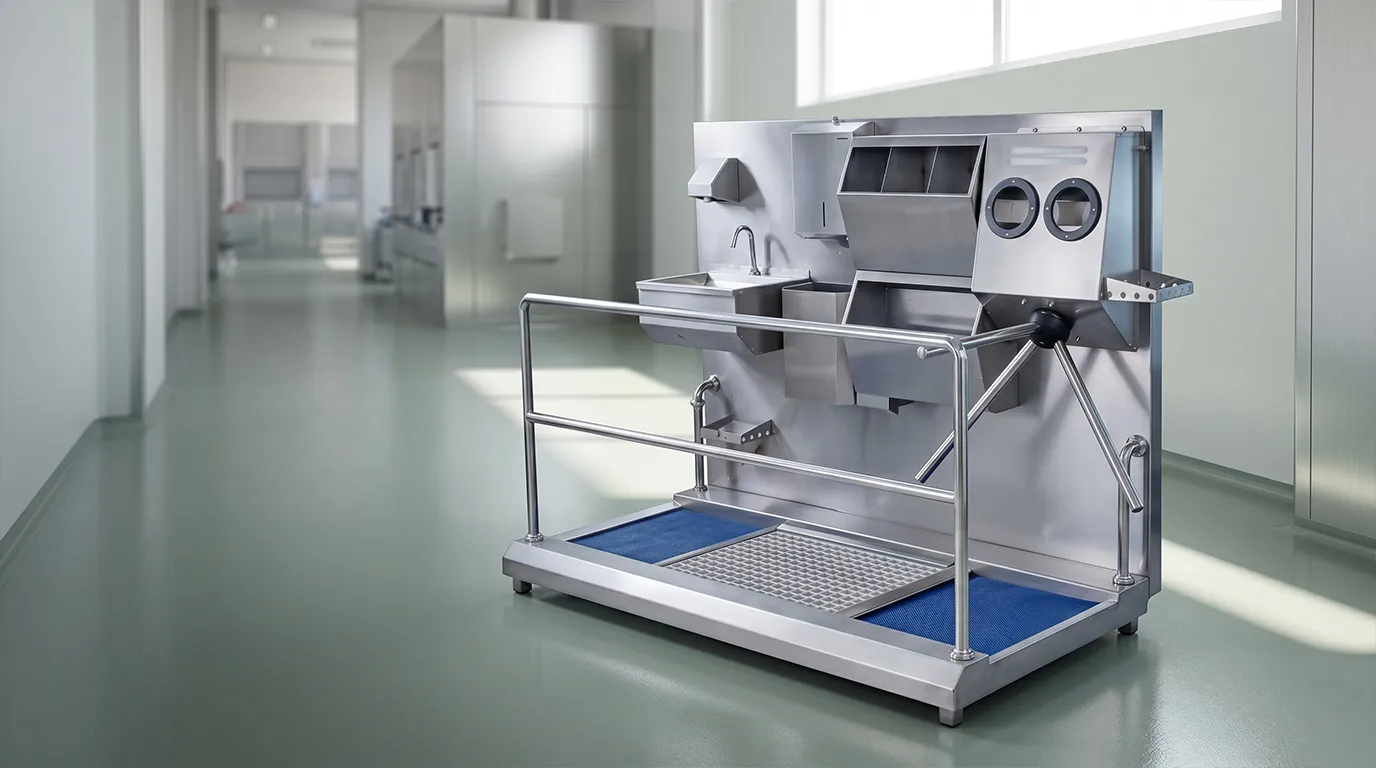
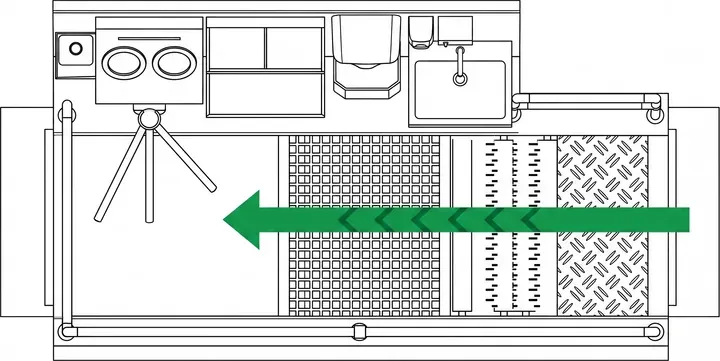
For a hand washing station to meet the BRCGS expectation, it should combine the following equipment. This is also the standard component list of a hygiene access unit — we detail which components a hygiene barrier consists of in a separate article:
- Touchless (photocell) tap — prevents recontamination from hand contact.
- Liquid soap unit — dosed, refillable and cleanable.
- Hygienic drying — paper towels or a touchless hand dryer; not textile towels.
- Hand disinfection unit — touchless, automatic-dosing; after washing, in areas where required.
- Washable, non-porous surface — typically
AISI 304stainless steel; does not harbour bacteria and withstands caustic cleaning.
The surface material itself is part of hygiene: a non-porous, corrosion-resistant surface is both easy to clean and leaves a positive impression in an audit. We cover why hygiene equipment is predominantly made of 304, with the technical rationale, in our 304 or 316 — choosing the hygiene steel article.
What changes in high-risk and high-care areas?
BRCGS divides production areas into zones by risk level and imposes stricter rules for personnel entry into high-risk and high-care areas. The basic logic is this: the hygiene step must be completed before entering the risk area, and the clean zone must be physically separated from the low-risk zone. In these areas the typical expectations are:
- Separate changing and passage layout — the high-risk area is separated from the low-risk area; clothing and footwear changes take place at a controlled passage.
- Footwear control — preferably area-dedicated (captive) clean footwear; in exceptional cases, a boot washing arrangement at the entrance.
- Location of washing + disinfection — hand washing and disinfection are positioned immediately before entry into the high-risk area.
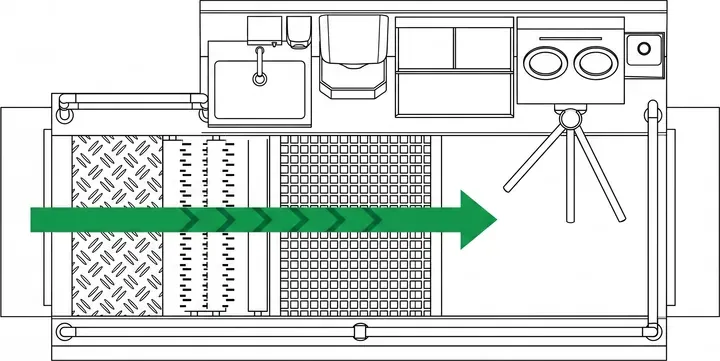
- One-way, controlled flow — personnel pass through a single point only after completing the hygiene steps.
Boot cleaning becomes critical at this point. We compare which of the boot-brush (mechanical) and footbath (disinfectant) methods suits your facility in our boot washing: boot-brush or footbath article. In facilities with a high organic load such as meat, poultry and seafood, the rigour of this step matters even more — you can look at the hygiene barrier in meat processing plants application in a separate article.
How does a hygiene barrier become evidence in a BRCGS audit?
In a BRCGS audit, a hygiene access unit is a concrete, visible control point showing that the personnel hygiene requirements are actually applied. The standard does not name a device; but on the floor the auditor looks for the answer to the question "how is hygiene enforced, and how is it proven?". A turnstile-equipped hygiene barrier answers this question directly, because:
- It makes hygiene mandatory — the turnstile does not open until the steps are completed; passage is tied to the step actually performed, not to a declaration.
- It ensures consistency — every employee follows the same sequence on every shift; person-dependent variability disappears.
- It produces records — with counter and sensor integration, passages can be logged, which is data that can be presented in an audit.
- It channels the flow through a single point — one controlled entrance instead of an uncontrolled side door; the cross-contamination route is closed.
A BRCGS audit audits behaviour, not documents. A hygiene barrier embeds the correct behaviour into the facility and produces its evidence automatically.
This is the concrete counterpart of the “auditability” principle. We detail why making passage traceable through records is so valuable in our making hygiene passage auditable article, and the general logic in our stopping contamination at the entrance article.
BRCGS personnel hygiene readiness checklist
The checklist below provides a quick self-assessment when preparing for a BRCGS audit from a personnel-entrance standpoint. Verify each item on the floor — not at the desk:
- There is a hand washing station at the entrance to the production area, in the right location (it cannot be bypassed).
- The station has a touchless tap, liquid soap, hygienic drying and, where required, a disinfectant together.
- At the entrance to the high-risk/high-care area, washing + disinfection is positioned before entering the area.
- Footwear control is defined: area-dedicated clean footwear, or boot washing at the entrance.
- Protective clothing (hairnet, snood, clean apron) is tied to the entry sequence and is applied.
- The rules are documented and communicated to everyone, including contractors, agency personnel and visitors.
- Passage is one-way and controlled; there is no uncontrolled side entrance.
- There is evidence of application: counter/sensor records, training records or an observation document.
This list focuses on the personnel entrance; if you want to broaden the scope, our 10 critical points when buying a hygiene barrier and how to choose a hygiene barrier guide articles address equipment selection together with the standard’s expectations.
Why is the right capacity part of BRCGS compliance?
Because insufficient capacity leads to hygiene rules being broken. When dozens of people pile up at the entrance at the same time at the start of a shift, a single narrow station creates a queue; as the queue lengthens, personnel start to shorten or skip steps. From the BRCGS standpoint this is a “there is a written rule but it is not being applied” situation, and it results in a non-conformity. That is why the number of stations and turnstiles must be sized according to the busiest shift flow.
The values in the table are examples; the actual need depends on the number of personnel, the shift structure and the duration of the hygiene steps. You can calculate how many lanes your facility needs using the approach in our how many people a hygiene barrier must serve article.
Conclusion
BRCGS wants personnel hygiene as a concrete, documented control that is applied on the floor; it ties hand washing and disinfection to the entrance of the production area, tightens the rules in high-risk areas and expects proof that everything is genuinely applied. Although it does not require a device called a “hygiene barrier” by name, a turnstile-equipped hygiene access unit meets all of these expectations at a single auditable point: it makes hygiene mandatory, makes it consistent and produces records that can be shown in an audit. We can plan together how to set up your facility’s entrance hygiene in line with BRCGS expectations.
Frequently asked questions
Is a hygiene barrier mandatory for BRCGS?
No; BRCGS does not require purchasing a device called a “hygiene barrier” by that name. However, it does require the means for hand washing/disinfection, protective clothing, entry control at the entrance to the production area, and proof that these are actually applied. A turnstile-equipped hygiene access unit is preferred because it meets these expectations in the most auditable way.
Is there a difference between BRCGS and BRC?
They are two names for the same standard. “BRC” (British Retail Consortium) is the former name; the standard was renamed BRCGS (Brand Reputation Compliance Global Standards) in 2019. The content and audit logic are continuous; the current version is the BRCGS Food Safety Standard.
Where does BRCGS require hand washing?
Hand washing must take place at the entrance to the production area and at a frequency that minimises the contamination risk. The station is positioned at the entry point where personnel cannot bypass it; a touchless tap, liquid soap, hygienic drying and, where required, a disinfectant are provided together. In high-risk areas, washing and disinfection are positioned before entering the area.
Do the BRCGS personnel hygiene rules also cover visitors and contractors?
Yes. In addition to permanent staff, the BRCGS personnel hygiene rules also cover contractor employees, temporary/agency personnel and visitors entering the production area. Everyone following the same hand washing and protective-clothing rules is a point frequently checked in an audit.
How should personnel entry into high-risk areas work?
High-risk and high-care areas must be separated from the low-risk zone; hand washing and disinfection must take place before entering the area. Footwear control is provided preferably with area-dedicated clean footwear, or in exceptional cases with boot washing at the entrance, and the flow must be one-way and controlled.
Is a hygiene barrier useful in a BRCGS audit?
Yes. A turnstile-equipped hygiene barrier does not allow passage until the hygiene steps are completed, and with counter/sensor integration it can log passages. This directly meets the “the rule is applied on the floor and can be proven” situation the auditor is looking for; it turns personnel hygiene into a visible and auditable control point.