Poultry plant hygiene
Staff entry hygiene and boot disinfection against high pathogen risk in poultry plants.
Hygiene in poultry (chicken) processing plants carries a heavier pathogen and biosecurity load than other food sectors: incoming birds can naturally carry Salmonella and Campylobacter, boots and footwear accumulate heavy organic soiling, and dirty and clean areas are highly prone to mixing. That is why hand washing, hand disinfection and especially boot cleaning at the personnel entrance are not an ordinary formality but the first line of the plant’s food safety defence. In this article we explain, from a manufacturer’s perspective, why the entrance is so critical in poultry plants, how to clean the boot correctly, how to preserve the dirty/clean area separation and how to make personnel hygiene auditable.
Why is hygiene so critical in poultry plants?
Because poultry processing is, by virtue of its raw material, a sector that carries a high pathogen risk. The feathers, skin and digestive system of chickens arriving for slaughter can naturally harbour microorganisms such as Salmonella and Campylobacter; the plant often takes in batches from different farms with different biosecurity histories. This keeps the contamination load high from the very outset.
In this environment, one of the most critical transmission routes is footwear and boots. The floors where "dirty" operations such as live receiving, bleeding, scalding and defeathering take place are covered with a heavy organic soiling of blood, feathers, faeces and water. Personnel boots carry this soiling in their sole tread and, if care is not taken, can move it into the clean area — the evisceration, washing, chilling and packaging zone — in a single step. It is a well-known fact in the sector: the boot of personnel moving from farm to farm, or from the dirty area to the clean area, is the fastest carrier of contamination.
In a poultry plant, cleanliness begins not on the production line but with the employee’s first step.
The personnel entrance is where this risk can be controlled from a single point. When passage into the clean area is blocked until hands and boots are cleaned, contamination is cut off before it reaches production. We cover the general logic of this approach in detail in our stopping contamination at the entrance article.
How is boot disinfection done correctly?
The golden rule of correct boot disinfection can be summed up in one sentence: clean first, then disinfect. A disinfectant only works on a clean surface; organic residue such as feathers, faeces and mud on the sole physically blocks the disinfectant and renders it ineffective. For this reason a standalone footbath (mat/footbath) is often insufficient in poultry plants — dipping a dirty boot does no more than disperse the soiling inside the disinfectant.
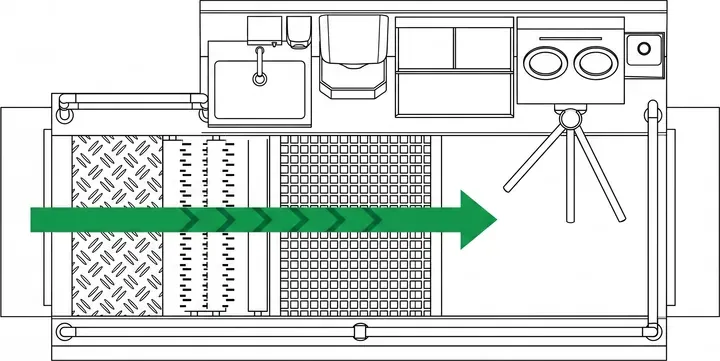
That is why an effective boot cleaning station in the poultry sector combines two stages: first the removal of organic residue by mechanical brushing, then disinfection. In practice, the correct sequence is as follows:
- 1Remove the coarse soiling — feathers, faeces and mud on the sole and side surfaces are physically removed with a brush/water.
- 2Brush the sole — a rotating or fixed boot-brush grate dislodges the hidden residue in the sole tread; this step is a precondition for disinfection.
- 3Disinfect — disinfectant is applied to the cleaned sole (spray or footbath); the active agent is allowed sufficient contact with the surface.
- 4Refresh the disinfectant — in footbath systems the solution loses its effect as it becomes soiled; regular replacement and correct concentration are essential.
A dirty boot cannot be disinfected. Feather and faeces residue consumes the disinfectant and shields the microorganism; that is why disinfection performed without brushing gives a feeling of safety but provides no real protection.
Whether a brush or a footbath method suits your facility depends on the number of personnel, the intensity of the soiling and the flow rate. We detail the pros and cons of the two methods in our boot washing methods: brush or footbath comparison.
Which comes first, hand washing or hand disinfection?
Both are necessary and the order matters: first washing, then drying, then disinfection. The principle that applies to boots also applies to hands — organic residue on the hands (blood, grease, dirt) reduces the effectiveness of the disinfectant. That is why hands should first be washed with liquid soap and dried, then treated with an alcohol-based hand disinfectant. The drying step should not be skipped, because a wet hand dilutes the disinfectant and reduces its effect.
In poultry plants this step is especially critical because hands come into direct contact with raw meat and fluids. We discuss when hand washing and when disinfection is sufficient in our hand washing or hand disinfection article. Rule of thumb: if there is visible soiling, washing is essential; disinfection alone is not enough.
- Touchless equipment — a photocell tap and automatic-dosing disinfectant prevent the cleaned hand from being recontaminated.
- Correct sequence — wash, dry, disinfect; disinfectant is not applied to a wet hand.
- Integrated passage — when the hand and boot steps are combined on the same line, no step can be skipped.
How is the dirty/clean area separation preserved?
Poultry plants are by nature designed as a line flowing from "dirty" to "clean": live receiving, bleeding, scalding and defeathering make up the dirty area, while evisceration, washing, chilling and packaging make up the clean area. Preserving hygiene depends on tightly controlling the passage between these two areas. In good practice each area has its own boots and work clothes; a change of clothing, hand hygiene and boot cleaning are mandatory when crossing between areas.
We can summarise the controls that hold this separation in place as a checklist:
- One-way flow — personnel move from the dirty area towards the clean area; back-flow is prevented.
- Area-specific footwear — dirty-area boots are not brought into the clean area; where possible a colour-coded separation is used.
- Colour-coded clothing — equipment such as aprons, sleeves and hairnets is separated by area.
- Controlled passage point — crossing between areas is done through a single hygiene station; there is no free passage.
- Visitors and maintenance staff — everyone coming from outside passes through the same entrance hygiene; this is the most frequently neglected risk.
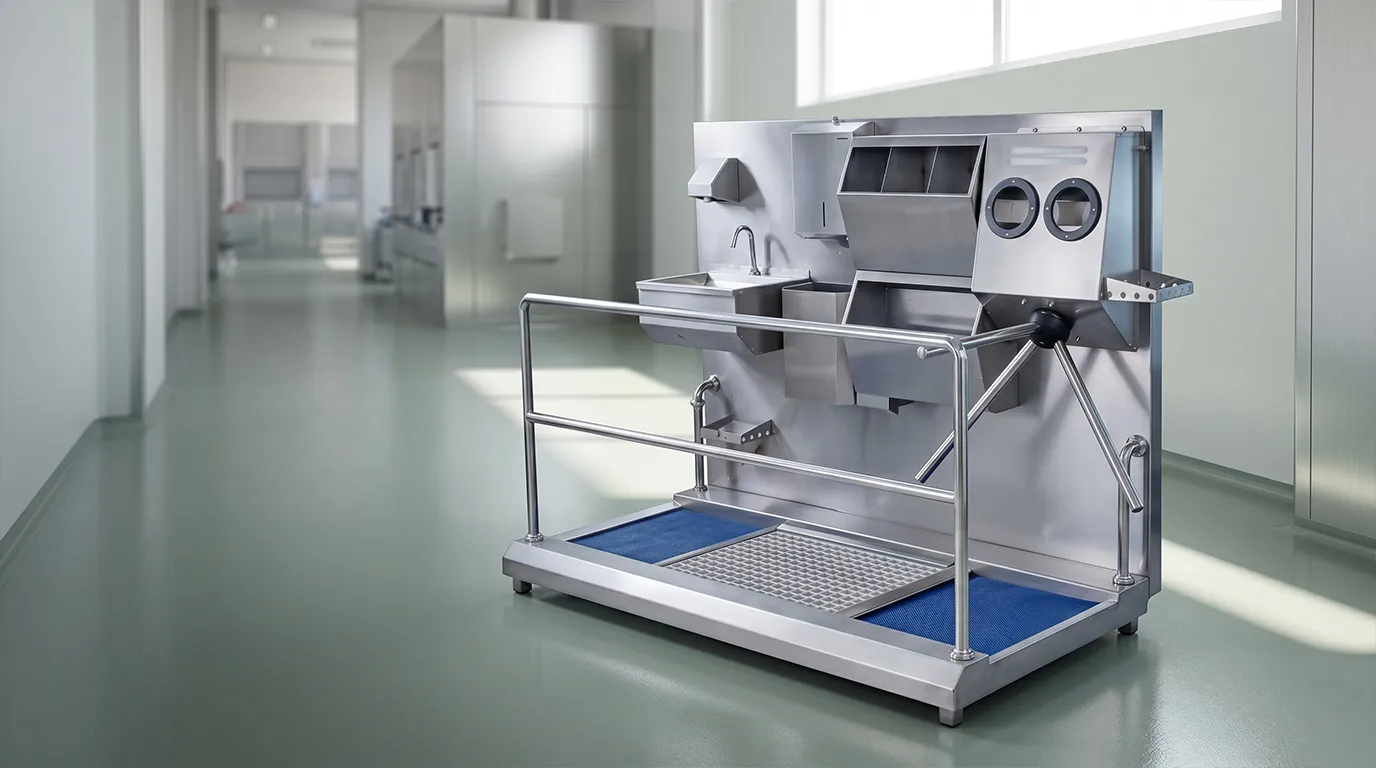
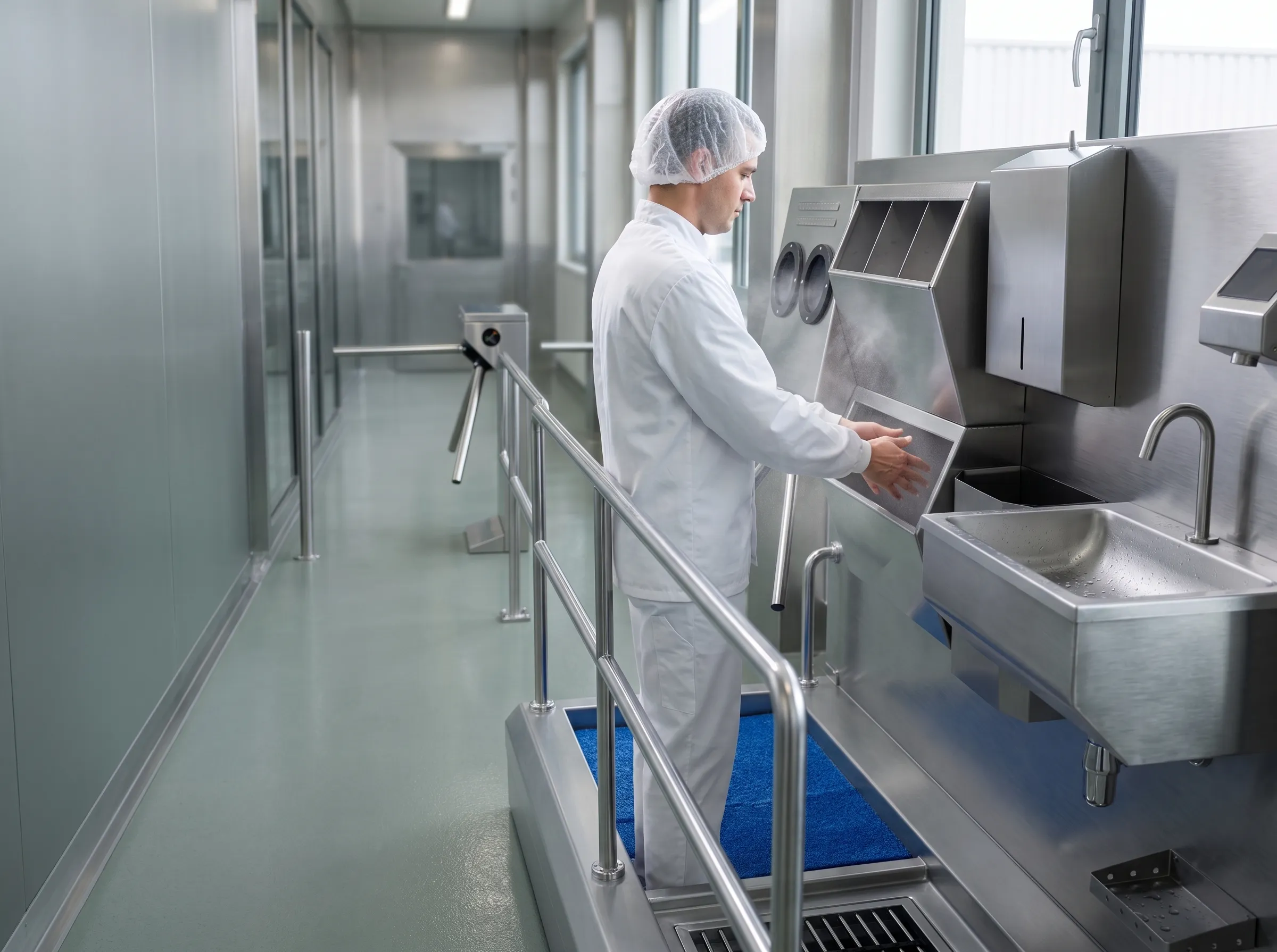
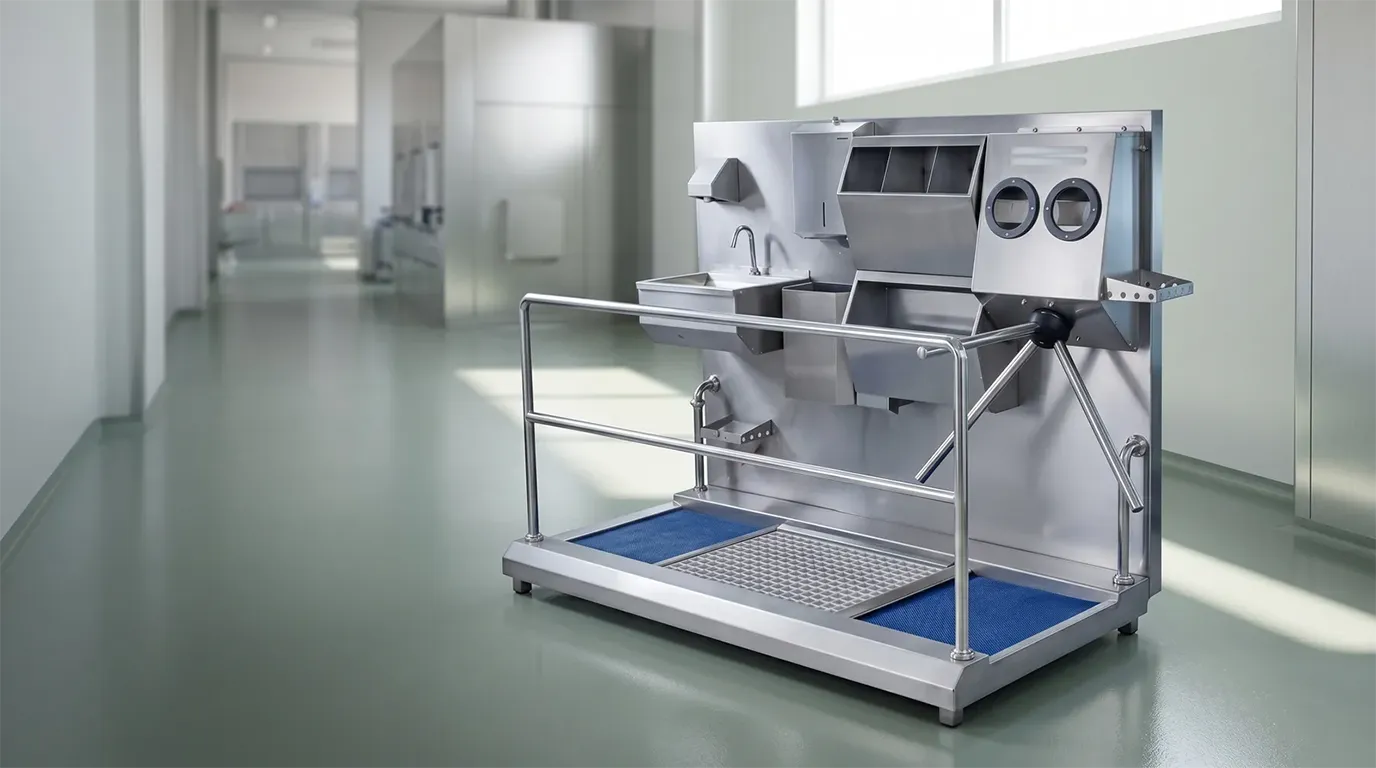
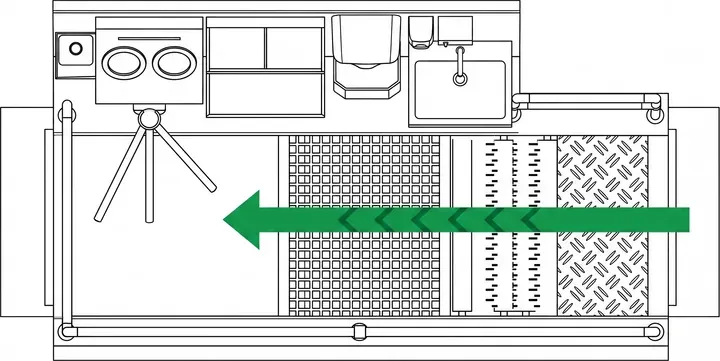
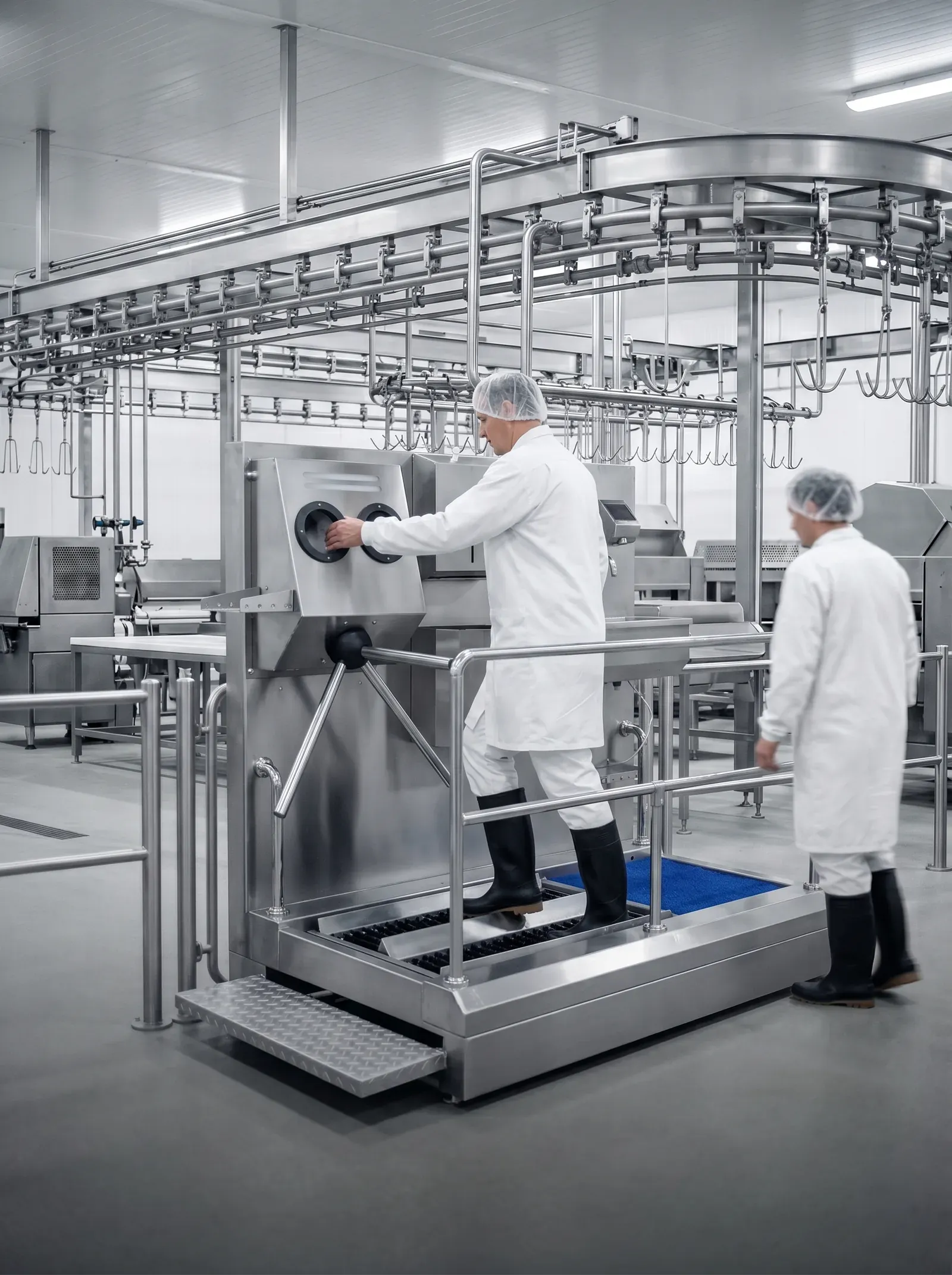
The equipment that physically enforces these controls is the hygiene barrier, which brings personnel entrance hygiene together on a single line. It combines hand washing, hand disinfection, boot cleaning and turnstile-controlled passage; because the turnstile does not open until the hygiene steps are completed, no employee can skip the controls.
What equipment and material does a poultry plant need?
Because poultry plants operate under intensive washing, water and organic load, the material of the equipment is at least as important as its design. The body is typically made of AISI 304 stainless steel: its non-porous surface does not harbour bacteria and it withstands caustic cleaning and frequent washing. At special points with a high chloride load (heavy chlorine-based disinfectant or brine), molybdenum-bearing AISI 316 can be considered; however, for personnel entrance hygiene, 304 is in most cases the correct and sufficient choice.
The table is only a sample configuration; the actual need is determined by the facility’s number of people and flow. In the wash-intensive poultry environment it is important that the sensors and equipment are protected against water ingress — we explain what the protection classes mean in our what is IP69K article. For the technical rationale of choosing the right steel, see our 304 or 316 article.
How is capacity planned for shift intensity?
Capacity should be planned according to the heaviest flow at the start of a shift. In poultry plants personnel usually clock in at the same time; if a single hygiene passage causes queuing at this intensity, personnel are forced to complete the hygiene steps incompletely or to skip them. Because boot cleaning and disinfection take longer than the hand steps, the bottleneck in a poultry environment most often forms at the boot station.
The solution is to size the passage according to shift intensity: if a single lane is not enough, the flow is sped up with a parallel (double) lane. To determine the right capacity, the number of people, the shift pattern and the duration of the hygiene steps are assessed together — you can find the detailed method in our how many people does a hygiene barrier need to serve article.
How is personnel hygiene proven in an audit?
Personnel hygiene can be proven in an audit once it is logged. Poultry plants are regularly audited under food safety systems such as HACCP, ISO 22000, BRCGS and IFS Food; none of these standards requires a "hygiene barrier" by that name, but all of them make personnel hygiene and the means for hand washing/disinfection mandatory as a prerequisite. A turnstile-controlled hygiene passage turns the claim "hygiene was done" into the steps actually completed — and into a counter and a record — providing concrete evidence during an audit. We address the detail of this relationship in our HACCP and the personnel hygiene station article.
In a high-risk sector like poultry, auditability is not merely a compliance tool; it is a traceability layer that makes root-cause analysis possible when a problem arises. We explore the ways to make hygiene passage measurable and recorded in our making the hygiene passage auditable article.
Conclusion
In poultry processing plants, hygiene is not a "nice to have" detail but the foundation of food safety, because of the high pathogen load and heavy boot soiling. The right approach is clear: control the hand and the boot at the entrance — cleaning first, then disinfecting — preserve the dirty/clean area separation tightly, use equipment resistant to intensive washing (usually AISI 304) and make every passage auditable. The hygiene barrier, which combines all of these at a single control point, is your poultry plant’s most visible and most consistent defence against contamination. We can determine the configuration suited to your facility together.
Frequently asked questions
Is a disinfectant footbath (mat) alone enough in a poultry plant?
Usually no. A disinfectant only acts on a clean surface; feather, faeces and mud residue on the boot consumes the disinfectant and shields the microorganism. That is why in poultry plants it is recommended to first remove the residue by mechanical brushing, then disinfect. A footbath alone does not provide safe protection on a dirty boot.
What is the biggest hygiene risk in poultry processing?
It is the natural pathogen load of the raw material (microorganisms such as Salmonella and Campylobacter) and the cross-contamination carried from the dirty area to the clean area. The fastest route for this transfer is the personnel’s boot and hand; that is why control must be carried out at the point where contamination begins — at the entrance.
Which stainless steel should be used in a poultry plant, 304 or 316?
For most personnel entrance applications AISI 304 is sufficient and the correct choice; it is non-porous, withstands caustic cleaning and is corrosion-resistant. At special points with constant heavy chloride contact (heavy chlorine-based disinfectant, brine), the molybdenum-bearing and more expensive 316 can be considered.
How is equipment protected in a wash-intensive poultry environment?
Because poultry plants operate under frequent, high-pressure washing, the equipment needs to be in a high protection class against water ingress. For sensors and electronic components, protection resistant to pressurised water/cleaning such as IP69K is important for durability in a poultry environment.
How should personnel cross between the dirty and clean areas?
The crossing should be made through a single controlled hygiene point: boot cleaning and disinfection, hand washing and disinfection, and where possible area-specific footwear and a colour-coded change of clothing. A turnstile-controlled passage does not open until these steps are completed, so it allows no employee to skip the control.
Is a hygiene barrier a HACCP requirement for poultry plants?
No standard requires a "hygiene barrier" by that name; however, HACCP, ISO 22000, BRCGS and IFS Food make personnel hygiene and the means for hand washing/disinfection mandatory as a prerequisite. A hygiene barrier is the tool that fulfils these requirements in the most auditable and consistent way.