Stopping contamination at entry
Staff entry is where cross-contamination most often begins — control strategies from food to pharma.

The place where cross-contamination most often begins is not the production line but the personnel entrance: the hands, footwear and work clothes of people entering the clean area carry microorganisms, soil and organic residue in from outside. That is why the most effective point for contamination control is the barrier built before the dirt reaches the product — that is, right at the entrance. In this article we summarise, from a manufacturer’s perspective, why cross-contamination begins at the entrance and which entrance strategies work in each of the food, meat, dairy, poultry, pharmaceutical (cleanroom) and hospital sectors.
Why does cross-contamination begin at the entrance?
Because every person entering the clean area brings the outside environment with them. In a food or pharmaceutical facility, the biggest source of contamination is usually not the raw material but the uncontrolled flow of personnel and visitors. Hands, shoe soles and work clothes are the three main carriers that transfer microbial load, soil and organic residue from the outside environment into the production area.
Among these carriers, hands come first. In healthcare, World Health Organization guidelines state clearly that the main route is the staff’s hands for the transfer of pathogens from patient to patient; the same logic applies in food production. The second major carrier is footwear: contamination picked up from the floor is easily carried from one zone to another via the sole, and it is one of the main routes by which environmental pathogens such as Listeria monocytogenes circulate within a facility.
Once contamination enters the production area you are chasing it; when you stop it at the entrance you never let it in at all.
The reason the entrance is so critical is simple: once a contaminant reaches inside the line, everything done to reverse it (stopping production, recalls, extra cleaning) is costly and comes too late. A hygiene barrier installed at the entrance, by contrast, cuts the risk off right at that point. We cover what a hygiene barrier is and how it works in detail in our what is a hygiene barrier article; here our focus is the contamination profile and strategies that vary by sector.
Which contamination-control layers are used at the entrance?
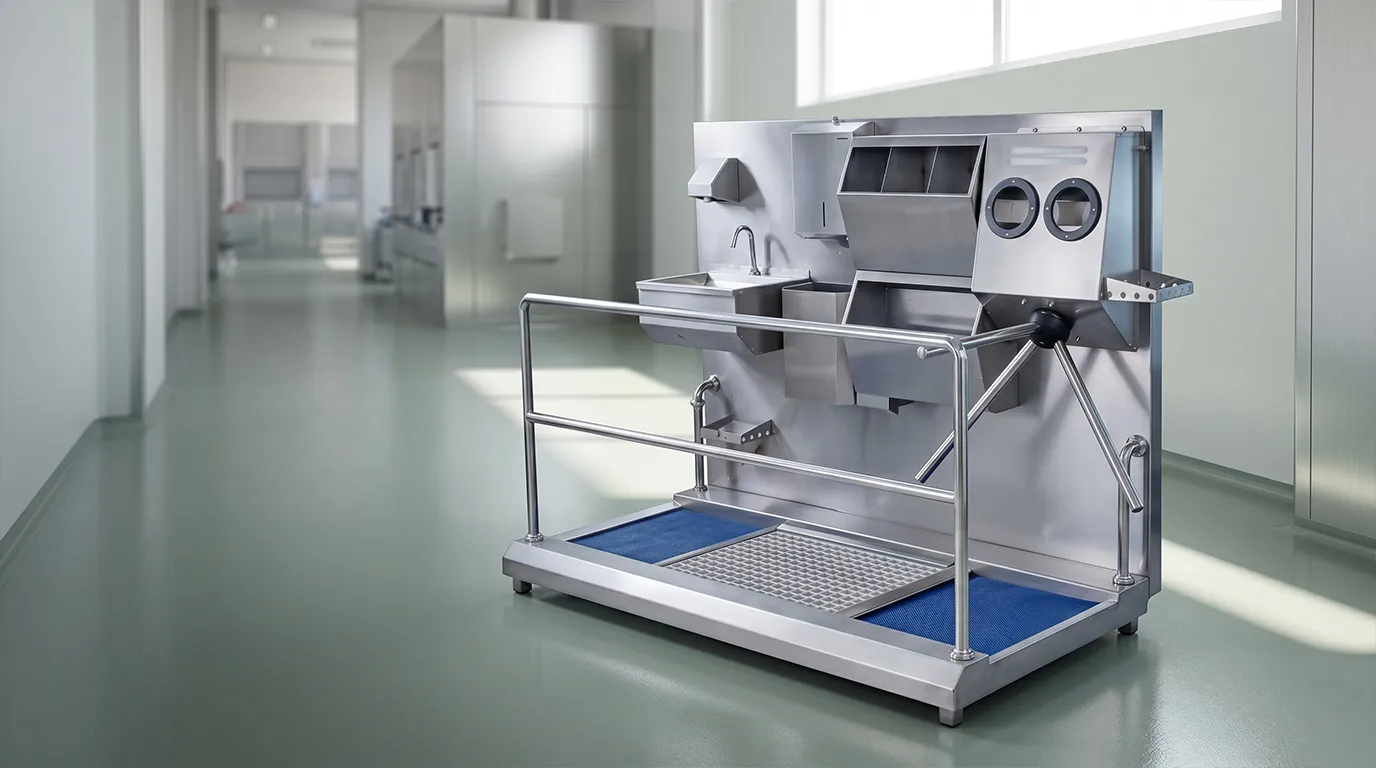
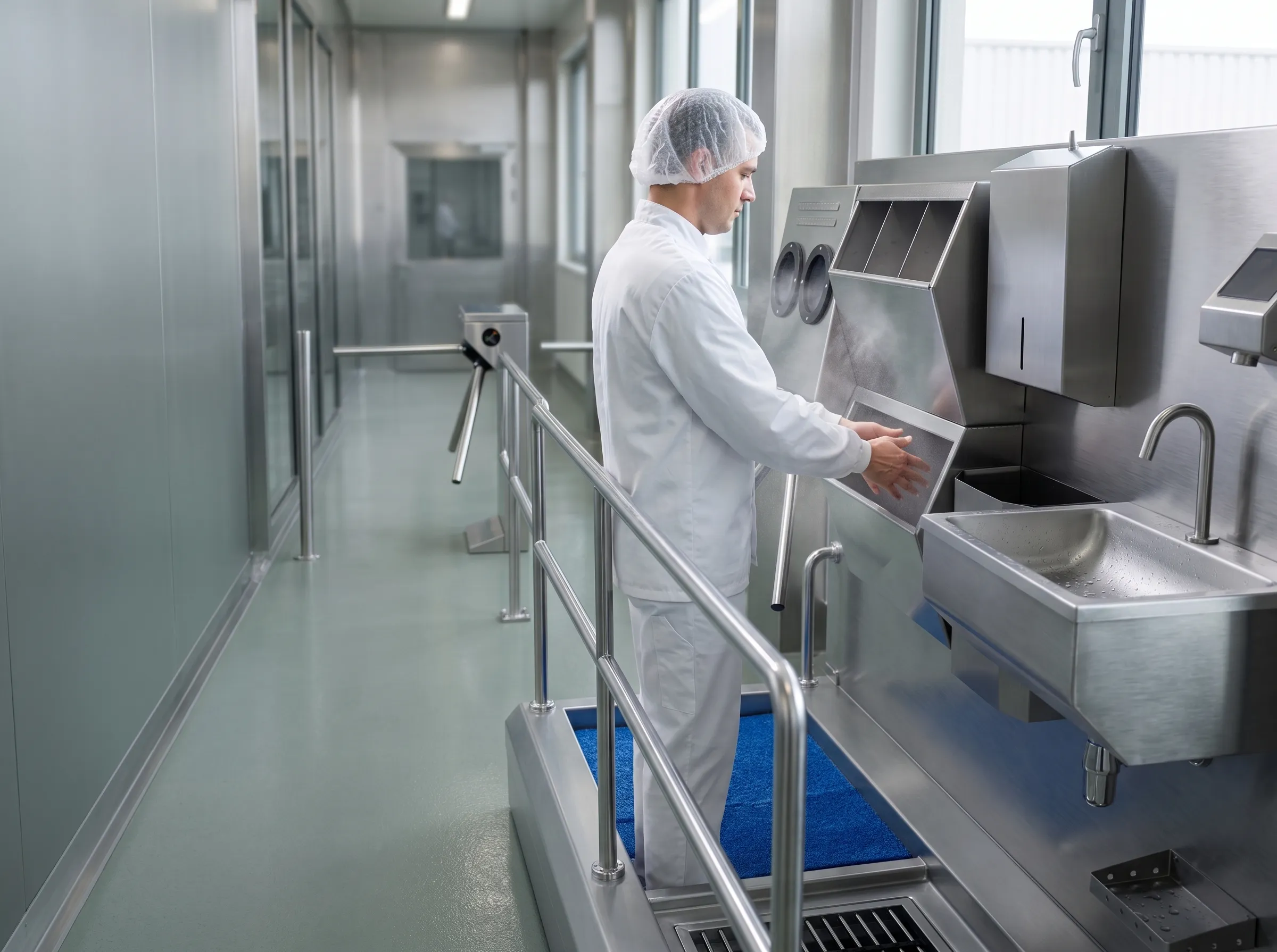
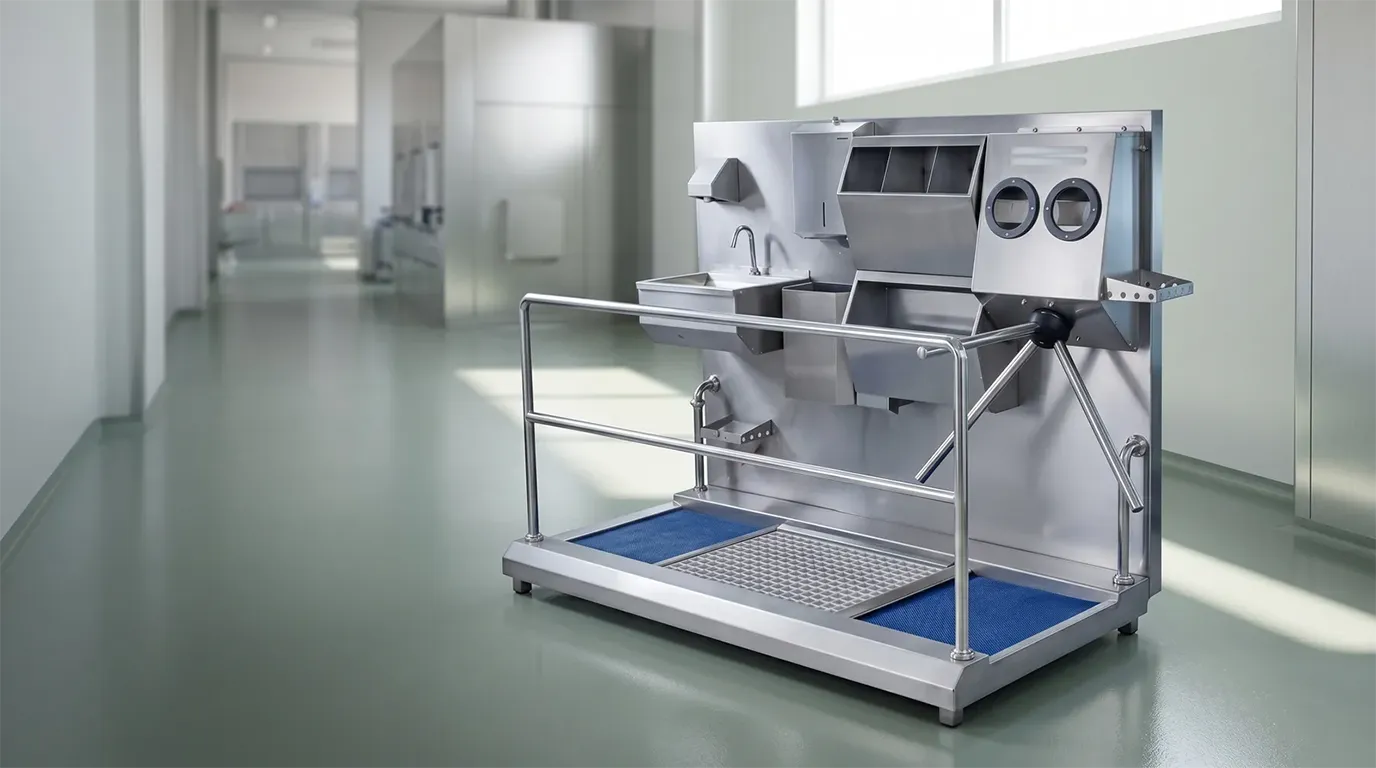
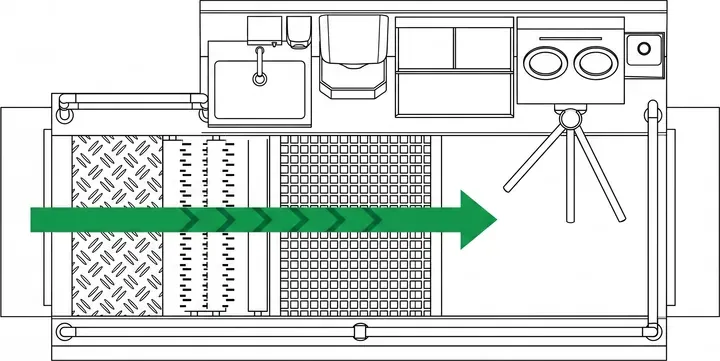
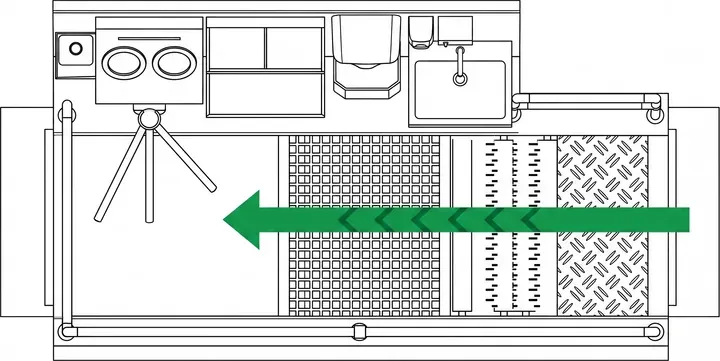
Contamination control at the entrance is achieved not with a single device but with overlapping layers. Each layer targets one carrier (hands, feet, clothing, air, flow); an effective entrance is the combination of these layers, selected according to risk:
- Hand hygiene — sensor-operated hand washing + touchless hand disinfection. Targets the first carrier (hands).
- Foot/boot hygiene — boot-brush sole cleaning or a footbath; targets the second carrier (footwear).
- Mandatory sequence (interlock) — the turnstile does not open until the steps are completed; it takes hygiene out of discretion and turns it into a precondition.
- Zoning — dirty and clean zones are physically separated; passage happens only through the controlled point.
- One-way + auditability — passage is one-way and can be logged with a counter/sensor.
Which of these layers are needed depends on the sector and the risk level. We compare whether washing or disinfection takes priority in hand hygiene in our hand washing or hand disinfection article, and the difference between boot-brush and footbath methods in our boot washing methods article.
The strongest control at the entrance is not the strictest equipment but the equipment that cannot be skipped. When the turnstile stays locked until the hygiene steps are verified, passage becomes a completed action rather than a claim. We cover how to turn this into audit evidence in our auditable hygiene passage article.
How does the contamination profile change by sector?
Each sector has a different dominant carrier and entrance strategy. The same hygiene barrier logic is configured differently for organic load in food, particles in pharma and cross-infection in hospitals. The table below summarises the dominant risk of five main sectors and the typical priority at the entrance:
Food, meat and poultry: organic load and footwear
In meat, poultry and seafood facilities the dominant risk is high organic load and footwear-borne contamination. In these facilities the entrance is not content with hand hygiene alone; boot cleaning and disinfection is a mandatory part of the full line. Because deep-treaded soles are hard to clean, captive (zone-specific) footwear and boot-brush sole cleaning come to the fore. For the sector specifics, see our meat plant hygiene barrier article for the meat side, our poultry processing hygiene article for poultry and our seafood hygiene passage article for seafood.
Dairy: environmental pathogens and zoning
In dairy and dairy-product facilities the main concern is environmental pathogens that can settle and circulate within the facility; foremost among them is Listeria monocytogenes. Here the strategy is to build a hygiene buffer not only at the entrance but also at transitions between zones: a hygienic lock, boot cleaning and zone-specific footwear prevent the pathogen from being carried from one area to another. For details, see our personnel hygiene in dairy facilities article.
Pharma / cleanroom: particles and airlock
At the entrance to pharmaceutical and cosmetic cleanrooms the risk is as much particle-borne as microbial, and the human being is the largest particle source. That is why the entrance is built around gowning, staged cleanliness classes and an airlock. In higher classes, interlocks that prevent the doors from opening at the same time and step-over barriers are used. We examine the approach specific to cleanroom entrances in our cleanroom entrance hygiene article.
Hospital: hand hygiene and critical-area control
In hospitals the dominant risk is cross-infection and the main carrier is the hands; that is why hand hygiene is at the centre of every strategy. At critical-area and department entrances, stations that make hand hygiene visible and auditable are used together with turnstile flow control where needed. We cover the use specific to healthcare facilities in our hygiene barrier in hospitals article. For mixed areas such as catering kitchens, our personnel hygiene in catering kitchens article provides guidance.
Do regulations require contamination control at the entrance?
The direct answer: no standard requires purchasing a device named "hygiene barrier" as such; however, every food safety standard makes personnel hygiene, the means for hand washing/disinfection and the prevention of cross-contamination mandatory as a prerequisite. The barrier at the entrance is the tool that fulfils these requirements in the most auditable way.
GFSI-recognised standards (for example BRCGS and IFS Food) expect risk-based zoning (high-care / high-risk / low-risk) and controlled personnel flow between these zones. ISO 22000 and ISO/TS 22002-1, which details the prerequisites for food manufacturing, explicitly address personnel hygiene facilities, hand washing provisions and the prevention of cross-contamination. Food legislation in Türkiye likewise requires having adequate hand washing/hygiene facilities. For standard-by-standard details, see our HACCP and the hygiene barrier, ISO 22000 and personnel entrance hygiene and personnel hygiene in Turkish food legislation articles.
A checklist for contamination control at the entrance
Regardless of sector, verify the following items one by one for strong contamination control at the entrance. This list is your starting point whichever sector you are in:
- 1Single passage point — the clean area is entered through only one controlled point; side doors are closed.
- 2Correct location — the unit is between the changing area and production; it is used after work clothes are put on.
- 3Hands + feet together — boot cleaning is added to hand hygiene according to risk; the footwear carrier is not neglected.
- 4Mandatory sequence — the turnstile does not open until the steps are verified; hygiene becomes impossible to skip.
- 5Adequate capacity — heavy flow at the start of a shift does not create a queue; a double lane is used if needed.
- 6Hygienic material — a non-porous, washable stainless steel (usually AISI 304) body.
- 7Auditability — passages can be logged with a counter/sensor; it produces evidence during audits.
When adapting these items to your facility, you can go deeper on the capacity calculation with our how many people a hygiene barrier serves article, on the location decision with our best location in the factory article and on the overall selection process with our 10 critical points when buying a hygiene barrier article.
Conclusion
Contamination control is won where it is cheapest and most effective — at the entrance. Hands, footwear and work clothes are the three carriers that bring the outside environment into the clean area; organic load dominates in meat and poultry, environmental pathogens in dairy, particles in pharma and cross-infection in hospitals. When the same hygiene barrier logic is configured with hand, boot and flow layers according to each sector’s risk, it cuts cross-contamination before it reaches the product, produces evidence for audits and keeps hygiene consistent. We can determine together the configuration that suits your facility’s sector and entrance layout.
Frequently asked questions
Why does cross-contamination mostly begin at the entrance?
Because personnel entering the clean area bring the outside environment with them. Hands, shoe soles and work clothes are the main carriers that transfer microorganisms, soil and organic residue from the outside environment into the production area. That is why the most effective control point is the entrance barrier built before the dirt reaches the product.
At the entrance, is the biggest contamination source hands or footwear?
Both are critical, but the sector determines the profile. Hands are generally the primary route of pathogen transfer (in healthcare this is emphasised in WHO guidelines). Footwear, on the other hand, comes to the fore in high-organic-load facilities such as meat, dairy and poultry for carrying contamination from the floor into a zone. A strong entrance addresses hand and foot hygiene together.
Is the same hygiene barrier used in every sector?
The logic is the same, the configuration differs. In meat and poultry a boot-washing-focused full line, in dairy zoning and captive footwear, in pharma/cleanroom gowning and airlock, in hospitals hand-hygiene-first control come to the fore. The layers added to the unit (washbasin, boot cleaning, number of lanes, turnstile) are selected according to the facility’s dominant risk.
Is contamination control at the entrance required by regulation?
No standard requires purchasing a "hygiene barrier" by that name; however, standards such as HACCP, ISO 22000, BRCGS and IFS Food make personnel hygiene, the means for hand washing/disinfection and the prevention of cross-contamination mandatory as a prerequisite. Food legislation in Türkiye likewise requires having adequate hand washing facilities.
What is the relationship between zoning and the hygiene barrier?
Zoning divides the facility into clean and dirty zones according to risk; the hygiene barrier is the controlled passage point between these zones. Zoning answers the question "where is the boundary", the hygiene barrier answers "how do you cross this boundary". When the two work together, cross-contamination routes are closed off.
What is captive (zone-specific) footwear for?
Captive footwear is footwear that never leaves a specific hygiene zone. This prevents contamination from the outside environment or from low-hygiene zones being carried into the high-hygiene area. In facilities with high environmental pathogen risk such as dairy and meat, it forms an effective layer together with boot cleaning and hygienic passage.