Seafood plant hygiene transit
Heavy washdown and staff hygiene in seafood plants — why the barrier may need 316 stainless.
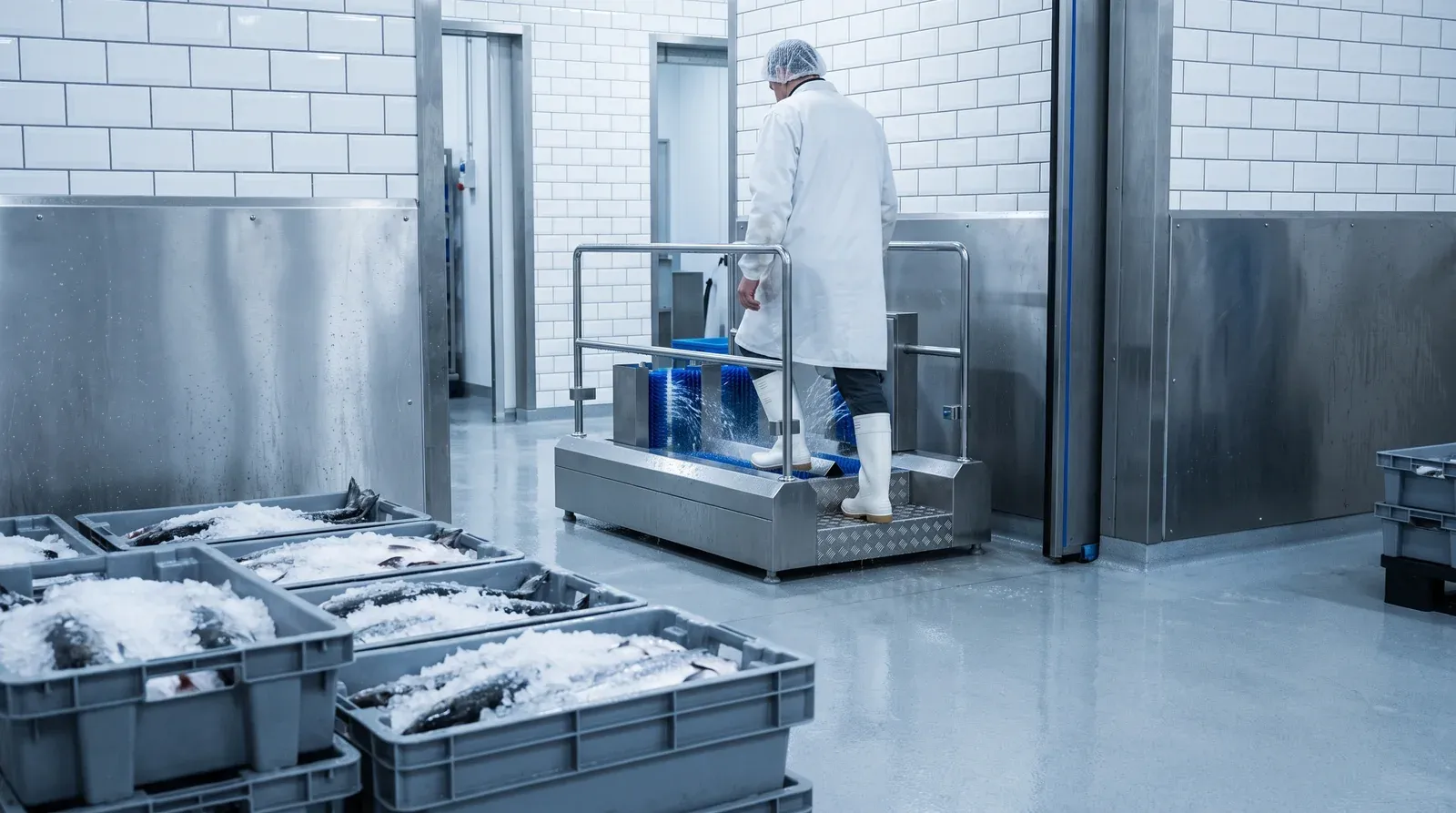
Personnel entrance hygiene in seafood plants has two defining differences: everything is constantly wet and salty, and the pathogen risk comes largely from the sole of the footwear. That is why, when a hygiene transit is designed for a fish processing plant, two decisions come to the fore — whether the body material can withstand the chloride load (304 or 316?) and whether boot disinfection is taken seriously. In this article we explain, from a manufacturer’s perspective, the contamination profile specific to seafood plants, the right barrier configuration and the choice of material.
Why is hygiene transit different in a seafood plant?
A seafood plant is one of the most demanding hygiene environments in the food sector, because there is constant water, sea salt and brine along the line; the end-of-shift washdown is often carried out with high-pressure, chlorine-based chemicals. This combination creates two separate stresses: a constant chloride load on the equipment and a permanently wet floor carrying organic residue. The hygiene access unit must therefore be chosen for exactly these two stresses.
The fundamental difference from other food sectors is that contamination originates mostly from the feet and the floor. Raw fish liquor, blood and tissue residue accumulate on the floor; personnel carry this residue on their boot soles from one area to another — especially from the low-hygiene reception/sorting area to the high-hygiene processing/packing area. That is why, in seafood, the step that is as critical as hand hygiene — and sometimes more so — is boot cleaning and disinfection.
Why do salt and chloride change the material choice?
Salt and chlorine are a source of chloride ions that attack the protective layer of stainless steel; that is why seafood is one of the leading sectors where evaluating AISI 316 instead of standard AISI 304 is most warranted. The thin chromium-oxide (passive) layer that protects stainless steel can break down locally in the presence of chloride ions; this leads to what is called pitting and crevice corrosion, which starts as small spots on the surface and progresses into the depth.
AISI 316, in addition to what 304 has, contains roughly 2–3% molybdenum, and molybdenum markedly increases resistance to precisely this chloride-driven pitting/crevice corrosion. In environments with constant salt, brine or heavy chlorinated-disinfectant contact, pitting can appear on a 304 surface over time, whereas 316 is structurally more resistant to this mechanism. In return, 316 is more expensive; according to material sources the price difference is typically in the range of about 15–25% compared with 304.
For dry or low-chloride food entrances, 304 is sufficient. But in environments like seafood with constant salt/brine and chlorine-based washdown, especially for the unit’s permanently wet base, the area around the footbath and the washed-down surfaces, 316 should be seriously evaluated. You can find the full technical rationale for this decision in our choosing 304 or 316 stainless steel article.
In practice, a smart middle ground for many facilities is to keep the body in 304 while specifying 316 for the critical parts exposed to constant chloride contact (the base plate, the boot disinfection footbath, the water-contact connections). Making the entire unit 316 is the safest but most costly option; the right balance is determined by the facility’s washdown regime and chloride intensity.
Why is boot disinfection so critical?
In seafood plants the most frequent carrier of pathogens is the personnel’s footwear; that is why boot cleaning is a step of the transit that must not be neglected. Floors kept constantly wet by raw product liquor and organic residue are a favourable environment for environmental pathogens — especially Listeria monocytogenes, which can survive in cold and damp conditions. A dirty boot sole can carry this load into the clean processing area within seconds.
For this reason, when a hygiene transit is designed for seafood, foot hygiene is thought of in two layers: first mechanical cleaning (removing visible dirt and residue with sole washing / boot-brushing), then disinfection (a boot-brush disinfectant grate or a disinfectant footbath). A disinfectant footbath alone is often not enough; because if the sole is not mechanically cleaned first, organic residue renders the disinfectant ineffective. We compare the boot-brush-versus-footbath question in detail in our boot washing methods article.
- Mechanical cleaning first — sole washing and brushing remove organic residue before disinfection.
- Sufficient disinfectant contact time — the footbath/grate must be positioned to ensure an effective contact time and must not be stepped over.
- Non-porous boots — easy-to-clean rubber boots, rather than rough/porous footwear, make disinfection effective.
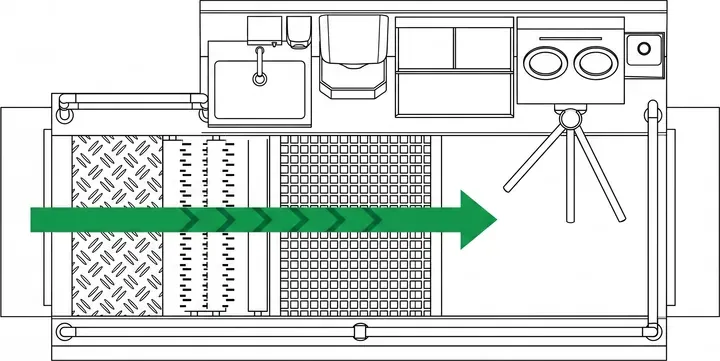
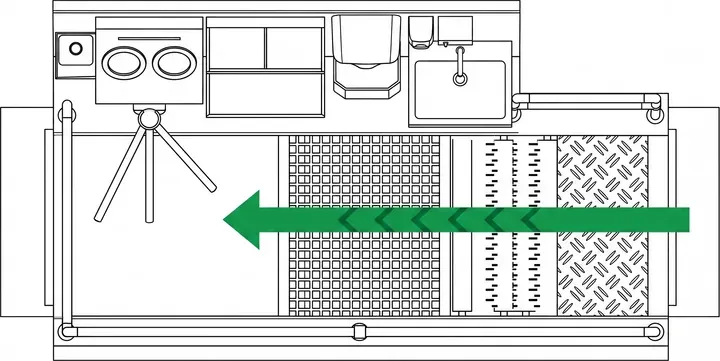
- One-way flow — passage from the low-hygiene area to the high-hygiene area must be through a single point and without back-flow.
What is the right barrier configuration for a seafood plant?
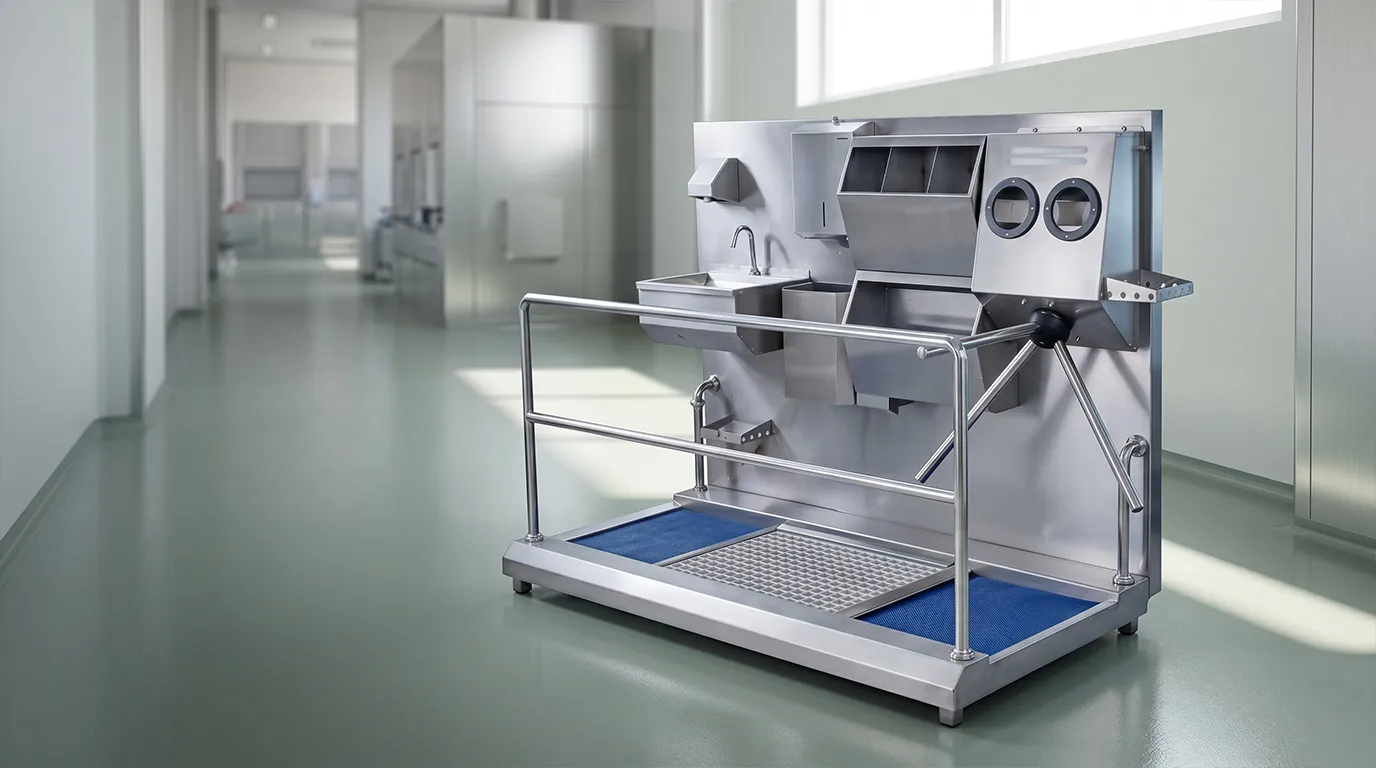
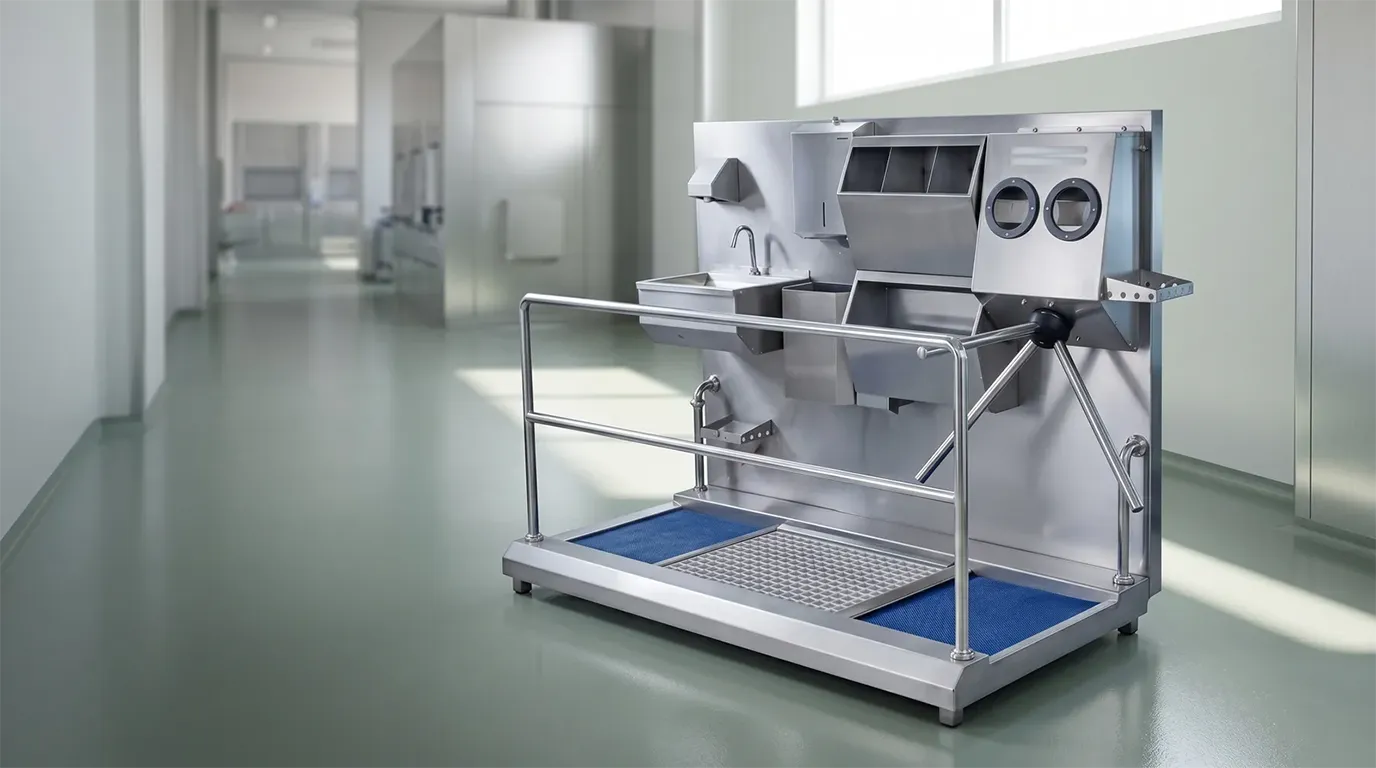
The typical configuration for a seafood plant is a fully equipped washbasin unit that combines hand washing, hand disinfection, boot cleaning and disinfection, and turnstile passage on a single line. An incomplete line (for example hand disinfection only) leaves the most critical risk in this sector — foot-borne contamination — exposed. The checklist below summarises the core components that should be present at a seafood entrance:
- Chloride-resistant material — a 304 body, with 316 for the constantly wet/salty critical parts (or the entire unit in 316).
- Hand washing + disinfection — a photocell tap, liquid soap and touchless disinfectant.
- Boot cleaning + disinfection — mechanical boot-brushing followed by a disinfectant footbath/grate.
- Turnstile-enforced sequence — a one-way locked passage that does not open until the steps are completed.
- High protection rating — sensor/dosing units resistant to water ingress against constant washdown.
- Drainage-compatible layout — a sloped position aligned with the drain so water does not pool in the wet environment.
In a constantly washed-down environment, the protection rating of the electronic components is also a critical decision; we cover what the IP69K protection rating means for the sensors and buttons exposed to high-pressure washdown in a separate article. To determine the right number of people and lanes you can calculate how many people the hygiene barrier must handle, and for the general selection steps you can see our how to choose a hygiene barrier guide.
Is personnel hygiene mandatory in a seafood plant?
Yes — seafood processing plants are required to have adequate personnel hygiene facilities under both Turkish food legislation and international food safety standards. No regulation mandates purchasing a device named a “hygiene barrier”; however, hand washing provisions, personnel hygiene and the prevention of cross-contamination are explicitly required. The hygiene access unit is the tool that meets these requirements in the most auditable way.
Good hygiene practices, which form the basis of HACCP, and GFSI standards such as ISO 22000 and BRCGS together with IFS Food, treat personnel hygiene facilities and hand hygiene at the entrance as a prerequisite. Seafood plants must also control the personnel flow between low- and high-hygiene areas — which is exactly the need that one-way turnstile passage meets. For standard-based details, you can see our HACCP and the personnel hygiene station and ISO 22000 personnel entrance hygiene articles.
In seafood the risk most often comes from the floor and the feet; designing the transit to take foot hygiene seriously means closing the largest gateway for contamination.
Conclusion
Hygiene transit in a seafood plant depends on getting two things right: choosing the material for the constant chloride load and putting boot disinfection at the centre of the line. While 304 is sufficient for standard food entrances, 316 — at least for the critical parts — should be evaluated where there is constant salt and chlorine contact. A high-protection, drainage-compatible unit that combines hands, feet and the turnstile on a single line cuts off cross-contamination right at the entrance. We can determine together the configuration that suits your facility’s washdown regime and chloride intensity, and provide a quote tailored to your needs.
Frequently asked questions
Should I use 304 or 316 stainless steel in a seafood plant?
Because there is constant salt, brine and chlorine-based washdown, seafood is one of the sectors where evaluating 316 is most warranted. The roughly 2–3% molybdenum that 316 contains increases resistance to chloride-driven pitting corrosion. For many facilities the practical solution is to keep the body in 304 while specifying 316 for the constantly wet/salty critical parts (the base, the boot footbath, the water connections).
Is boot disinfection mandatory in a fish processing plant?
Although regulations do not mandate boot disinfection as a specific device, it is critical in practice because in seafood the most frequent carrier of pathogens is the shoe sole. The correct application is two-layered: first mechanical sole cleaning (washing/brushing), then a disinfectant footbath or grate. A footbath alone can be ineffective due to organic residue if the sole is not cleaned first.
Where does the biggest contamination risk in seafood come from?
The risk comes largely from the floor and the feet. Raw fish liquor, blood and tissue residue accumulate on the floor; personnel carry this load on their boot soles from the low-hygiene area to the high-hygiene processing area. Environmental pathogens such as Listeria that can survive in cold and damp conditions are therefore particularly important; designing the transit to be one-way and to include foot hygiene reduces this risk.
Does a hygiene barrier get damaged in a constantly washed-down environment?
No, if the right material and protection rating are chosen. The body needs chloride-resistant stainless steel (304/316), the electronics need a high water-protection rating (e.g. IP69K level), and the layout must be drainage-compatible and not pool water. If the wrong material or a low protection rating is chosen, corrosion and sensor failure can appear over time.
Which components are essential for a seafood plant?
A typical full line combines hand washing, hand disinfection, boot cleaning + disinfection and one-way turnstile passage. In seafood, hand disinfection alone is insufficient because it leaves the most critical risk — foot-borne contamination — exposed. In addition, high-protection sensor/dosing units and chloride-resistant material should be chosen.