How to choose a hygiene barrier
A complete guide to choosing the right hygiene barrier by sector, headcount, cleaning type and space — step-by-step criteria.
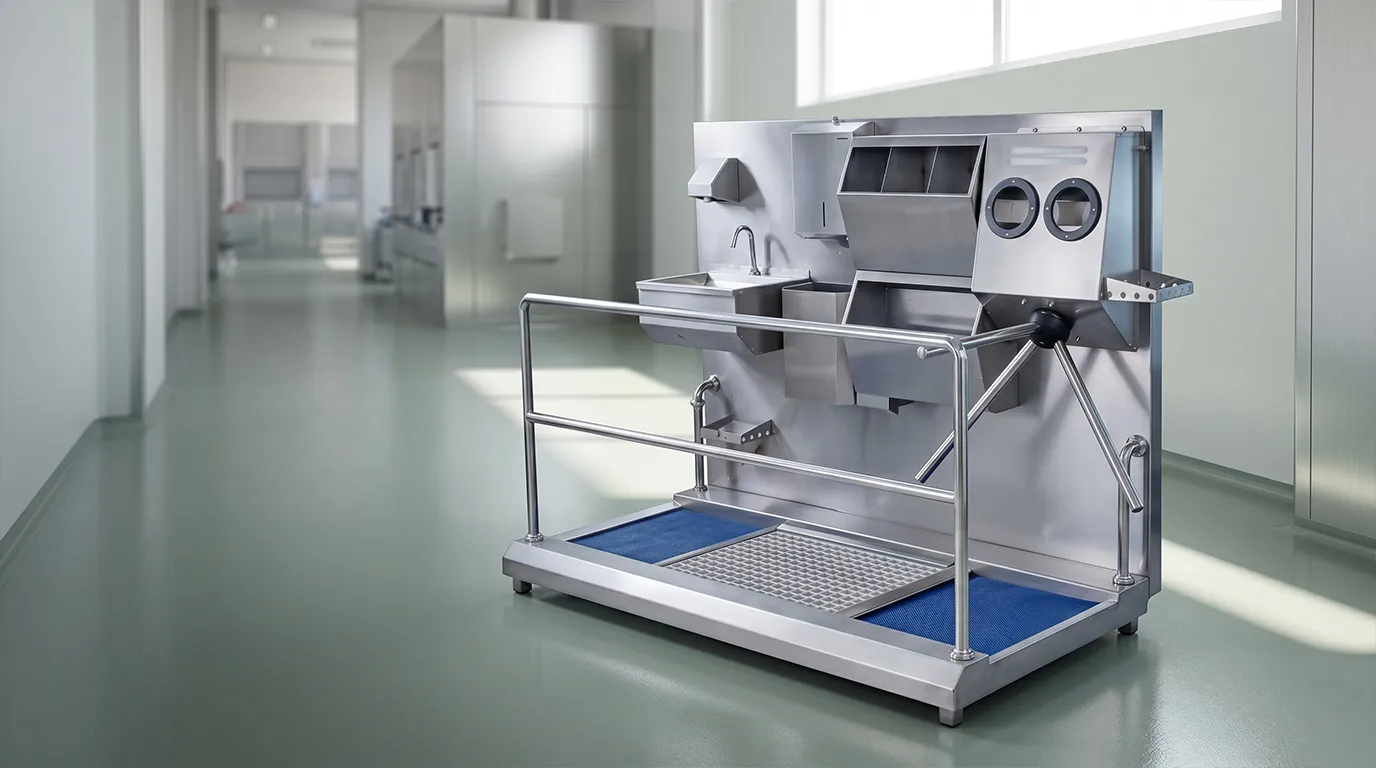
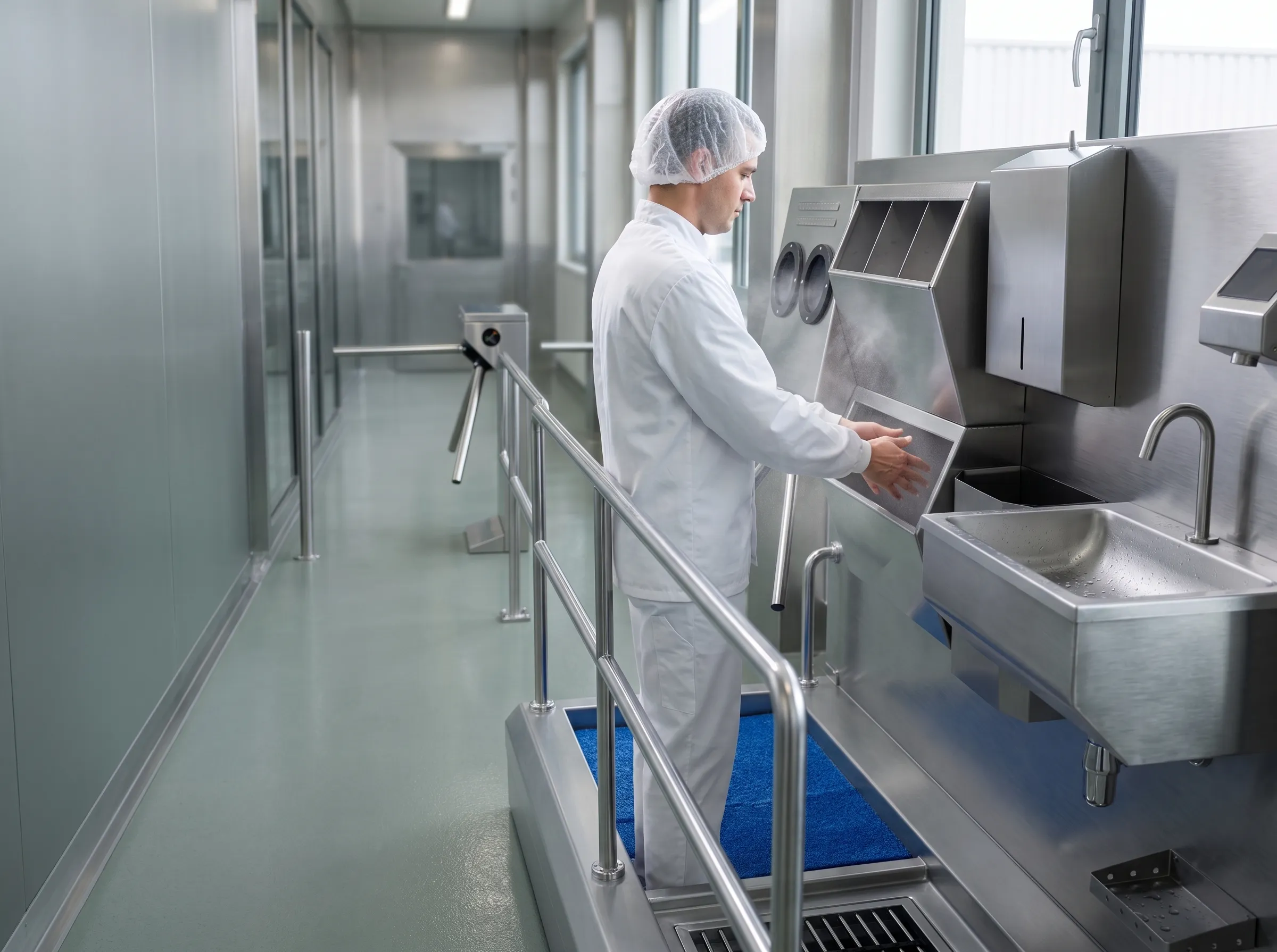
Choosing the right hygiene barrier is not about ordering an off-the-shelf box; it means clarifying five decisions in order: which sector (contamination risk), how many people (capacity), what kind of cleaning (brush/pool/combined), where and how it will be installed (space and flow), and which features (sensor, logging, turnstile type, 304/316). Once these five axes are clear, all that remains is to combine the components in the right configuration. This guide works through each axis step by step with clear decision criteria; with a comparison table and a pre-purchase checklist, you can narrow down the configuration that fits your facility yourself.
If you are not sure what a hygiene barrier is, we recommend first laying the groundwork with our what is a hygiene barrier and what does it do article. This guide assumes you already know what the product is and focuses on a single question: which configuration is right for my facility?
Every hygiene barrier decision can be reduced to these five: (1) sector/risk, (2) headcount/capacity, (3) cleaning type (brush/pool/combined), (4) space and layout, (5) features (sensor, logging, turnstile, 304/316). Below we clarify each of them in turn.
Which sector are you in? (risk profile)
The first and most decisive axis of the decision is your sector, because the sector directly defines the contamination risk and therefore the hygiene steps required. A meat plant carrying a high organic load and a pharmaceutical cleanroom where particle control is paramount call for completely different configurations of the same product. So first answer this question: what kind of soil and microbial load might the personnel entering the clean area carry?
In practice, splitting sectors into three risk groups makes the decision easier:
- High organic load (meat, poultry, seafood) — visible soil, blood and organic residue are carried on the soles; a full hand-washing line (with sink) and mechanical brush boot cleaning are usually required.
- Medium risk / wet production (dairy, beverages, ready meals, bakery) — heavy personnel flow and wet floors stand out; hand washing with sink + disinfection, plus sole cleaning where needed, is appropriate.
- Particle / controlled environment (pharma, cosmetics cleanroom, hospital critical area) — the priority is particle and microbial load rather than visible soil; since hand washing is mostly done in a separate wet area, sink-less disinfection + turnstile at the entrance may be sufficient.
The sector determines not which brand of turnstile you will buy, but which hygiene steps are mandatory. The right choice starts here.
For your sector, we compare where contamination begins and which measures are needed at the entrance in our stopping contamination at the entrance article. For sector-specific details you can go straight to the relevant guide: meat processing plant, dairy plant personnel hygiene, seafood hygiene transition, henhouse and poultry, cleanroom entrance hygiene, hospital hygiene barrier and central kitchen personnel hygiene.
How many people will pass through? (capacity and number of lanes)
The second axis is capacity, and the most common mistake here is to look at the facility’s total headcount. The number that determines capacity is not the total workforce but the peak flow at shift start: how many people must enter the clean area within a window of how many minutes. Because personnel usually arrive together at shift start, it is the peak value within this short window — not the average — that determines the critical capacity.
An important subtlety: the bottleneck in a hygiene barrier is not the speed of the turnstile but the duration of hand washing. A single-lane tripod turnstile can mechanically pass roughly 25–30 people per minute; but because proper hand washing typically takes about 20 seconds, including the hygiene cycle the realistic lane capacity drops to roughly 10–15 people per minute. Sizing based on the catalog turnstile speed leads to queues on site.
Number of lanes ≈ peak people ÷ (lane capacity × window). Take the lane capacity as a realistic 12 people/min, round the result up, and leave one step of safety margin. For the full calculation, examples and a lane table by facility scale, see our what capacity hygiene barrier do you need article.
The capacity decision often comes down to a single question: single lane or double lane? The practical distinction is this — if personnel can pass through one by one without forming a queue at shift start, a single lane is enough; if there is a heavy, simultaneous mass flow, a double or multiple lane is needed to prevent the queue (and the hygiene steps that get rushed or skipped along with it).
What kind of cleaning? (brush, pool or combined)
The third axis is the shoe/boot cleaning method, and this is one of the most critical engineering decisions that determines the model, because a brush and a disinfectant pool do different jobs. With its rotating bristles, the brush mechanically removes the soil and organic residue on the sole; the disinfectant pool, on the other hand, wets the sole to target microorganisms invisible to the eye but does not remove the surface soil. This distinction is the heart of the decision.
- Choose brush cleaning — if visible soil, dirt or organic residue is carried on the sole. Without mechanical action, disinfectant alone does not remove this soil.
- Choose a disinfectant pool (footbath) — if the sole is largely clean but disinfection is needed, or if a low-cost additional layer is wanted on an existing line.
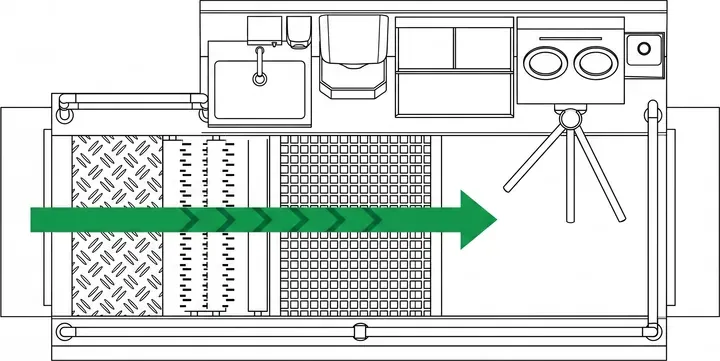
- Choose combined (brush first, then disinfection) — in facilities with a high organic load; it gives the most complete result because it first removes the soil, then disinfects.
There is a similar decision on the hand side: with a sink (full hand-washing line) or disinfection only? If the hands risk carrying visible soil or organic residue into the clean area, the sink model is correct; because the effectiveness of disinfectant applied to wet or soiled hands drops significantly. If hand washing is already done in a separate wet area and the risk is low, a sink-less disinfection turnstile may be sufficient. We address this dilemma in detail in our hand washing or disinfection article, and the brush/pool choice on the boot side in our boot washing: brush or pool article.
Where and how will it be installed? (space and flow)
The fourth axis is space and layout; even the best configuration loses its effect when positioned incorrectly. The right location is the single controlled transition point between the changing/dressing area and the production area. Personnel should use the unit after putting on their work clothes and just before entering production; otherwise the effect of the cleaning is lost on the way. In addition, the entrance must be physically channeled to a single point so it cannot be bypassed.
The space decision constrains the model choice in two ways: how many lanes the available width allows, and whether the corridor layout amplifies the queue. What you need to evaluate in the layout:
- Passage width — does the available opening suffice for a double lane, or is a single lane + staggered entry needed.
- Single controlled point — the unit must close off the entire entrance so it cannot be bypassed.
- Queue area — there must be room in front of the unit where personnel can wait at peak flow without crowding.
- Infrastructure — clean water supply, drainage and electricity (for the sensor tap, dosing and turnstile control) must be close to the location.
The location decision is more critical than most people think; a cramped or incorrectly placed unit both amplifies the queue and invites people to walk around it. You can find the detailed layout checklist in our the best location for a hygiene barrier in a factory article, and the installation and infrastructure requirements in our hygiene barrier installation article.
Which features? (sensor, logging, turnstile, 304/316)
The fifth axis is the features added on top of the core configuration: sensor/touchless level, pass logging (counter), turnstile type and body material. These decisions determine not the unit’s basic function but how consistent, auditable and durable the hygiene will be. Let us take them in turn.
Sensor, touchless operation and pass logging
A touchless (photocell) tap and automatically dosed disinfectant both reduce cross-contamination and speed up the flow. One step further is integrating a counter that counts and logs the passes: these records provide concrete evidence in audits and turn hygiene from "we said it was done" into something measurable. We discuss why auditability is valuable in our auditable hygiene transition article. The protection rating also matters so that electronic components withstand the washing environment; at points exposed to high-pressure washing, IP69K-level protection is preferred.
Turnstile type
The turnstile type affects both capacity and security. The most common choice for personnel hygiene transitions is the compact and economical tripod (three-arm) turnstile; for personnel carrying wheeled equipment or carts, a flap turnstile is smoother; and for unsupervised or high-security entrances, a full-height turnstile is used. You can find the detailed decision between the two common options in our tripod or flap turnstile comparison.
Body material: 304 or 316?
The body of hygiene barriers is typically made of AISI 304 stainless steel; its non-porous, corrosion-resistant surface that withstands caustic cleaning makes it the default material for food and pharmaceutical equipment. AISI 316, on the other hand, contains roughly 2–3% molybdenum, which increases resistance to pitting corrosion especially in environments with a high chloride load (heavy salt, brine, chlorine-based disinfectant) — but it is generally about 25% more expensive. For most personnel entrance hygiene, 304 is the right choice; 316 is considered for special environments with continuous chloride contact. We detail the technical rationale in our why AISI 304 stainless steel article, and the expected service life of stainless equipment in our service life of stainless hygiene equipment article.
For a standard food/pharma personnel entrance, 304 is sufficient and economical. Only switch to 316 in aggressive environments with continuous chloride contact (such as seafood brine or heavily chlorinated CIP) — otherwise you pay the extra cost needlessly.
What is the recommended configuration by facility type?
Once the five axes are clear, a typical starting configuration emerges for most facility types. The table below distills these five axes into a single summary; it is a starting point, and the final choice is always clarified according to the facility’s actual flow and cleaning regime.
The table is a starting point; even within the same sector, two facilities can have different flows. For the full taxonomy of model variants (turnstile, sink, boot cleaning, lane, direction), our hygiene barrier types and models article, and for sizing capacity numerically, our what capacity hygiene barrier do you need article complete this guide.
Pre-purchase selection checklist
Use the checklist below to quickly review the five axes before requesting a quote. If you can answer these questions clearly, you have largely determined the right configuration:
- 1Risk: What kind of soil/load does personnel carry into the clean area — visible organic soil, or particle/microbial load?
- 2Peak flow: At the busiest shift start, how many people enter within a window of how many minutes? (Not the total workforce — the peak.)
- 3Hand line: Is full hand washing with a sink required, or is disinfection only enough?
- 4Boot cleaning: Is sole cleaning needed — brush (removes soil), pool (disinfects), or combined?
- 5Location: Between the changing area and production, where is the single controlled transition point that cannot be bypassed?
- 6Infrastructure: Are clean water, drainage and electricity available at that point? How many lanes does the passage width allow?
- 7Features: Is pass logging (counter) required? Turnstile type (tripod/flap/full-height)? If washing is heavy, is the IP protection rating sufficient?
- 8Material: Is standard 304 enough, or does continuous chloride contact require 316?
- 9Maintenance: Can the brushes be removed and cleaned without tools, and is refilling the reservoir easy?
If you want to turn this list into a more detailed, purchase-focused checking tool, our 10 critical points when buying a hygiene barrier article can be used as a quick decision guide.
How do regulations and audits affect the choice?
Regulations do not directly tell you which device to buy, but they steer the choice indirectly. No standard requires buying a "hygiene barrier" by name; however, all food safety standards mandate personnel hygiene and the availability of hand washing/disinfection as a precondition. If you are aiming for a consistent control point that can be demonstrated in an audit, this expectation pushes your choice toward pass logging (counter) and a clear flow.
Which standards you are subject to sharpens your decisions on the feature axis (logging, auditability). We address the relevant frameworks in separate articles: HACCP and the hygiene barrier, ISO 22000 personnel hygiene and, specifically for Türkiye, the Turkish Food Codex personnel hygiene. These frameworks position the hygiene barrier not as a requirement in itself, but as the tool that meets the requirements in the most auditable way.
What are the most common mistakes in the selection?
Knowing the common mistakes is as important as the right choice, because these mistakes usually lead to expensive or queue-producing configurations. The four we encounter most often:
- Sizing by turnstile speed — calculating with the catalog turnstile value of 25–30 people/min; the real bottleneck is the hygiene cycle, so a queue forms on site.
- Unnecessary 316 — buying 316 for a standard food entrance with no chloride load; you pay the extra cost for nothing.
- Pool only, instead of a brush — passing the sole through a disinfectant pool alone under a high organic load; because the pool does not remove soil, the cleaning remains incomplete.
- Wrong location — placing the unit at a point that can be walked around; even the best configuration is useless when it can be bypassed.
Conclusion: how do you narrow down the right choice?
Choosing the right hygiene barrier means clarifying five decisions in order: which hygiene steps your sector makes mandatory, how many lanes your peak flow requires, brush or pool or sink for the sole and hands, where and how the unit will sit at the entrance, and which features (sensor, logging, turnstile type, 304/316) are needed. Once you have answered these five, all that remains is to combine the components in the right configuration — the rest is standard.
Fill in the checklist above and share your shift flow with us; let us clarify the configuration that fits your facility together and move on to a tailored Get a Quote step. If you want to see the items that determine the price in advance, our what determines the price of a hygiene barrier article will guide you.
Frequently asked questions
Where should I start when choosing a hygiene barrier?
Start with your sector, that is, your risk profile: what kind of soil and microbial load does the personnel entering the clean area carry? This determines which hygiene steps (hand washing with sink, brush boot cleaning, disinfection) are mandatory. Then clarify the capacity, cleaning type, space/layout and feature axes in turn.
Should I choose capacity based on total headcount?
No. The decisive factor is not the total workforce but the peak flow at the busiest shift start — how many people enter within a window of how many minutes. Calculate with a realistic 10–15 people/min capacity per lane (not the turnstile’s theoretical 25–30 value) and round up, leaving a safety margin.
Should I choose a model with a sink or without one?
If the hands risk carrying visible soil or organic residue into the clean area, the model with a sink (full hand-washing line) is correct, because the effectiveness of disinfectant applied to wet or soiled hands drops significantly. If hand washing is already done in a separate wet area and the risk is low, a sink-less model with disinfection + turnstile only may be sufficient.
For boot cleaning, should I choose a brush or a disinfectant pool?
The two do different jobs: the brush mechanically removes the soil on the sole, while the disinfectant pool wets and disinfects the sole but does not remove soil. If there is visible soil on the sole, a brush is needed; the highest hygiene is achieved in facilities with a high organic load by a combined model that brushes first and then disinfects.
For the body, should I choose 304 or 316 stainless steel?
For most personnel entrance hygiene applications, AISI 304 is the sufficient and economical choice. Because 316 contains roughly 2–3% molybdenum, it is more resistant to pitting corrosion in aggressive environments with continuous chloride contact (heavy salt/brine, chlorine-based disinfectant); but it is generally about 25% more expensive. If there is no chloride load, 304 is sufficient.
Is a single lane or a double lane enough?
If personnel can pass through one by one without forming a queue at shift start, a single lane is enough. If there is a heavy, simultaneous mass flow, a double or multiple lane is needed to prevent the queue and the hygiene steps that get rushed or skipped along with it. Doing the calculation with a safety margin and rounding the result up is the safe approach.