Catering kitchen hygiene
Hygiene stations for high staff flow in hotels, restaurants and catering — hand and shoe hygiene at entry.

The lifeline of personnel hygiene in commercial kitchens is a hygiene station installed at the kitchen entrance that puts everyone through hand washing and disinfection before they pass inside. In hotel, restaurant and catering operations the problem is not a lack of knowledge but consistency: at the start of a shift, dozens of people enter at the same time, in a hurry, and at an unsupervised door the hand-washing step is easily skipped. In this article we explain, in operator’s language, how to make personnel hygiene in mass catering mandatory, fast and auditable at the entrance, along with compact solutions suited to narrow kitchen entrances and a practical checklist.
Why is personnel hygiene so critical in a commercial kitchen?
Because in a commercial kitchen a single hygiene mistake spreads to hundreds of plates. In a restaurant a faulty hand contact affects a few people, whereas in a hotel or catering kitchen turning out thousands of portions a day, the same mistake instantly puts a large crowd at risk. What is more, a food-borne contamination incident is not only a health problem for the business — it is a reputation, brand and licence problem.
Commercial kitchens have three challenges of their own: personnel flow is heavy and irregular (a sudden crowd at the start of a shift), team turnover is high (a constant stream of new and temporary staff) and space at kitchen entrances is usually tight. When these three factors come together, the instruction "everyone must wash their hands" is not enough on its own; hygiene has to be physically built into the entrance.
In a commercial kitchen, hygiene is not a sign but a gateway: it happens at that one door everyone passes through, one by one.
What should hand hygiene at the kitchen entrance look like?
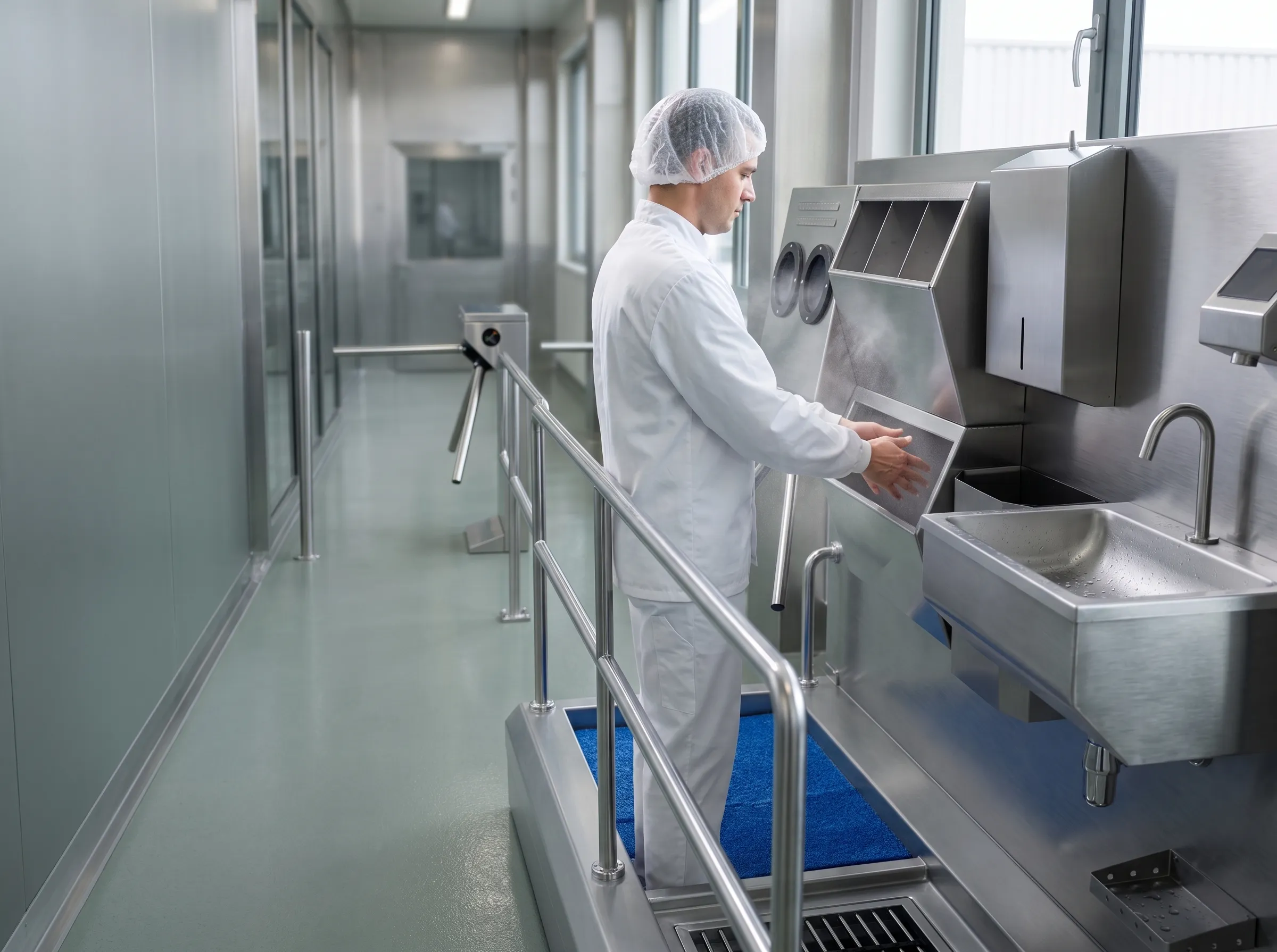
Hand hygiene at the kitchen entrance consists of hand washing performed in the correct sequence, followed by hand disinfection. Hands are wetted with warm water, scrubbed with soap for at least 20 seconds — including between the fingers, under the nails and the backs of the hands — rinsed thoroughly and dried with a single-use paper towel. Because wet hands carry bacteria more easily, the drying step must not be skipped; hands are never wiped on an apron or a cloth towel.
The critical detail in a commercial kitchen is the touchless (hands-free) fixture. If an employee closes the tap, touches the soap dispenser or grabs the door handle after washing, the hand they have just cleaned is contaminated again. That is why hygiene stations use a photocell tap, automatic-dosing liquid soap and a touchless disinfectant unit — knee/elbow-operated or sensor-based solutions bring the contact points down to zero. We cover in detail when hand washing and when hand disinfection is required in our hand washing or hand disinfection article.
Wet → scrub with soap for at least 20 s (between the fingers + under the nails + backs of the hands) → rinse → dry with a paper towel → apply touchless disinfectant. That is the sequence; it is repeated especially after contact with raw food, after the toilet and after breaks.
Is a washbasin enough, or do you need a hygiene station?
A washbasin alone is the minimum requirement; real control comes from a hygiene station. Food legislation requires a sufficient number of washbasins in the production area dedicated solely to hand washing, equipped with hot and cold water, liquid soap and hygienic drying. But an ordinary washbasin neither enforces nor records who has actually washed their hands. In a commercial kitchen the real need is to move hand hygiene from "may have been done" to "must be done before passing".
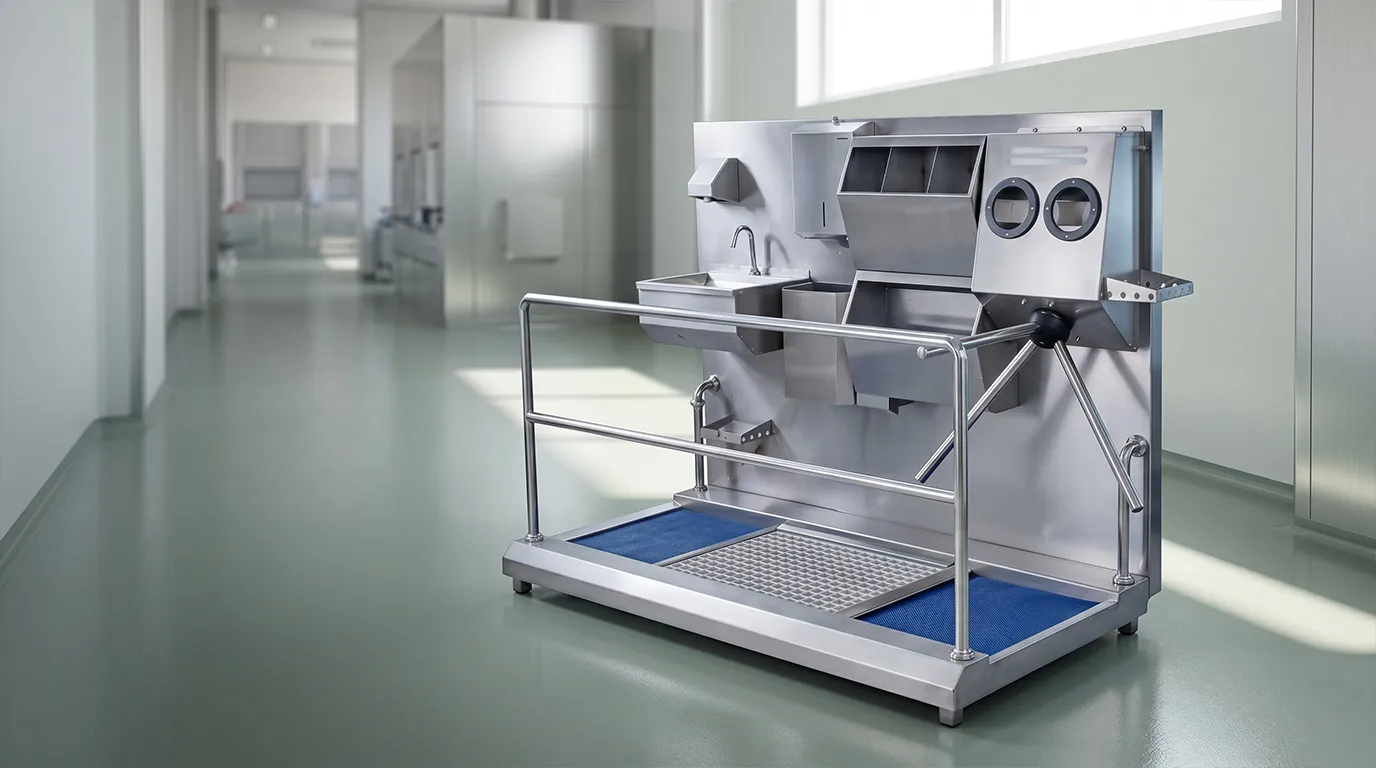
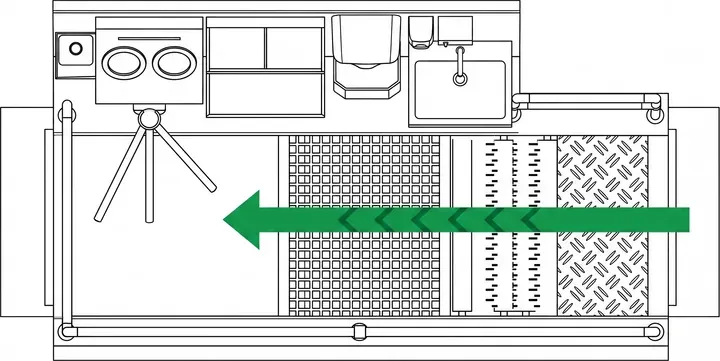
This is where the hygiene station comes in — that is, the hygiene barrier that combines a hand-wash washbasin, a touchless disinfectant unit and a turnstile in a single stainless steel body. The turnstile stays locked until the hygiene steps are verified by sensors; personnel pass inside only after washing and disinfecting their hands. You can find the technical detail of this logic in our how a hygiene barrier works article. This way, hand hygiene in a commercial kitchen is tied to the same standard every single time, independent of shift crowding or a person’s attention at that moment.
How do you manage heavy and variable personnel flow?
Heavy flow is managed by choosing the capacity correctly and gathering entry at a single point. In hotel and catering kitchens the problem is not the whole day but those 10-15 minutes of peak crowding at the start of a shift. If a queue forms at that moment, staff tend either to skip the hygiene step or to force the turnstile. The solution is to size passage capacity for the peak flow.
A single-lane tripod turnstile typically lets through about 25-30 people per minute; the actual speed, however, depends on the duration of the hand washing and disinfection steps. Adding a hygiene step lengthens the per-person passage time, which is why in kitchens with a large staff a double-lane configuration prevents queuing. To determine the right number based on your facility’s headcount per shift, see the calculation in our what capacity hygiene barrier do you need article.
The turnstile type also directly affects flow. A tripod turnstile is compact and economical, ideal for narrow kitchen entrances; a flap turnstile provides a smoother, wider passage but requires more room. You can examine which one suits your entrance in our tripod turnstile or flap turnstile comparison.
Is shoe hygiene necessary in a commercial kitchen?
In most hotel and restaurant kitchens the priority is hand hygiene; in catering and mass-catering production facilities with wet floors and high throughput, however, shoe hygiene also comes into play. Shoe soles carry soil, organic residue and microorganisms from warehouses, car parks and outdoor areas straight onto the production floor. As the floor gets wet, this dirt spreads and creates a constant burden for the cleaning staff.
In practice two methods are used: mechanical sole cleaning with a brush, and passage through a disinfectant footbath. For light soiling and standard kitchens, a compact disinfectant mat or a single footbath is usually sufficient; where there is heavy mud and organic load, a boot-brush system is preferred. We compare which method suits your operation in our boot washing: brush or footbath article. For most hotel and restaurant kitchens, a compact, hand-focused station is the right starting point; sole cleaning can be added as the need arises.
Which solution fits a narrow kitchen entrance?
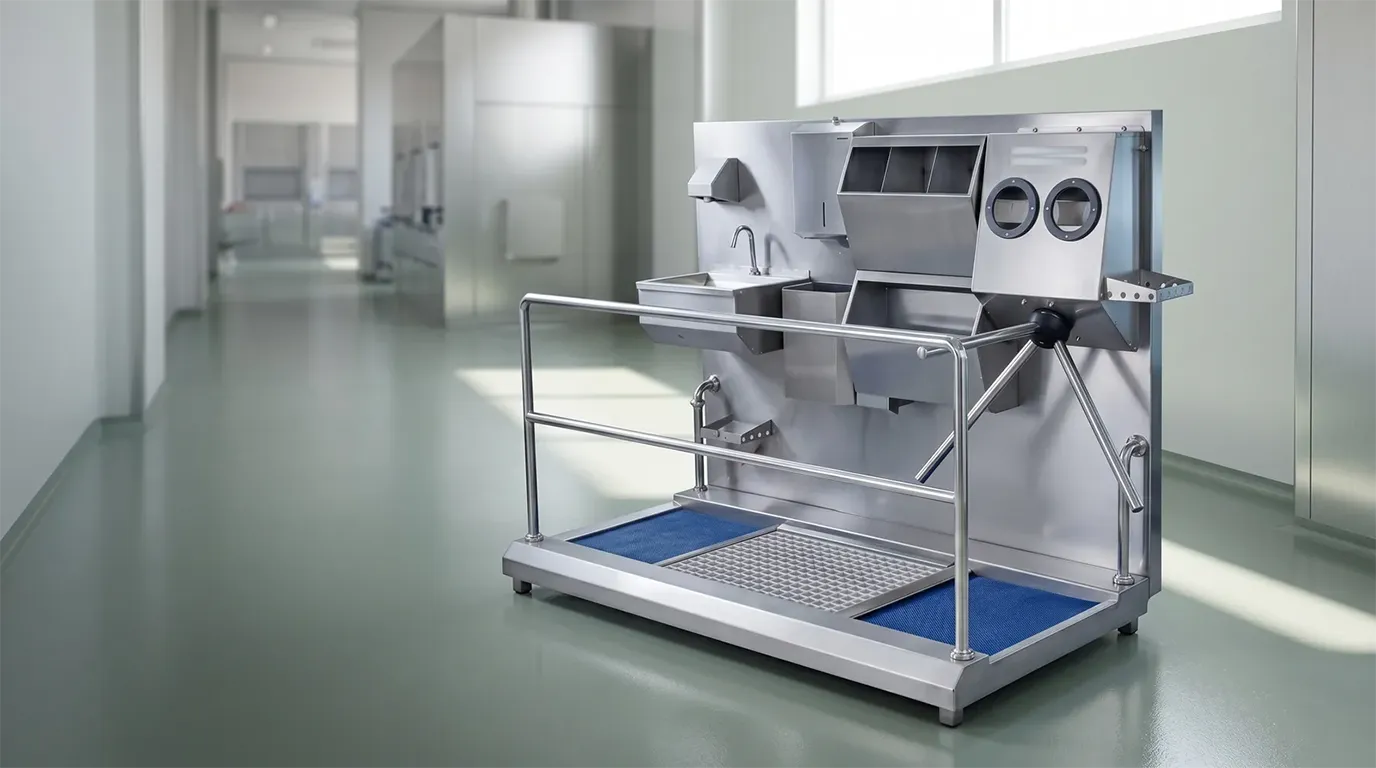
For narrow entrances, the answer is a compact, stainless steel hygiene station gathered on a single line. Entrance space in commercial kitchens is usually limited, which is why washbasin-equipped hygiene access units — combining the hand-wash washbasin, disinfectant unit and turnstile in a single slim body — are ideal. Thanks to the modular structure, only the components actually needed are selected; the result is a layout that takes up little space and does not block the flow.
The body material should, without question, be AISI 304 stainless steel. Its non-porous surface does not harbour bacteria, withstands corrosion and resists the kitchen’s heavy cleaning chemicals — it is the right and standard choice for a food environment. We explain the difference between AISI 304 and AISI 316 and when each is required in our 304 or 316 article; for a standard kitchen entrance, 304 is sufficient.
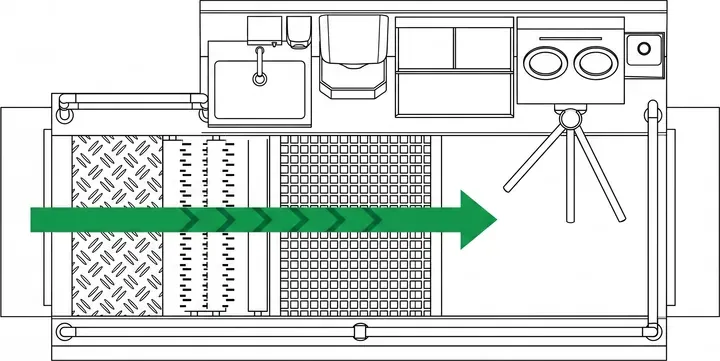
The values above show a sample configuration; the actual capacity, number of units and components are determined by your operation’s shift flow and entrance space.
Does a hygiene station help in audits?
Yes — a hygiene station is a concrete control point that can be demonstrated in an audit. Commercial kitchens are regularly subject to official inspections and customer/chain audits. A sensor-based hygiene passage turns the statement "our staff perform hand hygiene at the entrance" into physical — and, where needed, logged — evidence. No food safety standard requires purchasing a "hygiene barrier" by that name; however, HACCP, ISO 22000 and Turkish food legislation all make personnel hygiene and adequate hand washing facilities mandatory as a prerequisite. A hygiene station fulfils this requirement in the most auditable way — for the details, see our HACCP and the personnel hygiene station and personnel hygiene in Turkish food legislation articles.
Commercial kitchen personnel hygiene checklist
The checklist below summarises how hotel, restaurant and catering operations can secure personnel hygiene at the entrance:
- A single entry point — all staff should enter the kitchen through one controlled door; side and bypass routes should be closed off.
- Touchless fixtures — photocell tap, automatic soap and disinfectant; hands must not be re-contaminated.
- Paper towels — not cloth towels; wet hands carry bacteria, single-use drying is a must.
- Mandatory sequence — the turnstile should not open until the hand hygiene steps are verified (interlock logic).
- Capacity sized for peak crowding — a double lane if needed to prevent queues at the start of a shift.
- AISI 304 body — a washable, non-porous, chemical-resistant stainless surface.
- Consumables tracking — soap, disinfectant and towel reservoirs must never run empty; check them daily.
- Shoe hygiene (where needed) — add sole cleaning in wet-floor, high-throughput catering kitchens.
The way to secure personnel hygiene in a commercial kitchen is a compact hygiene station that makes hand hygiene touchless, fast and mandatory at the entrance. Not a sign — a door that must be passed through.
Conclusion
In hotel, restaurant and catering kitchens, the success of personnel hygiene lies not in the existence of the rule but in the consistency of its application. Heavy and variable personnel flow, high team turnover and tight entrance areas leave the instruction "everyone must wash their hands" insufficient on its own. A touchless, auditable, compact hygiene station that builds hand hygiene into the entrance reduces cross-contamination, produces evidence for audits and guarantees the same standard on every shift. We can determine together the configuration that best suits your entrance layout and shift flow, and move on to the quote stage.
Frequently asked questions
When should staff in a commercial kitchen wash their hands?
Hands should be washed on starting work and entering the kitchen, after touching raw food (meat, chicken, fish, eggs, unwashed vegetables), after every visit to the toilet, after breaks/smoking, after contact with waste or dirty equipment, and before service. Each wash should include at least 20 seconds of soaping, followed by drying with a paper towel and, where needed, applying disinfectant.
Is a washbasin in the kitchen enough, or is a hygiene turnstile a must?
A washbasin is the minimum requirement; legislation requires a sufficient number of washbasins in the production area dedicated solely to hand washing. But a washbasin does not make hand washing mandatory. A hygiene station (washbasin + disinfectant + turnstile) locks the passage until the steps are completed, taking hygiene out of the "optional" category; in busy, audit-facing commercial kitchens this control makes the critical difference.
How do you prevent queues at the start of a busy shift?
Size the passage capacity for the peak crowding at the start of a shift, not for the daily average. A single-lane tripod turnstile lets through about 25-30 people per minute; because the hygiene step lengthens the time, a double-lane configuration prevents queuing in crowded kitchens. Gathering entry at a single point also smooths the flow.
Does a hotel kitchen need touchless (photocell) fixtures?
Strongly recommended. If an employee closes the tap or touches the soap dispenser after washing, their hand is contaminated again. A photocell tap, automatic soap and a touchless disinfectant unit prevent this re-contamination; knee/elbow-operated solutions serve the same purpose. For hand hygiene in a commercial kitchen to be effective, touchless fixtures should be considered the standard.
Is shoe/boot hygiene also necessary in a commercial kitchen?
In most hotel and restaurant kitchens the priority is hand hygiene. In wet-floor, high-throughput catering and mass-catering production facilities, however, shoe soles carry soil and organic residue onto the floor; in that case, sole cleaning with a mechanical brush or a disinfectant footbath is added. The need is determined by the facility’s soiling profile.
What material should a kitchen hygiene station be made of?
AISI 304 stainless steel. Its non-porous surface does not harbour bacteria and withstands corrosion and the kitchen’s heavy cleaning chemicals; it is the standard and right choice for a food environment. Only in special environments with constant heavy chloride/salt contact is AISI 316 — which contains molybdenum and costs more — considered.