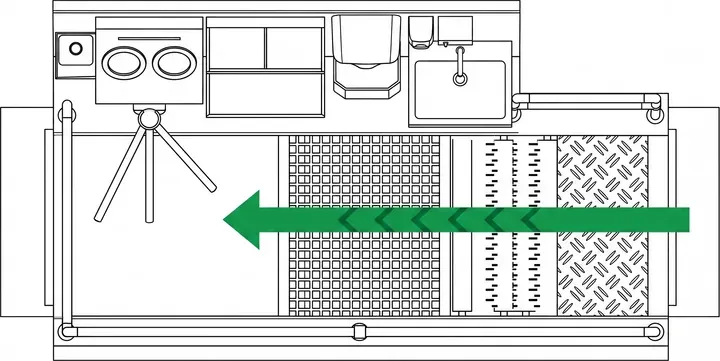
Dairy plant staff hygiene
Why staff entry hygiene is critical in dairy plants — hygiene barriers for pathogen control.

In dairy and dairy-product plants, staff hygiene is the first line of defence for product safety: because the most critical pathogen, Listeria monocytogenes, lives and multiplies in exactly the natural conditions of these facilities — cold, damp and constantly washed environments. Personnel’s hands and boots are the most common vector carrying this microorganism from floor drains, cold storage rooms and outdoor areas into the clean production zone. In this article we explain, from a manufacturer’s perspective, why personnel entrance hygiene is so sensitive in dairy plants, the role of hand and boot hygiene in pathogen control, and how a hygiene barrier stops this risk at the entrance.
Why is staff hygiene so critical in dairy plants?
Staff hygiene is critical in dairy plants because most products are ready-to-eat (RTE) items that, after pasteurisation, undergo no further killing step and are stored cold and consumed directly. Pasteurisation destroys the pathogens in the milk; however, in post-pasteurisation steps such as filling, packaging and slicing, the product is exposed again. At this point the only practical source of contamination is the environment and personnel — not the microorganisms in the raw milk.
In a plant producing cheese, yoghurt, butter, ice cream and drinking milk, personnel arrive on every shift from the outside environment, the changing area and different hygiene zones. The soil, organic residue and microbial load carried on hands and shoe soles reach the clean area directly through an uncontrolled entrance. That is why, in a dairy plant, hygiene begins not at the production line but at the personnel entrance.
In a pasteurised dairy product, the final safety barrier is not the machine but the hygiene of the personnel who touch that product.
Why is Listeria so dangerous in dairy plants?
Listeria monocytogenes is a special threat to dairy plants because this bacterium survives and multiplies comfortably in conditions that a food factory considers challenging for most microorganisms. It is a cold-tolerant (psychrotrophic) pathogen: although its optimum growth is around 30–37 °C, it keeps multiplying slowly even at refrigerator temperatures — at values dropping down to about 0 °C. It is also resistant to salt and low water activity. In other words, the cold storage rooms and chilled production areas of a dairy plant, rather than stopping Listeria, offer it a suitable environment.
The second property that makes Listeria so stubborn is that it forms biofilms on damp and hidden surfaces. Floor drains, drainage channels, wheels, cracks and corners that stay constantly wet are typical settling points for this bacterium. Once a biofilm has formed it becomes resistant to cleaning and disinfection; it can become resident in the facility for years. The bridge from these persistent focal points to the product is most often a person: the boot of an employee who cleans a drain or walks on a wet floor carries the microorganism into the clean area.
Because Listeria loves cold, damp and salt, the natural conditions of a dairy plant (cold chain + constant washing + wet drains) work in its favour. That is why pathogen control in the dairy sector requires stopping contamination at the entrance before keeping the production area clean — this is the foundation of the stopping contamination at the entrance approach.
Why are hand and boot hygiene handled together in pathogen control?
Hand and boot hygiene must be handled together in a dairy plant because these are the two main routes by which the pathogen is carried into the clean area: hands touch the product and contact surfaces directly, while boots carry contamination up and forward from the floor — from the drains and wet surfaces where Listeria is most often found. Washing only hands means ignoring the floor-borne contamination carried by feet; washing only boots means skipping the contamination transferred by hand contact.
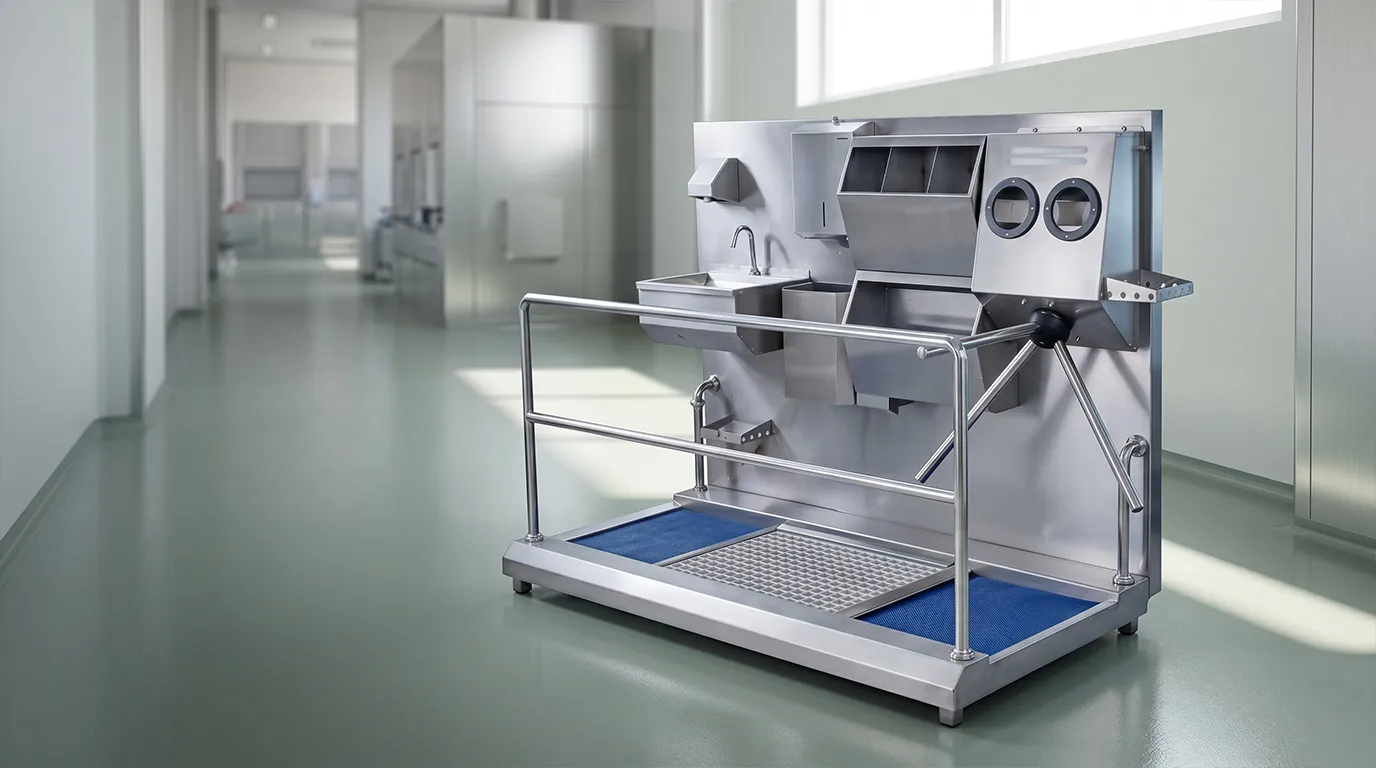
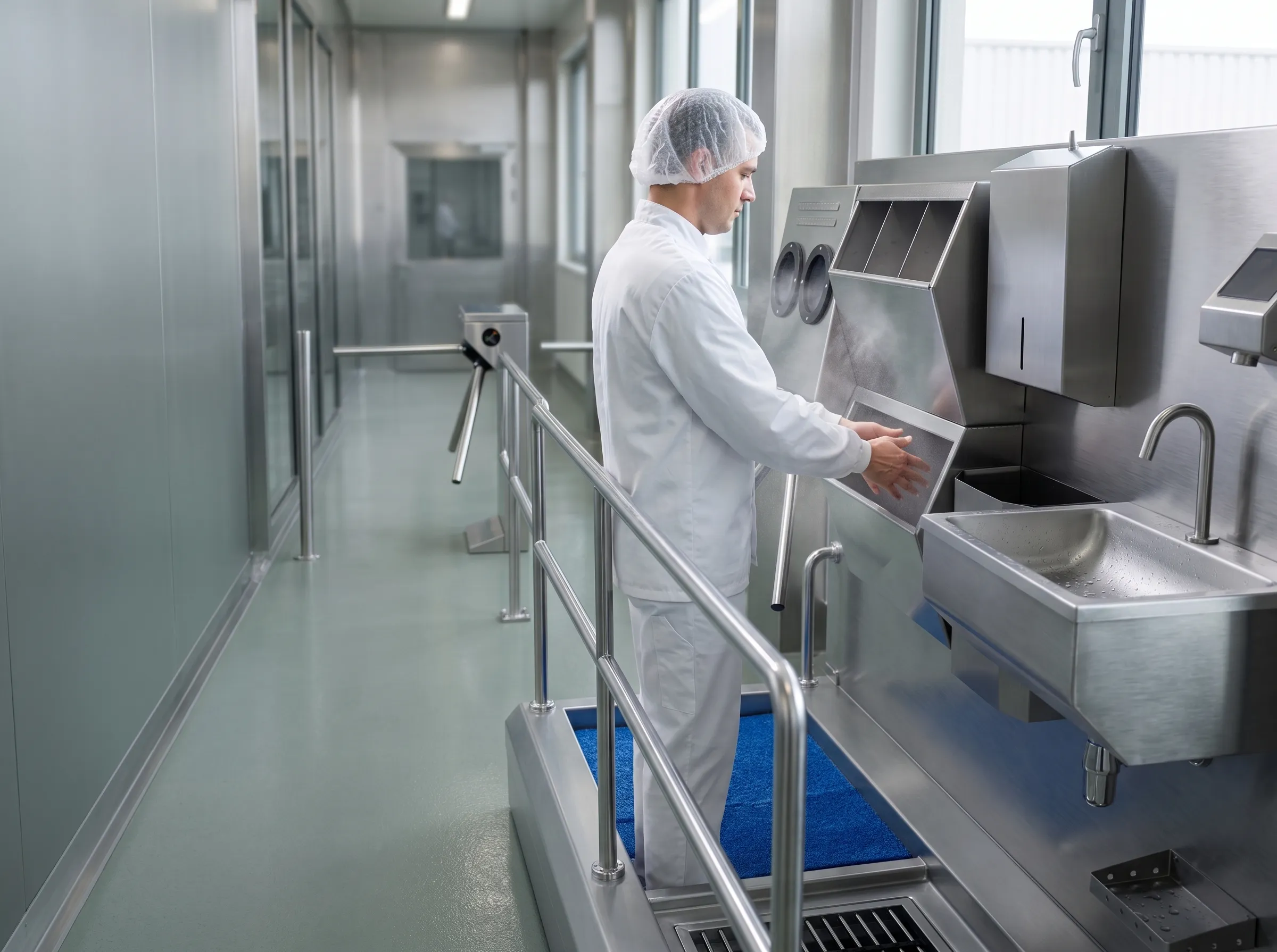
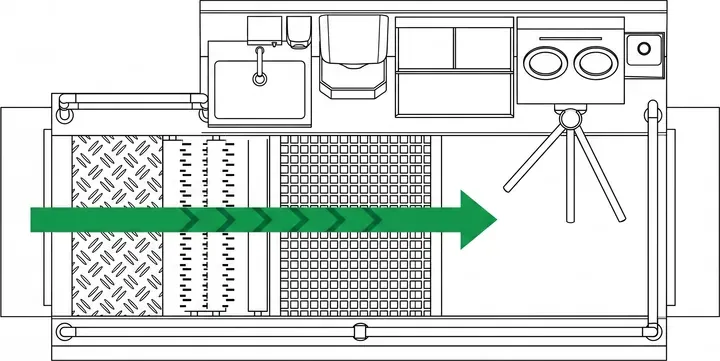
The constantly wet and cold floor of a dairy plant makes boot hygiene even more important than in meat or dry-food plants. In a wet environment the shoe sole is continuously re-contaminated; that is why what is needed is not a one-off measure but a step repeated at every entry. At the personnel entrance the following sequence is typically applied:
- 1Hand washing — with a touchless (photocell) tap, liquid soap and single-use paper towels.
- 2Hand drying — this step is not skipped, because wet hands dilute the disinfectant.
- 3Hand disinfection — alcohol-based disinfectant from a touchless, automatic-dosing unit.
- 4Boot cleaning and disinfection — mechanical boot-brush and/or disinfectant for the sole; a solution suited to the wet dairy environment is selected.
- 5Turnstile passage — one-way controlled passage that opens once the steps are verified.
For boot cleaning, both boot-brush (mechanical) and footbath (dip) methods are used; which is more suitable depends on the facility’s soiling type and flow. We compare the two methods in detail in our boot washing methods article. In wet environments like dairy, it is critical that a standing disinfectant footbath is refreshed regularly so that it does not look constantly “clean” while in fact carrying bacteria.
How does a hygiene barrier reduce risk in a dairy plant?
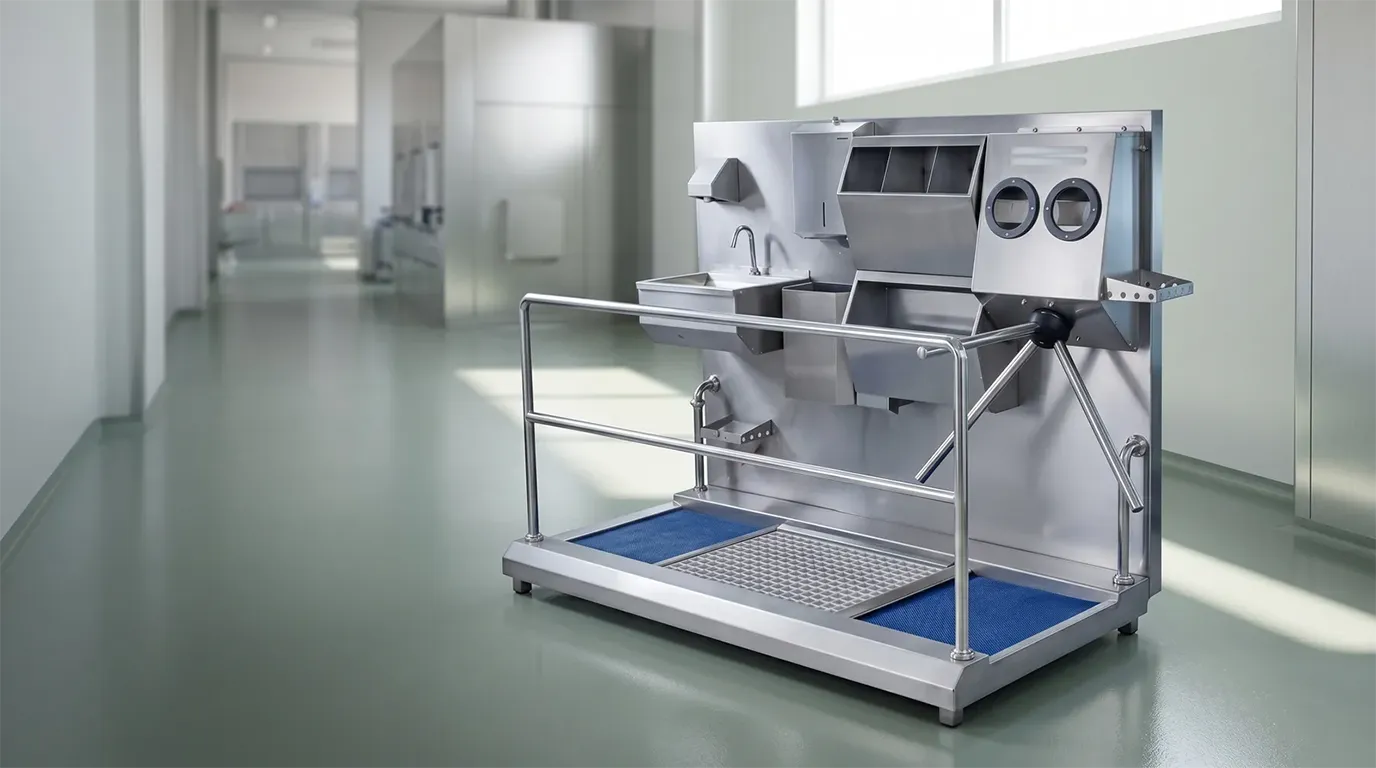
A hygiene barrier reduces risk by combining the hand and boot steps above on a single stainless steel line and making them mandatory with a turnstile. What sets it apart from an ordinary washbasin is that it does not leave the steps to the employee’s discretion: the turnstile stays locked and no passage opens until hand washing, disinfection and boot cleaning are verified by sensors. This way, even at the start of a busy shift, no employee can skip the hygiene steps. You can find all the components and working logic of a hygiene barrier in our what is a hygiene barrier article.
For the dairy sector, this approach has three concrete benefits:
- Cuts off floor-borne contamination — boots are cleaned before entering the clean area; Listeria’s drain→foot→product bridge is broken.
- Guarantees consistency — every shift, every employee and every visitor applies the same steps in the same way.
- Produces auditable evidence — counter and sensor records provide concrete data that can be shown in food safety audits (auditable hygiene passage).
Which stainless steel and protection class suit a dairy plant?
The default and correct material for dairy plants is usually AISI 304 stainless steel; being non-porous, it does not harbour bacteria, withstands frequent and aggressive washing, and is corrosion-resistant. AISI 316 stainless steel (with molybdenum added) is considered only in special cases of constant, heavy chloride contact — for example brine-heavy dairy products or very high use of chlorine-based disinfectant — and is typically more expensive. For most dairy plant personnel entrances, 304 is sufficient. We cover the technical difference between the two in our 304 or 316 article.
As much as the material, the protection class of the electronic components matters in a dairy environment. Dairy plants are cleaned with high-pressure, hot and chemical washing; for this reason the sensors and dosing units must be resistant to water and washing. For protection against high-pressure washing, IP69K-class components are preferred — we explain what this means in our IP69K protection class article.
The values in the table show a sample configuration; the number of lanes, the boot cleaning method, the protection class and the number of steps are determined by the facility’s personnel flow, cold-chain layout and cleaning regime.
What does the legislation say about staff hygiene in dairy plants?
In Türkiye, no legislation requires purchasing a device named “hygiene barrier” as such; however, it explicitly makes personnel hygiene, adequate hand washing provision and the prevention of cross-contamination mandatory. The Food Hygiene Regulation and dairy-specific good-practice guides expect entry into production areas with dedicated clothing/overshoes, the availability of hand washing facilities and controlled passage between hygiene zones. A hygiene barrier is the tool that fulfils these requirements in the most consistent and auditable way.
For dairy plants producing for the international market the picture is even clearer: HACCP prerequisite programmes, ISO 22000 personnel entrance hygiene, BRCGS personnel hygiene requirements and IFS Food hand hygiene standards all require hand hygiene and personnel flow control at the entrance. A hygiene barrier creates a concrete control point that can be demonstrated in these audits.
Where should a hygiene barrier be located in a dairy plant?
The most correct location is the single controlled passage point between the changing/dressing area and the chilled production area. Personnel must use the unit after putting on their work clothes and boots, and just before entering production; otherwise the cleaning effect is lost on the way. An additional consideration in dairy plants is the separation of hygiene zones: control must be repeated at every passage from a wet/low-hygiene area to a high-hygiene area. You can find the correct-placement checklist in our where to locate a hygiene barrier article.
Passage capacity is also a frequently overlooked topic in dairy plants: if dozens of personnel enter at the same time at the start of a shift, a single-lane unit creates a queue and people are forced to skip steps. Capacity suited to the need should be planned using the approach in our how many people a hygiene barrier should handle article.
Conclusion
Staff hygiene in dairy plants is not a formality but the control point at the centre of product safety. Listeria’s liking for cold and damp turns the natural conditions of a dairy factory into a risk zone; the most effective way to manage this risk is to stop contamination at the moment of entry. A hygiene barrier that makes hand and boot hygiene mandatory with a turnstile, configured with the right material (usually AISI 304) and components resistant to high-pressure washing (IP69K), reduces cross-contamination, keeps hygiene consistent on every shift and produces concrete evidence in audits. We can determine together the configuration suited to your facility’s flow and cold-chain layout.
Frequently asked questions
What is the most critical pathogen in a dairy plant?
Listeria monocytogenes is the prominent pathogen in dairy and dairy-product plants. Being a bacterium that can multiply in the cold (down to about 0 °C), is salt-resistant and forms biofilms on damp surfaces, it can become resident in the cold and constantly wet environment of a dairy plant. Personnel’s hands and boots are the main route carrying this bacterium from drains and wet floors into the clean area.
Is hand washing alone enough in a dairy plant?
No. Hand washing reduces the contamination transferred from hand to product, but in dairy plants the pathogen is most often found on floors and drains; foot-borne contamination brings this into the clean area. That is why hand hygiene and boot cleaning must be applied together. A hygiene barrier makes both steps mandatory in a single passage.
Does a dairy plant need 304 or 316 stainless steel?
For most dairy plant personnel entrances, AISI 304 is sufficient and the right choice; it is non-porous, withstands frequent washing and is corrosion-resistant. AISI 316 stainless steel is considered only in special cases of constant heavy chloride contact (for example brine-heavy products or very high use of chlorine-based disinfectant) and is typically more expensive.
Should hygiene equipment in a dairy plant withstand high-pressure washing?
Yes. Dairy plants are cleaned with high-pressure hot water and chemicals. For this reason it is important that the sensors, dosing units and electronic components are resistant to water and washing (IP69K protection class for high pressure); otherwise the equipment is damaged during cleaning.
Is a hygiene barrier mandatory for dairy legislation?
The legislation does not require purchasing a “hygiene barrier” by that name; however, the Food Hygiene Regulation and dairy-sector good-practice guides make personnel hygiene, adequate hand washing provision and controlled passage between hygiene zones mandatory. A hygiene barrier is a tool that meets these requirements in a consistent and auditable way.
Where should a hygiene barrier be installed in a dairy plant?
It should be installed at the single controlled passage point between the changing area and the chilled production area — where personnel will use it after putting on their clothing and boots and just before entering production. In addition, control must be repeated at the passage from a low-hygiene area to a high-hygiene area.